Calculating Combined Loading Stress: Neutral Axis and Bending Moment at Point A

  • Context: Undergrad 
  • Thread starter Thread starter morpheus343
  • Start date Start date
  • Tags Tags
    Bending moment
Click For Summary

Discussion Overview

The discussion revolves around calculating combined loading stress, specifically focusing on the neutral axis and bending moment at a specified point (Point A) in a structure with two members connected by a non-deformable plate. The scope includes theoretical considerations and mathematical reasoning related to bending stress and shear forces.

Discussion Character

  • Technical explanation
  • Mathematical reasoning
  • Homework-related

Main Points Raised

  • One participant questions the location of the neutral axis when calculating bending stress at Point A, considering whether it should be at the midpoint of the entire cross-section or at the centroid of each individual member.
  • Another participant suggests that the neutral axis should be determined for each member separately, indicating that in a symmetric cross-section, it typically passes through the centroid of each member's cross-section.
  • This second participant notes that the neutral axis for the top member is at a distance of h/4 from the top surface, and for the bottom member, it is at a distance of h/4 from the bottom surface, where 'h' is the height of the entire cross-section.
  • A third participant raises a question about calculating maximum shear forces at Point B, emphasizing the need for the vertical force V to determine transverse shear using the τ=VQ/It formula, given that only the bending moment M and axial force P are provided.

Areas of Agreement / Disagreement

Participants express differing views on the determination of the neutral axis, with one suggesting a unified approach for the entire cross-section and another advocating for an individual analysis of each member. The discussion regarding the calculation of shear forces at Point B remains unresolved, as the necessity of additional information is questioned.

Contextual Notes

There are limitations regarding the assumptions made about the structure's geometry and loading conditions, as well as the dependence on the definitions of neutral axis and shear forces. The discussion does not resolve these aspects.
morpheus343
Messages
29
Reaction score
4
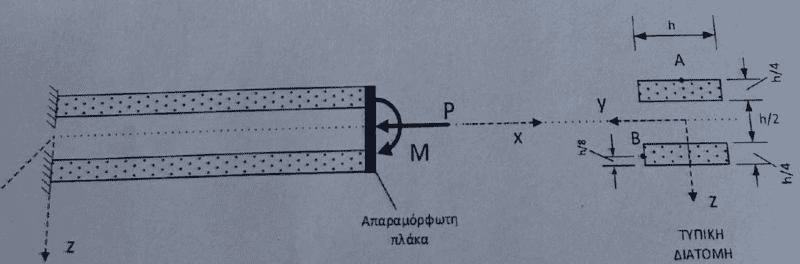
Left side is fixed and right side is held together by a non deformable plate. There are two members with space inbetween. My question is when i want to calculate the stress due to bending moment at point A, which is shown in the crossection, where is the neutral axis? Is it at the middle of the whole thing, where the dotted line is (at the height of the force P), or do i take each member (top and bottom) as individuals and assume the neutral axis at the middle of each beam (h/4*1/2).
1694063817710.png
 
Physics news on Phys.org
To calculate the stress due to bending moment at point A in a structure with two members connected by a non-deformable plate, you should consider each member individually and determine the neutral axis for each member separately. rsdfgrgvfd
The neutral axis is the axis within a member where the stress due to bending is zero. In a symmetric cross-section, like the one you described, the neutral axis typically passes through the centroid of the cross-section.
For each member (top and bottom), you can assume the neutral axis to be at the centroid of that specific member's cross-section. This means that the neutral axis for the top member is at a distance of h/4 from the top surface, and the neutral axis for the bottom member is at a distance of h/4 from the bottom surface, where 'h' is the height of the entire cross-section.
So, you should analyze each member separately and calculate the bending stress at point A based on the neutral axis position for that member. The stress in the top member and the stress in the bottom member might be different, and you'll need to account for both in your calculations.
In summary, when calculating the stress due to bending at point A, treat each member as an individual beam and determine the neutral axis for each member separately, considering their individual cross-sections and dimensions. :)
 
Thank you a lot for your response. I have another question, i need to calculate the maximum shear forces and their planes at point B. Don't i need to be given the vertical force V that is causing the bending moment in order to find the transverse shear at point B using the τ=VQ/It formula and then use the general stress transformation formulas? I am only given the value of M and axial force P
 

Similar threads

  • · Replies 11 ·
Replies
11
Views
3K
  • · Replies 6 ·
Replies
6
Views
1K
  • · Replies 25 ·
Replies
25
Views
3K
  • · Replies 5 ·
Replies
5
Views
6K
  • · Replies 1 ·
Replies
1
Views
2K
  • · Replies 30 ·
2
Replies
30
Views
8K
  • · Replies 3 ·
Replies
3
Views
2K
  • · Replies 7 ·
Replies
7
Views
3K
  • · Replies 1 ·
Replies
1
Views
3K
  • · Replies 3 ·
Replies
3
Views
3K