Stresses Caused By Deformation For Bending

Click For Summary

Discussion Overview

The discussion centers around the stresses caused by deformation in bending beams, particularly focusing on the need for normal stresses in the radial direction and the implications of such stresses in the context of beam mechanics. Participants explore the theoretical underpinnings and practical considerations of stress distribution in curved versus straight beams.

Discussion Character

  • Technical explanation
  • Debate/contested
  • Mathematical reasoning

Main Points Raised

  • Some participants question the necessity of radial stresses in the context of a bending beam, suggesting that the y-components of forces at the ends may balance out without the need for additional stresses.
  • Others argue that internal stress forces must be applied to satisfy static equilibrium when considering a section of the beam, indicating that radial stresses are indeed relevant.
  • A participant notes that curved beams exhibit a hyperbolic stress distribution, contrasting with the linear distribution in straight beams, and mentions that published analyses often neglect radial stresses.
  • It is proposed that while radial stresses may be small in solid sections, they can become significant in thin plates or cross sections, and thus should not be overlooked.
  • One participant emphasizes that the usual beam bending formulas are approximations and that Poisson's ratio effects contribute to normal stresses that balance forces in the beam.
  • A question is raised about the nature of hyperbolic stress distribution in curved beams, seeking clarification on how this is defined in terms of traction vectors across the beam.

Areas of Agreement / Disagreement

Participants express differing views on the necessity and significance of radial stresses in bending beams, indicating that multiple competing perspectives remain on this topic. The discussion does not reach a consensus on the correctness of the initial logic presented by the original poster.

Contextual Notes

Some limitations include the dependence on specific definitions of stress distribution and the unresolved nature of the mathematical treatment of the problem, particularly regarding the exact solutions versus approximations in beam theory.

person123
Messages
326
Reaction score
52
TL;DR
I was wondering if the deformation of a bending beam would lead to normal stress perpendicular to the applied stress and if deformation causing stress is common and important to consider.
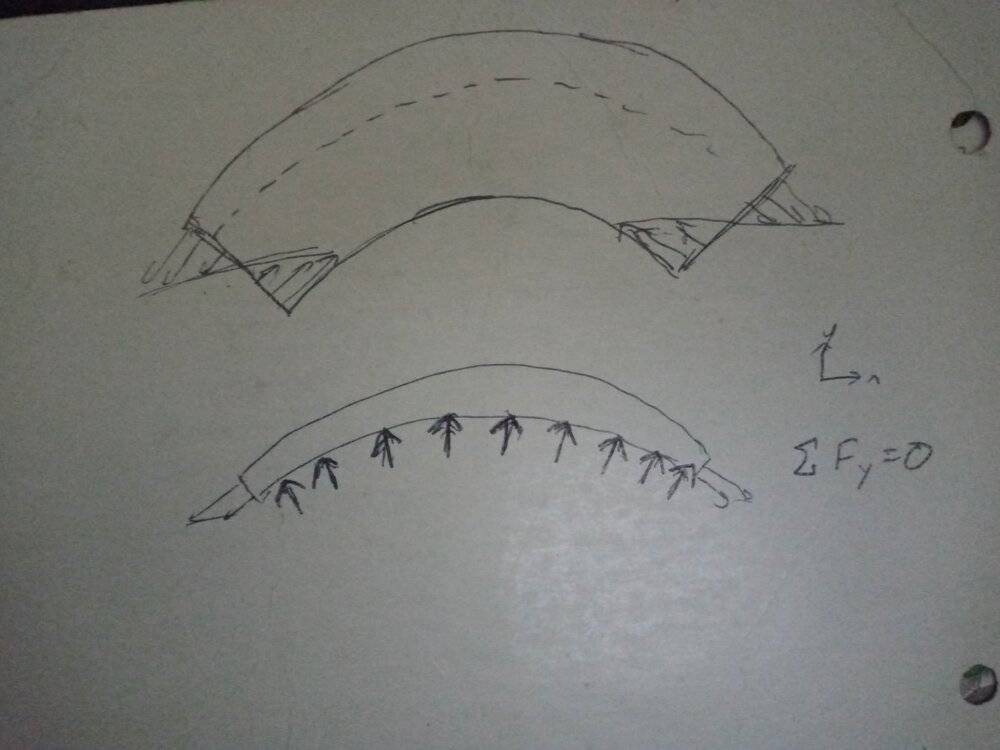
Hi. Say you apply a moment on a beam and bend it into an arch. If you take a free body diagram of a section of the beam you would need normal stresses in the radial direction to balance the forces:
20200803_023426.jpg

I have never seen this brought up before though -- is it correct logic? Also, is this sort of situation where deformation leads to other stresses common? Thanks!
 
  • Like
Likes   Reactions: etotheipi
Physics news on Phys.org
From your diagram, I don't see why you would need forces in the y-direction. It seems to me, the y components of the loadings at the ends balance out.
 
Chestermiller said:
From your diagram, I don't see why you would need forces in the y-direction. It seems to me, the y components of the loadings at the ends balance out.

As far as I could tell, OP is making a slice through the beam so as to consider the top half or so of the beam in isolation, in which case the loading at either end is exclusively in the negative ##\hat{y}## direction. Then, wouldn't internal stress forces need to be applied on the upper section by the lower section (and vice versa) in order to satisfy static equilibrium?
 
  • Like
Likes   Reactions: person123
Curved beams have a hyperbolic stress distribution, where straight beams have a linear stress distribution. The published analyses of curved beam stresses do not include stresses in the radial direction. Search terms bending curved beams brings up a number of good sites.

A close look at a stress element in a curved beam shows that radial stress is needed to balance the normal stress. More advanced analyses include these radial stresses. Search term bending curved beam stress element brings up this hit: http://courses.washington.edu/me354a/chap4.pdf, from which the following is quoted:

It is worth noting that due to the curvature of the beam a compressive radial stress (acting in the direction of r) will also be developed. Typically the radial stress is small compared to the circumferential stress and can be neglected, especially if the cross section of the member is a solid section. Sometimes, such as the case of thin plates or thin cross sections (e.g., I-beam), this radial stress can become large relative to the circumferential stress.

The OP has the right idea, but these radial stresses are not on the surface of the beam. They show up on a stress element inside the beam.
 
  • Like
Likes   Reactions: person123 and Lnewqban
person123 said:
Summary:: I was wondering if the deformation of a bending beam would lead to normal stress perpendicular to the applied stress and if deformation causing stress is common and important to consider.
...
I have never seen this brought up before though -- is it correct logic? Also, is this sort of situation where deformation leads to other stresses common? Thanks!
This type of stress is common and extremely important.
It can be combined with other loads (shear, compression, tension) that act simultaneously on the bending element, inducing more complicated internal reactions.

Please, see:
https://en.wikipedia.org/wiki/Bending

:cool:
 
The usual beam bending formulas are not the exact solution to the stress equilibrium equation. They are only a Strength of Materials approximation to the full solution of the theory of elasticity equations. In the direction normal to the beam, there are Poisson ratio effects that come in, that give rise to the normal stress effect (spread over the long length of the beam) to balance the forces you are referring to. For the complete exact treatment of the problem, see Timoschenko, theory of elasticity.
 
  • Like
Likes   Reactions: etotheipi
jrmichler said:
Curved beams have a hyperbolic stress distribution, where straight beams have a linear stress distribution.
In what way is it hyperbolic? One thing I can imagine is taking the magnitude of the largest traction vector on any surface. Then going across the beam, that value varies hyperbolically. Is this what that means?
 

Similar threads

Replies
3
Views
1K
  • · Replies 9 ·
Replies
9
Views
2K
  • · Replies 1 ·
Replies
1
Views
2K
  • · Replies 69 ·
3
Replies
69
Views
5K
  • · Replies 5 ·
Replies
5
Views
6K
  • · Replies 30 ·
2
Replies
30
Views
10K
  • · Replies 9 ·
Replies
9
Views
4K
Replies
6
Views
2K
  • · Replies 2 ·
Replies
2
Views
2K
  • · Replies 8 ·
Replies
8
Views
2K