Compound Microscope, Ray Diagram Mistakes.

Join the discussion
Ask a follow-up here, or get your own question answered by working scientists, mathematicians and engineers — people, not an autocomplete.
Real named experts · corrections over time · the nuance an AI answer skips
6 replies · 10K views
Meet Vora
Messages
4
Reaction score
0
I noticed that the ray diagram for the "how the compound microscope works" and "how the telescope works" is wrong in my government sanctioned physics textbook(and countless other books and websites!)
The diagram printed was this-
Name: Physics Standard XI
Printed by: Maharastra State Board of Secondary and Higher Secondary Education
Year:2011
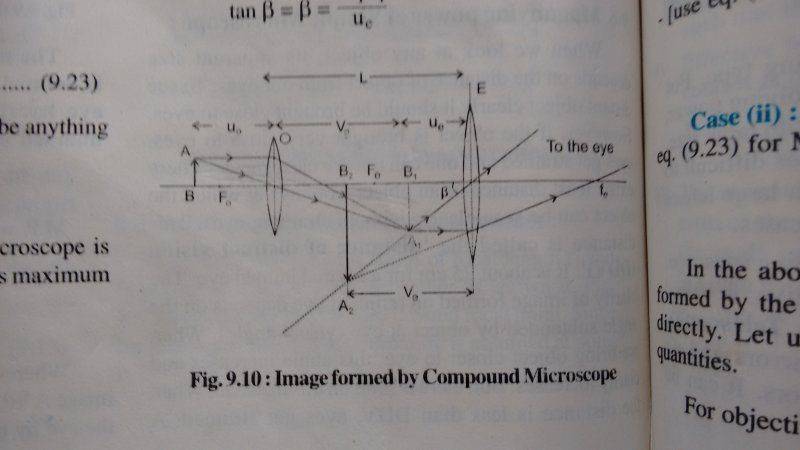
attachment 1.jpg
attachment 2.jpg

Whereas the correct one is this(taken from www.schoolphysics.co.uk)-
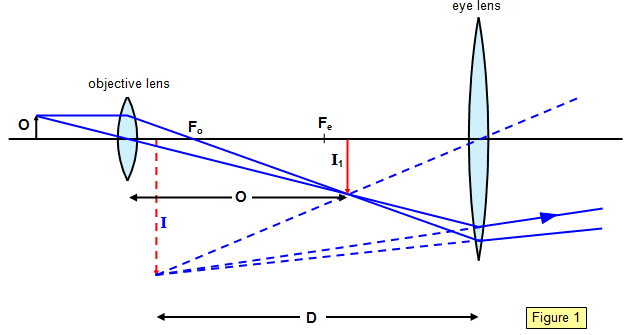
1.png

So i decided to spread some awareness about it by writing an open letter, but for that i need to know if its wrong only in India(where i stay) or other countries as well. What i need is people from around the world to post the picture of wrong diagrams(if any) in their physics textbooks.
It has become a big problem with teachers teaching the students wrong things. Some have become so ignorant that even after i pointed out the mistakes to them they didn't listen to my argument and simply ignored me.

Thanks a lot to whoever posts their pictures!
Please mention the country name, grade, author(s), Textbook name, and all other relevant information.
 
Physics news on Phys.org
Andy Resnick said:
I don't understand where you think the error is?
yes, i am glad someone asked, its very simple.

take a look at attachment-1.
1.Let us name the ray that is initially perpendicular to the principal axis as X
2.Let us name the ray that goes through the center of the lens as Y
Do you see how these two rays (X and Y) suddenly change their directions after forming the image A1 B1? This is wrong. they should carry on in a straight line unless they are acted upon by an external force or a change in conditions like refractive index etc. (as you can see in attachment-3)

the same mistake has been repeated in attachment-2!

If i haven't explained properly feel free to tell me, ill make another diagram to explain it.
 
Rays X and Y are what used to be called 'locating rays'. They are better thought of as constructions to locate the intermediate image rather than as paths of light through the system. All the same, the first two diagrams you reproduce do need a health warning. In my opinion they are likely to confuse a student, for just the reason you point out.

If I remember rightly, there was a campaign by one or two influential Physics teachers in the UK against using this sort of diagram without a warning, thirty or forty years ago. I've just looked in my 1987 edition of "Physics: A textbook for Advanced Level Students" by Tom Duncan. He has, on p 122, a diagram of the type we're discussing, but it's clearly labelled "Constructional (underlined) ray diagram".

I don't think that microscopes are on any school Physics syllabus in the UK any longer. The astronomical telescope survives, I believe, on one exam board's syllabus.
 
Philip Wood said:
Rays X and Y are what used to be called 'locating rays'. They are better thought of as constructions to locate the intermediate image rather than as paths of light through the system. All the same, the first two diagrams you reproduce do need a health warning. In my opinion they are likely to confuse a student, for just the reason you point out.

If I remember rightly, there was a campaign by one or two influential Physics teachers in the UK against using this sort of diagram without a warning, thirty or forty years ago. I've just looked in my 1987 edition of "Physics: A textbook for Advanced Level Students" by Tom Duncan. He has, on p 122, a diagram of the type we're discussing, but it's clearly labelled "Constructional (underlined) ray diagram".

I don't think that microscopes are on any school Physics syllabus in the UK any longer. The astronomical telescope survives, I believe, on one exam board's syllabus.

Yes, I'm glad to know that it's not a real "Mistake" but without a health warning its as good as one. My college teachers are hopeless but my school physics teacher did introduce me to this amazing book called "Conceptual Physics" by Paul.G.Hewitt which i often read to strengthen my basics. Thank you for your inputs, Philip Wood.
 
Andy Resnick said:
I agree with Philip: it appears that the A-B plane is located at the front focal plane of the lens 'E' in the both diagrams (with different notations...), resulting in the confusion.
Ahh, that is another matter altogether. The AB is named differently to 'prevent confusion', so teachers can go like "Object AB forms image A1B1 which is magnified by the second lens to form image A2B2--"
Frankly what surprises me most is how my teachers who are considered to be the "best" overlooked this for Years and are still teaching it in class. Thank you Andy Resnick.