Discussion Overview
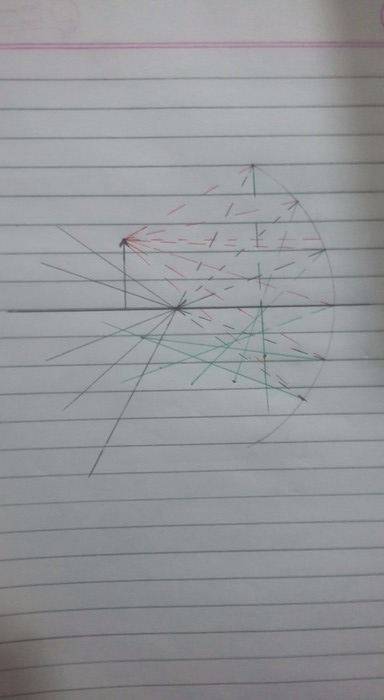
The discussion revolves around the behavior of reflected rays from a concave mirror, particularly focusing on why they may not converge at a single point. Participants explore concepts related to spherical and elliptical mirrors, aberrations, and the implications of ray geometry.
Discussion Character
- Exploratory
- Technical explanation
- Debate/contested
- Mathematical reasoning
Main Points Raised
- One participant presents a diagram showing incident and reflected rays from a concave mirror, questioning why they do not meet at one point.
- Another participant notes that only special geometries, such as elliptical mirrors, guarantee convergence of rays from a point source, while regular curved mirrors may focus rays but not necessarily at a single point.
- Several participants discuss the concept of spherical aberration, indicating that a spherical mirror produces a point image only under certain conditions, specifically in the paraxial approximation.
- There is mention of coma as another aberration affecting the convergence of rays, particularly when the object is off-axis.
- Participants inquire about the implications of placing an object on the optical axis and how it affects ray convergence.
- Some participants express a need for additional resources to better understand the phenomena discussed, indicating dissatisfaction with their current textbook.
Areas of Agreement / Disagreement
Participants do not reach a consensus on the specifics of ray convergence in concave mirrors, with multiple competing views on the effects of spherical aberration and coma, as well as the conditions under which rays converge.
Contextual Notes
Limitations include the dependence on specific geometrical configurations and the unresolved nature of how different types of aberrations affect ray behavior in practical scenarios.