Confusion in using the continuity equation here

Join the discussion
Ask a follow-up here, or get your own question answered by working scientists, mathematicians and engineers — people, not an autocomplete.
Real named experts · corrections over time · the nuance an AI answer skips
4 replies · 1K views
tracker890 Source h
Messages
90
Reaction score
11
Homework Statement
I feel that the mass within the system changes over time, but this perception contradicts the solution.
Relevant Equations
continuity equation
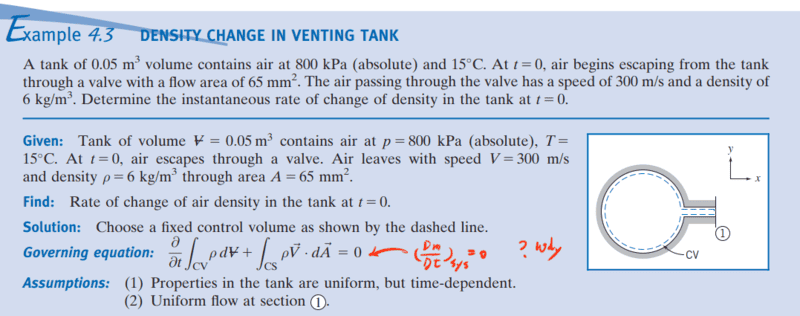
Q: Why does assuming "Properties in the tank are uniform, but time-dependent" lead to the validity of
(DmDt)sys=0? Doesn't the mass within the system change over time?
reference.
1700656597283.png
 
Physics news on Phys.org
tracker890 Source h said:
Homework Statement: I feel that the mass within the system changes over time, but this perception contradicts the solution.
Relevant Equations: continuity equation

Q: Why does assuming "Properties in the tank are uniform, but time-dependent" lead to the validity of
(DmDt)sys=0? Doesn't the mass within the system change over time?
reference.
View attachment 335945
The mass of the system is the total mass, i.e. what’s inside and what’s outside the control volume at a particular time. It is invariant (at least in classical physics?). at ##t=0## all of the system is inside the control volume, as time progresses some portion of the system is outside. That ∫ on the left (unsteady) represents what portion of the system is inside (only) the control volume at a particular time.

Summarizing: The system is not the control volume. The system is the stuff (matter) inside the control volume, on its way into the control volume, or what has left the control volume.
 
Last edited:
Reply
  • Like
Likes   Reactions: tracker890 Source h and TSny
To add a little to @erobz, the first integral ##\int_{\small CV}\rho dV## is the instantaneous mass within the control volume. This mass changes with time. So, ##\frac{\partial}{\partial t}\int_{\small CV}\rho dV## represents the rate of change of mass within the tank. The second integral represents the rate at which mass is flowing out through the neck of the container.
 
Reply
  • Like
Likes   Reactions: tracker890 Source h, Chestermiller and erobz