nonequilibrium
- 1,412
- 2
Goodday.
In my introductory course of Physics, we use Serway. I've typed over a little piece from the book that I find quite vague. It is giving an example of (after deducing the plane wave EM equations) EM radiation. It uses the following antenna:
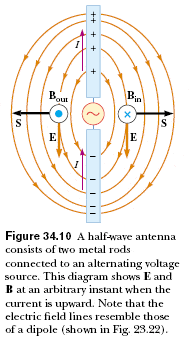
The positive and negative sides are continuously switching due to the AC voltage source in the middle and thus we approximate it with an oscillating electric dipole.
1) So first they use the Poynting vector to argue energy is flowing out, but then they say it's actually not those fields that present the radiation, because they're out of phase.
2) Then they go on to say that at a farther distance, the earlier E and B fields have gone and just the derivates are there, am I right? And they say the changing E-field produces a B-field, much like the law of Faraday and Ampere-Maxwell, but that would mean they are out of phase, wouldn't it? Yet a little further in the text they seem to take it as evident that the E and B are in phase.
3) Also, in the description in bold "at a farther distance, something else...", they seem to imply the radiation itself only originates from a far distance? But the photons actually come from the antenna itself, don't they? It's not that if there is a certain point in space with varying E and B waves, that photons start to shoot out of that point, right?
This section has confused me a bit on the production of EM-waves.
The way they explain it, you would also expect EM-waves going directly up for example, because far (directly) above the antenna, there is also a changing E-field (no matter how weak), but the formula it gives a little bit later ("I ~ sin²(theta)/r²") gives a theoretical zero for theta = 90°...
Is this a bad text or am I completely misinterpreting it? (or both...)
EDIT: A NB that has nothing to do with Serway: and would you expect a uniformly accelerating charge to radiate? The derivate of the E-field is constant...
In my introductory course of Physics, we use Serway. I've typed over a little piece from the book that I find quite vague. It is giving an example of (after deducing the plane wave EM equations) EM radiation. It uses the following antenna:
The positive and negative sides are continuously switching due to the AC voltage source in the middle and thus we approximate it with an oscillating electric dipole.
Serway said:"At the two points where the magnetic field is shown in Figure 34.10, the Poynting
vector S is directed radially outward. This indicates that energy is flowing away from
the antenna at this instant. At later times, the fields and the Poynting vector reverse
direction as the current alternates. Because E and B are 90° out of phase at points
near the dipole, the net energy flow is zero. From this, we might conclude (incorrectly)
that no energy is radiated by the dipole.
However, we find that energy is indeed radiated. Because the dipole fields fall off as
1/r³ (as shown in Example 23.6 for the electric field of a static dipole), they are negligible
at great distances from the antenna. At these great distances, something else
causes a type of radiation different from that close to the antenna. The source of this
radiation is the continuous induction of an electric field by the time-varying magnetic
field and the induction of a magnetic field by the time-varying electric field, predicted
by Equations 34.3 and 34.4. The electric and magnetic fields produced in this manner
are in phase with each other and vary as 1/r. The result is an outward flow of energy at
all times."
1) So first they use the Poynting vector to argue energy is flowing out, but then they say it's actually not those fields that present the radiation, because they're out of phase.
2) Then they go on to say that at a farther distance, the earlier E and B fields have gone and just the derivates are there, am I right? And they say the changing E-field produces a B-field, much like the law of Faraday and Ampere-Maxwell, but that would mean they are out of phase, wouldn't it? Yet a little further in the text they seem to take it as evident that the E and B are in phase.
3) Also, in the description in bold "at a farther distance, something else...", they seem to imply the radiation itself only originates from a far distance? But the photons actually come from the antenna itself, don't they? It's not that if there is a certain point in space with varying E and B waves, that photons start to shoot out of that point, right?
This section has confused me a bit on the production of EM-waves.
The way they explain it, you would also expect EM-waves going directly up for example, because far (directly) above the antenna, there is also a changing E-field (no matter how weak), but the formula it gives a little bit later ("I ~ sin²(theta)/r²") gives a theoretical zero for theta = 90°...
Is this a bad text or am I completely misinterpreting it? (or both...)
EDIT: A NB that has nothing to do with Serway: and would you expect a uniformly accelerating charge to radiate? The derivate of the E-field is constant...
Attachments

Last edited: