Relative strength of E and B fields in EM radiation

Click For Summary

Discussion Overview

The discussion centers on the relationship between the electric (E) and magnetic (B) fields in electromagnetic (EM) radiation, exploring the implications of their relative strengths and the units used to express them. Participants examine theoretical frameworks, unit systems, and the conceptual understanding of EM waves.

Discussion Character

  • Debate/contested
  • Technical explanation
  • Conceptual clarification

Main Points Raised

  • One participant proposes that the relationship between E and B fields is given by E = Bc, questioning the implications of this equation regarding their relative strengths.
  • Another participant argues that the electric and magnetic fields of an electromagnetic wave contain equal energy, suggesting that comparing their strengths directly is not meaningful without considering the units used.
  • A participant challenges the comparison of E and B fields by likening it to comparing different physical quantities, emphasizing that the units must be consistent for a valid comparison.
  • Discussion includes the preference for Gaussian units in theoretical physics, which allow for a more straightforward comparison of E and B fields, as they share the same units in this system.
  • One participant explains that while the magnitudes of E and B fields can be equal in Gaussian units, the Lorentz force equation indicates that magnetic forces can be smaller due to the velocity factor involved.
  • Participants mention the complexity introduced by SI units, which complicate direct comparisons of field strengths due to the presence of conversion factors like ε₀ and μ₀.

Areas of Agreement / Disagreement

Participants express differing views on the relationship between the strengths of the E and B fields, with some asserting they are equal in energy while others emphasize the challenges of comparing them directly due to unit differences. The discussion remains unresolved with multiple competing perspectives.

Contextual Notes

The discussion highlights limitations in comparing E and B fields across different unit systems and the implications of these differences on understanding electromagnetic phenomena. The nuances of energy density calculations and the role of unit conversion factors are also noted.

DiracPool
Messages
1,254
Reaction score
514
I think the equation for the relationship of the E (electrical) and B (magnetic) fields in electromagnetic (EM) radiation is E=Bc, where c is the speed of light.

I think this is correct, but what does it tell us? On it's face, it looks as though the B field (of a photon, say) is 1/300,000,000th the strength of the E field. Is this not correct?

Why, then, do we see these diagrams of the EM propagation of say, light, where the proportion of the E and B field appear to be equal?
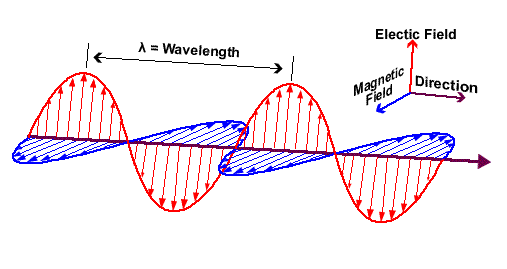
elec_mag_field.gif


According to that equation, the size of the B field would be almost negligible. So why am I seeing blue lines on this diagram?

I've heard it both ways, though: 1) that the B field is, indeed, much smaller than than the E field in EM radiation, and 2) that they are actually the exact same in field strength. I can spend some valuable time searching for the references but it's going to cost you if you make me do that o_O

I think the counter-argument is that you can just set the speed of light to 1 and then the equation just becomes E=B? Its that simple? And perhaps this is the case because EM radiation is relativistic, and always travels at c so therefore we should set c to one here? Or is this bad logic?

In any case, what is the answer? Are the strengths of the E and B fields identical in a traveling EM wave or is the E field much stronger than the B field?
 
Science news on Phys.org
No, that's not correct. The magnetic and electric fields of an electromagnetic wave contain equal energy. The numerical value of the electric and magnetic fields depend on the units used, so it doesn't make sense to compare them in the way you are doing. In Gaussian cgs units, the electric and magnetic fields have the same units and can be compared. For a plane wave in vacuum, they are equal.
 
  • Like
Likes   Reactions: vanhees71 and DiracPool
DiracPool said:
I think this is correct, but what does it tell us? On it's face, it looks as though the B field (of a photon, say) is 1/300,000,000th the strength of the E field. Is this not correct?
This is comparing apples and oranges. Would you say that 1 m was some fraction of 1 kg? If you were plotting m on one axis and kg on another, would you feel compelled to scale them in any particular way?
 
Indeed, it's a drawback of the use of SI units in (theoretical) electromagnetics. You can not directly compare the field components althrough they belong together in one field, the electromagnetic field. That's why in theoretical physics one usually prefers Gaussian units (which is a mixture of electrostatic and magnetostatic units) or rationalized Gaussian units (also known as Heaviside-Lorentz units), which are used in high-energy physics and relativistic quantum field theory.

The situation in the SI is somehow a bit like measuring distances in different units, depending on their direction, as in the US, where they measure distances on the road in miles but heights of bridges or mountains in feet.

In the more natural Gaussian-type units the electric and magnetic field components are measured in the same units, and the (non-covariant) Lorentz force on a point charge reads
$$\vec{F}=q \left(\vec{E} + \frac{\vec{v}}{c} \times \vec{B} \right).$$
If you have, e.g., a plane-wave field, you have ##\vec{E}^2-\vec{B}^2=0## in these units, i.e., the magnitude of the electric and the magnetic component of the field is the same, and this is so in any inertial reference frame, because ##\vec{E}^2-\vec{B}^2## turns out to be a Lorentz invariant.

On the other hand, the Lorentz force formula makes it clear, why magnetic forces are often smaller than electric, because you have a factor ##\vec{v}/c## for the magnetic part. For slowly moving charges, thus you have small forces although the magnetic and electric field are of the same magnitude.

The systems of units agree in "mechanical" quantities like energy density as already stated in #2. The energy density of the em. field is
$$\mathcal{E}=\frac{1}{2}(\vec{E}^2 + \vec{B}^2) \quad \text{(Heaviside-Lorentz units)}$$
or
$$\mathcal{E}=\frac{1}{2} \left (\epsilon_0 \vec{E}^2 + \frac{1}{\mu_0} \vec{B}^2 \right) \quad \text{(SI units)}.$$
These conversion factors ##\epsilon_0## and ##\mu_0## make the comparison of the field components difficult. So it's indeed easier to compare the energy densities of the electric and magnetic field to get that kind of intuition about the field components' magnitude.
 
  • Like
Likes   Reactions: DiracPool and Dale

Similar threads

  • · Replies 23 ·
Replies
23
Views
18K
  • · Replies 3 ·
Replies
3
Views
2K
  • · Replies 15 ·
Replies
15
Views
1K
  • · Replies 0 ·
Replies
0
Views
1K
  • · Replies 10 ·
Replies
10
Views
2K
  • · Replies 29 ·
Replies
29
Views
5K
  • · Replies 11 ·
Replies
11
Views
1K
  • · Replies 15 ·
Replies
15
Views
3K
  • · Replies 51 ·
2
Replies
51
Views
5K
  • · Replies 4 ·
Replies
4
Views
1K