Conservation law form of Navier Stokes Equation

Click For Summary
The discussion focuses on converting the Navier-Stokes Equation into conservation form, addressing confusion about the density term and pressure gradient. It clarifies that the term du^2/dx can be expressed as u du/dx through integration by parts. The continuity equation indicates that certain terms drop out, simplifying the equation. The derivation ultimately leads to a clearer representation of the momentum equation. Understanding these transformations is essential for applying the Navier-Stokes Equation in fluid dynamics.
aerograce
Messages
63
Reaction score
1
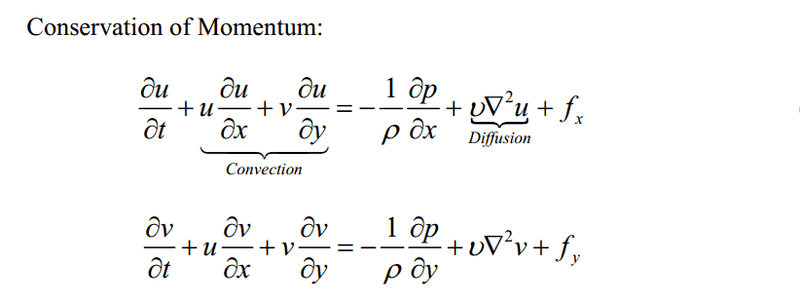
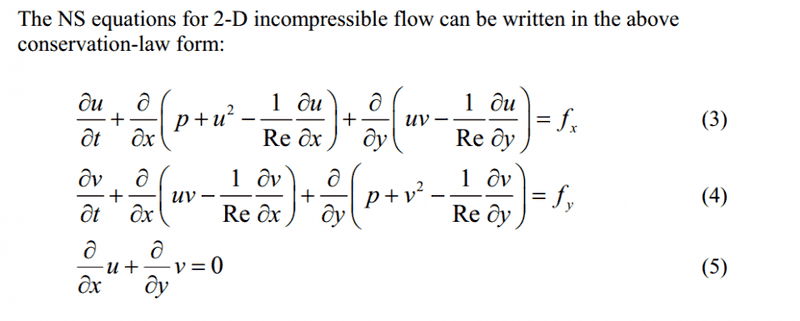
I am pretty confused about how to write Navier-Stokes Equation into conservation form, it seems that from my notes,
first, the density term with the pressure gradient dropped out.
and second, du^2/dx seems to be equal to udu/dx.
Why is it so? I attached my notes here for your reference.
upload_2016-11-19_22-38-9.png

upload_2016-11-19_22-37-37.png
 
aerograce said:
I am pretty confused about how to write Navier-Stokes Equation into conservation form, it seems that from my notes,
first, the density term with the pressure gradient dropped out.
and second, du^2/dx seems to be equal to udu/dx.
Why is it so? I attached my notes here for your reference.
View attachment 109122
View attachment 109121
This is pretty straightforward to do. Integrating by parts, $$u\frac{\partial u}{\partial x}+v\frac{\partial v}{\partial y}=u\frac{\partial u}{\partial x}+\frac{\partial (uv)}{\partial y}-u\frac{\partial v}{\partial y}$$Next, adding and subtracting ##u(\partial u/\partial x)## gives:
$$u\frac{\partial u}{\partial x}+v\frac{\partial u}{\partial y}=2u\frac{\partial u}{\partial x}+\frac{\partial (uv)}{\partial y}-u\left(\frac{\partial u}{\partial x}+\frac{\partial v}{\partial y}\right)$$
But, from the continuity equation, the last term in parenthesis in this equation is zero. So$$u\frac{\partial u}{\partial x}+v\frac{\partial u}{\partial y}=2u\frac{\partial u}{\partial x}+\frac{\partial (uv)}{\partial y}=\frac{\partial u^2}{\partial x}+\frac{\partial (uv)}{\partial y}$$
The rest of the derivation is straightforward.
 
I built a device designed to brake angular velocity which seems to work based on below, i used a flexible shaft that could bow up and down so i could visually see what was happening for the prototypes. If you spin two wheels in opposite directions each with a magnitude of angular momentum L on a rigid shaft (equal magnitude opposite directions), then rotate the shaft at 90 degrees to the momentum vectors at constant angular velocity omega, then the resulting torques oppose each other...

Similar threads

  • · Replies 5 ·
Replies
5
Views
5K
  • · Replies 11 ·
Replies
11
Views
1K
  • · Replies 18 ·
Replies
18
Views
6K
  • · Replies 3 ·
Replies
3
Views
7K
  • · Replies 3 ·
Replies
3
Views
1K
  • · Replies 11 ·
Replies
11
Views
3K
  • · Replies 17 ·
Replies
17
Views
4K
  • · Replies 7 ·
Replies
7
Views
4K
  • · Replies 4 ·
Replies
4
Views
3K
  • · Replies 4 ·
Replies
4
Views
2K