Constant Velocity : Does it means objects is at Rest

Click For Summary
Constant velocity indicates that an object is moving at a steady rate, meaning its displacement changes consistently over time. If velocity is constant, it does not imply that displacement is the same; rather, displacement increases linearly with time. The confusion arises from misinterpreting the relationship between displacement and time. A constant velocity results in a straight-line graph, reflecting continuous movement rather than rest. Therefore, an object with constant velocity is not at rest; it is in motion.
PrakashPrasad
Messages
22
Reaction score
0
I have been studying that velocity = displacement / time.

Now what if displacement / time always gives me same value - does it means that object is at rest as displacement is same then the body has not moved at all.
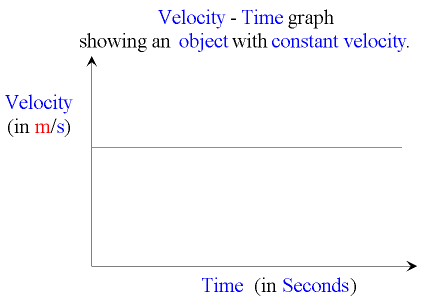
Velocity-Time-Graph-Constant-Velocity.gif

So in above graph velocity is constant - ie displacement wrt to time is same - so if displacement is same it would mean that object hasn't moved

In other word constant velocity does it means displacement remains the same wrt time which then would mean that object is at rest
 
Last edited:
Physics news on Phys.org
PrakashPrasad said:
So in above graph velocity is constant - ie displacement wrt to time is same - so if displacement is same it would mean that object hasn't moved
The displacement is not the same--the object is moving! What remains the same is the velocity, the rate at which the displacement changes.
 
  • Like
Likes PrakashPrasad
PrakashPrasad said:
I have been studying that velocity = displacement / time.

Now what if displacement / time always gives me same value - does it means that object is at rest as displacement is same then the body has not moved at all.

Velocity-Time-Graph-Constant-Velocity.gif

So in above graph velocity is constant - ie displacement wrt to time is same - so if displacement is same it would mean that object hasn't moved

In other word constant velocity does it means displacement remains the same wrt time which then would mean that object is at rest

Such confusion usually arises because of not adhering strictly to a definition, and using misleading language. You first stated, correctly, that velocity = displacement / time, and then went on to say, incorrectly, that it is displacement WRT time. I do not know what that means! Velocity is always displacement / time, so if the velocity is constant, that means displacement / time is constant. Then the displacement is constant velocity multiplied by time, so it is not constant. The displacement vs time graph in this case is a straight line with a slope equal to the velocity.
 
For simple comparison, I think the same thought process can be followed as a block slides down a hill, - for block down hill, simple starting PE of mgh to final max KE 0.5mv^2 - comparing PE1 to max KE2 would result in finding the work friction did through the process. efficiency is just 100*KE2/PE1. If a mousetrap car travels along a flat surface, a starting PE of 0.5 k th^2 can be measured and maximum velocity of the car can also be measured. If energy efficiency is defined by...

Similar threads

  • · Replies 11 ·
Replies
11
Views
2K
  • · Replies 8 ·
Replies
8
Views
2K
  • · Replies 4 ·
Replies
4
Views
3K
  • · Replies 11 ·
Replies
11
Views
6K
  • · Replies 49 ·
2
Replies
49
Views
4K
  • · Replies 5 ·
Replies
5
Views
2K
  • · Replies 8 ·
Replies
8
Views
7K
  • · Replies 11 ·
Replies
11
Views
3K
Replies
26
Views
3K
  • · Replies 15 ·
Replies
15
Views
2K