thegreengineer
- 54
- 3
I´m taking a course on control engineering and I have a test next Tuesday so I need to study the basics which are: Laplace transform, simplification of block diagrams, and analysis of transient and steady state responses. Right now I am dealing with the second one.
I know the basic rules of block diagram simplification and the specific case I want to deal in this thread is this one:
NEGATIVE FEEDBACK LOOP
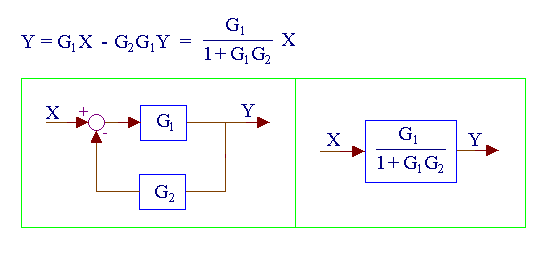
Image taken from: http://www.msubbu.in/sp/ctrl/BD-Rules.htm
In other words, the equivalent transfer function is the product of the feed-forward path divided by one plus the product of the transfer functions that make the loop.
So I get stuck on this and the problem is that the author (the book is MODERN CONTROL ENGINEERING by KATSUHIKO OGATA 5th ed.) skipped steps explaining how to simplify this:
This is the way the author simplified it:
https://scontent-lax3-1.xx.fbcdn.net/v/t1.0-9/14358649_1778386355779234_9131464410329635376_n.jpg?oh=e7cd4c25c4caafab8260b0e61c814aa2&oe=583D6FC2
The author simplified from step c) to step d). The equivalent transfer function is not similar to what I get. I'll explain you what I did and I will compare the results:
First of all let's start in step c). The blocks containing the transfer functions \frac{G_{1}G_{2}}{1-G_{1}G_{2}H_{1}} and G_{3} are in series, therefore the equivalent transfer function is \frac{G_{1}G_{2}G_{3}}{1-G_{1}G_{2}H_{1}}. The reduced diagram is the following:
https://scontent-lax3-1.xx.fbcdn.net/v/t1.0-9/14355645_1778854725732397_2673141930938132618_n.jpg?oh=187ae0673bdb279bd12d64a28207f93c&oe=5874F734
Here's now where my problem starts. As far as I see the loop formed by the second-to right summation point, the transfer function \frac{G_{1}G_{2}G_{3}}{1-G_{1}G_{2}H_{1}}, and the transfer function \frac{H_{2}}{G_{1}} are forming the negative feedback loop configuration, when I did it the result was not the same as the author's. Trust me, I actually did it and I would put the proof below but my computer is failing so don't insist please, I'm trying to understand this topic but I keep stuck so I would want someone to tell me what the author exactly did step by step.
I know the basic rules of block diagram simplification and the specific case I want to deal in this thread is this one:
NEGATIVE FEEDBACK LOOP
Image taken from: http://www.msubbu.in/sp/ctrl/BD-Rules.htm
In other words, the equivalent transfer function is the product of the feed-forward path divided by one plus the product of the transfer functions that make the loop.
So I get stuck on this and the problem is that the author (the book is MODERN CONTROL ENGINEERING by KATSUHIKO OGATA 5th ed.) skipped steps explaining how to simplify this:
This is the way the author simplified it:
https://scontent-lax3-1.xx.fbcdn.net/v/t1.0-9/14358649_1778386355779234_9131464410329635376_n.jpg?oh=e7cd4c25c4caafab8260b0e61c814aa2&oe=583D6FC2
The author simplified from step c) to step d). The equivalent transfer function is not similar to what I get. I'll explain you what I did and I will compare the results:
First of all let's start in step c). The blocks containing the transfer functions \frac{G_{1}G_{2}}{1-G_{1}G_{2}H_{1}} and G_{3} are in series, therefore the equivalent transfer function is \frac{G_{1}G_{2}G_{3}}{1-G_{1}G_{2}H_{1}}. The reduced diagram is the following:
https://scontent-lax3-1.xx.fbcdn.net/v/t1.0-9/14355645_1778854725732397_2673141930938132618_n.jpg?oh=187ae0673bdb279bd12d64a28207f93c&oe=5874F734
Here's now where my problem starts. As far as I see the loop formed by the second-to right summation point, the transfer function \frac{G_{1}G_{2}G_{3}}{1-G_{1}G_{2}H_{1}}, and the transfer function \frac{H_{2}}{G_{1}} are forming the negative feedback loop configuration, when I did it the result was not the same as the author's. Trust me, I actually did it and I would put the proof below but my computer is failing so don't insist please, I'm trying to understand this topic but I keep stuck so I would want someone to tell me what the author exactly did step by step.