Coupled inductor boost converter - Ripple current

Click For Summary
SUMMARY

The forum discussion focuses on calculating the ripple current (∆i1 and ∆i2) in a coupled inductor boost converter, specifically between time intervals DT and T, and its dependency on voltage levels (Vin or Vin-Vout). The user seeks assistance in deriving accurate formulas for these ripple currents, as they are essential for their design assignment. The topology discussed is not a flyback but rather a unique boost converter design utilizing coupled inductors to achieve a higher boost ratio, addressing limitations of conventional boost converters.

PREREQUISITES
  • Understanding of boost converter topology and operation
  • Familiarity with ripple current calculations in power electronics
  • Knowledge of coupled inductors and their applications
  • Basic circuit analysis skills, including time-domain waveform interpretation
NEXT STEPS
  • Research the derivation of ripple current formulas in boost converters
  • Study the operational principles of coupled inductor boost converters
  • Explore simulation tools for modeling boost converter performance
  • Examine design procedures for high step-up DC-DC converters
USEFUL FOR

Electrical engineers, power electronics designers, and students working on boost converter projects will benefit from this discussion, particularly those interested in ripple current analysis and coupled inductor applications.

member 638480
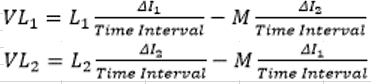
I am trying to calculate the ripple current in boost converter for ∆i1 and ∆i2 between time intervals between DT and T, and also dependent on the voltage level (Vin or Vin-Vout). To find a formula for ∆i1 and ∆i2, two formulas have to be derived for them. This is done from the equation:
upload_2018-1-5_13-47-0.png

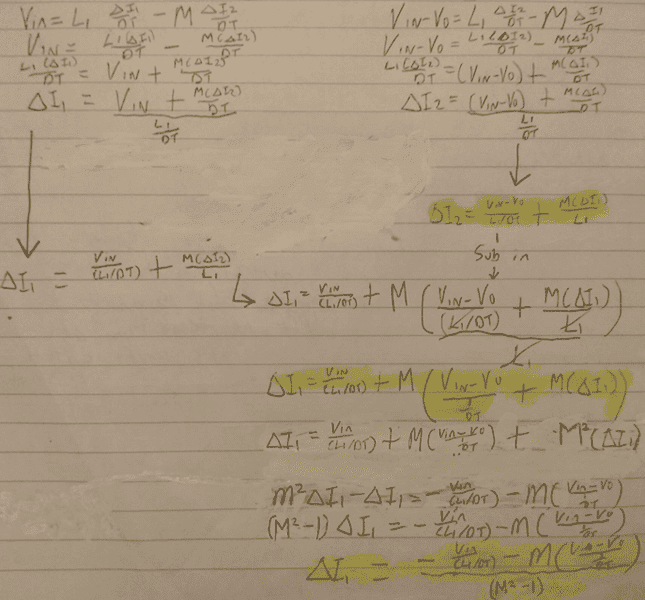
I derived equations for ∆i1 and ∆i2 as shown below, however I don't think this is right and I was wondering has anybody done this before that can provide some assistance, thanks!
upload_2018-1-5_13-48-14.png
 

Attachments

  • upload_2018-1-5_13-41-20.png
    upload_2018-1-5_13-41-20.png
    83 KB · Views: 755
  • upload_2018-1-5_13-47-0.png
    upload_2018-1-5_13-47-0.png
    5 KB · Views: 1,234
  • upload_2018-1-5_13-48-14.png
    upload_2018-1-5_13-48-14.png
    87.8 KB · Views: 1,352
Engineering news on Phys.org
Tommy Drudy said:
I am trying to calculate the ripple current in boost converter for ∆i1 and ∆i2 between time intervals between DT and T, and also dependent on the voltage level (Vin or Vin-Vout). To find a formula for ∆i1 and ∆i2, two formulas have to be derived for them. This is done from the equation: View attachment 217893
I derived equations for ∆i1 and ∆i2 as shown below, however I don't think this is right and I was wondering has anybody done this before that can provide some assistance, thanks!
View attachment 217894
Welcome to the PF. :smile:

Can you post your schematic and time-domain waveforms with all of the times and such listed? Thanks, we should be able to help you on this.

BTW, is this for schoolwork?
 
Below is a screenshot of VL1 and VL2, it shows the voltage and ripple current when the switch is either on or off due to interleaving. The only unknown variables from the formula mentioned in my previous post is ∆i1 and ∆i2, which is replicated by the red line in this photo. That is why I am trying to derive an expression for the two ripple currents, in order to find their value at each point, ie DT, T/2, DT+T/2, and T.
upload_2018-1-5_17-21-55.png

This question is for a boost converter that I am trying to design as part of an assignment.
 

Attachments

  • upload_2018-1-5_17-9-3.png
    upload_2018-1-5_17-9-3.png
    16.5 KB · Views: 729
  • upload_2018-1-5_17-9-43.png
    upload_2018-1-5_17-9-43.png
    15.4 KB · Views: 780
  • upload_2018-1-5_17-21-55.png
    upload_2018-1-5_17-21-55.png
    37.7 KB · Views: 1,177
juniorbvetran said:
Below is a screenshot of VL1 and VL2, it shows the voltage and ripple current when the switch is either on or off due to interleaving. The only unknown variables from the formula mentioned in my previous post is ∆i1 and ∆i2, which is replicated by the red line in this photo. That is why I am trying to derive an expression for the two ripple currents, in order to find their value at each point, ie DT, T/2, DT+T/2, and T.
View attachment 217902
This question is for a boost converter that I am trying to design as part of an assignment.
You didn't attach the schematic yet. Is this a flyback topology Boost converter?
 
berkeman said:
You didn't attach the schematic yet. Is this a flyback topology Boost converter?
Apologies, the topology is below, no its not a flyback.
upload_2018-1-5_17-32-10-png.png
 

Attachments

  • upload_2018-1-5_17-32-10-png.png
    upload_2018-1-5_17-32-10-png.png
    7.9 KB · Views: 746
Interesting! I hadn't seen that topology before, but I work with Buck converters a lot more than Boost converters. Can you say more about it? Where did you find it? I can see the motivation for using 2 inductors, but why use coupled inductors? Thanks.
 
berkeman said:
I did a little Google searching on your thread title, but this topology is different than what you have posted so far...

http://www.onsemi.com/pub/Collateral/AN-5081.pdf.pdf
Ya I am not to sure, i just know the equations are used to derive the ripple current. I've had a good look around for a final derivation of the ripple current formula but there doesn't seem to be anything online.
 
I'm not intuitively seeing how the coupled inductor part would help the ripple current. Have you seen anything about the coupled inductor part of it?

If not, I'm sure others can chime in who have seen this topology before. Or worst case I can run a simulation on it this weekend at work (in all of my spare time... Ack). :smile:
 
  • #10
berkeman said:
I did a little Google searching on your thread title, but this topology is different than what you have posted so far...

http://www.onsemi.com/pub/Collateral/AN-5081.pdf.pdf
It looks like that (different) boost topology with coupled inductors is to get a higher boost ratio:
Conventional step up dc-dc converters or boost converters
are not suitable for high voltage conversion ratio since the
effective series resistor (ESR) of the boost inductor
prohibits the output voltage from increasing more than 10
times of the input voltage.In this article, a high step-up dc-dc converter
with tapped inductor or coupled inductor is introduced and its
operational principle and design procedure will be described
as well.

Where did you get your circuit from?
 
Last edited:

Similar threads

  • · Replies 13 ·
Replies
13
Views
3K
  • · Replies 8 ·
Replies
8
Views
3K
  • · Replies 14 ·
Replies
14
Views
2K
  • · Replies 8 ·
Replies
8
Views
2K
  • · Replies 3 ·
Replies
3
Views
4K
  • · Replies 9 ·
Replies
9
Views
4K
  • · Replies 23 ·
Replies
23
Views
4K
  • · Replies 12 ·
Replies
12
Views
6K
  • · Replies 3 ·
Replies
3
Views
2K
  • · Replies 17 ·
Replies
17
Views
3K