Boost converter in Simulink problem

Click For Summary

Discussion Overview

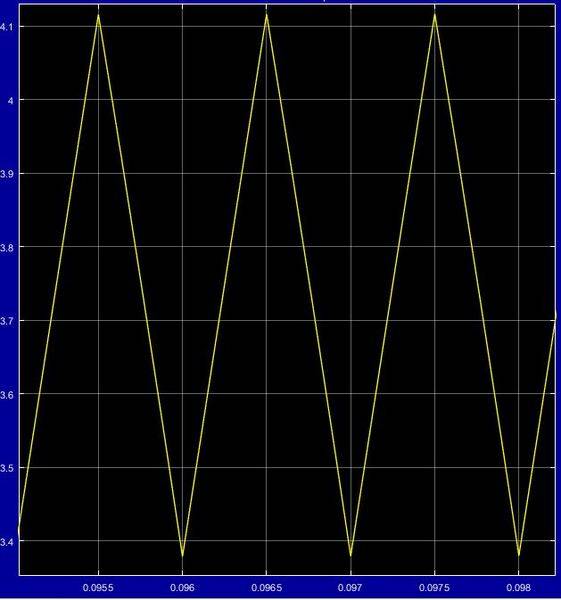
The discussion revolves around simulating a boost converter in Simulink, specifically addressing the unexpected triangular waveform of the inductor current instead of the anticipated exponential waveform. The conversation touches on the behavior of inductor current in converters, design considerations, and the effects of various parameters on performance.

Discussion Character

  • Technical explanation
  • Conceptual clarification
  • Debate/contested

Main Points Raised

  • One participant notes that the triangular waveform of inductor current is typical in converters, with the average centered around the output current.
  • Another participant explains that a slower switching frequency could reveal a hyperbolic curve, but the usual operation keeps the waveform mostly linear.
  • A later reply emphasizes that inductor current ripple is a critical design factor, influenced by inductance values and switching frequencies, which must be balanced against efficiency, power requirements, and noise tolerance.
  • Participants discuss the implications of continuous conduction mode (CCM) and discontinuous conduction mode (DCM) on output noise and performance, noting that inductance and frequency affect these modes.

Areas of Agreement / Disagreement

Participants generally agree on the nature of the inductor current waveform in boost converters, but there are nuanced discussions regarding the design implications and trade-offs involved, indicating that multiple perspectives exist on optimal design strategies.

Contextual Notes

Limitations include assumptions about the operating conditions of the boost converter, the specific definitions of CCM and DCM, and the impact of component parameters on the observed waveforms, which remain unresolved in the discussion.

OliskaP
Messages
38
Reaction score
7
Hi

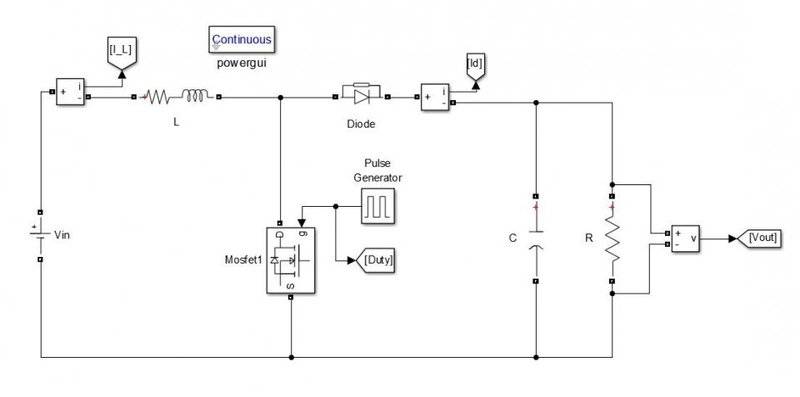
I am trying to simulate a boost converter in Simulink, but I have a problem. When I measure the inductor current it shows as a triangular waveform instead of an exponential waveform like I would expect, does anyone know why? Does simulink do some simplification I am not aware of?

Parameters:
Inductor with parasitic resistance: 6.5e-3H, 0.01Ohm
Diode: 0.0001 Ohm on resistance and 0.8 forward voltage
Mosfet: 0.1 Ohm on resistance
Capacitor: 1000e-6 F
Load resistance: 5 Ohm

Simulation model:
boost converter.JPG


Inductor current:
inductor ripple current.JPG
 
Engineering news on Phys.org
That's what inductor current normally looks like in a converter. You get a triangular ripple with an average centered about output current. If you were to drastically slow the switching frequency to where the converter was no longer operating properly you would see the hyperbolic part of the curve, but the on/off time is normally short enough to stay in the mostly linear region. You'd see the same thing with a capacitor if you were to charge and discharge with a short interval.
 
  • Like
Likes   Reactions: OliskaP and berkeman
Aha, thank you.
 
Welcome, that ripple is a major point of design when it comes to inductor selection. Higher inductance values and higher switching frequencies result in less inductor current ripple. There are tradeoffs as always so you have to balance ripple with optimal efficiency, power requirements, and noise tolerance. Then there's the threshold for CCM/DCM. (continuous and discontinuous conduction modes). Inductance value and switching frequency affect that as well. The main thing is that output is typically noisier in DCM so in some cases you want to stay in CCM over a wider range of power outputs.
 
  • Like
Likes   Reactions: OliskaP

Similar threads

  • · Replies 36 ·
2
Replies
36
Views
6K
  • · Replies 9 ·
Replies
9
Views
4K
  • · Replies 23 ·
Replies
23
Views
6K
  • · Replies 23 ·
Replies
23
Views
4K
  • · Replies 16 ·
Replies
16
Views
5K
  • · Replies 12 ·
Replies
12
Views
6K
  • · Replies 9 ·
Replies
9
Views
815
  • · Replies 13 ·
Replies
13
Views
4K
  • · Replies 14 ·
Replies
14
Views
2K
  • · Replies 10 ·
Replies
10
Views
3K