Creating a Cloud Chamber for Deflecting Charged Particles

Click For Summary
SUMMARY

The discussion centers on constructing a cloud chamber to observe the deflection of charged particles, specifically alpha particles emitted from Americium 241. The participant seeks guidance on the strength of magnets required for effective particle deflection, with a focus on using neodymium magnets, particularly N42 class, which have a magnetic field strength of 1.3 T. Key calculations involve determining the magnetic field strength (B) necessary for visible particle curvature using the formula R = (2mv)/(qB). The conversation emphasizes the importance of safety when handling radioactive materials and suggests using a search coil to measure magnetic fields.

PREREQUISITES
  • Understanding of alpha particle properties (mass, charge, speed)
  • Familiarity with magnetic field concepts and Lorentz force
  • Basic knowledge of cloud chamber construction techniques
  • Ability to perform calculations involving magnetic fields and particle trajectories
NEXT STEPS
  • Research the construction and operation of a cloud chamber using Americium 241
  • Learn how to calculate magnetic field strength using the formula R = (2mv)/(qB)
  • Explore the use of search coils for measuring magnetic fields
  • Investigate safety protocols for handling radioactive materials in educational projects
USEFUL FOR

High school physics students, educators in experimental physics, hobbyists interested in particle physics, and anyone involved in constructing cloud chambers or studying charged particle behavior in magnetic fields.

Garlic
Gold Member
Messages
181
Reaction score
72
Hello and thanks for reading

Homework Statement


I'm in high school. I chose my yearly project in physics, and wanted to make a cloud chamber. The subject is "deflection of charged particles in a magnetic field", so I must set a magnet alongside the cloud chamber. I've prepared for it, bought isopropyl alcohol and gathered the Americium 241 source from a smoke detector. The chamber will look like this. [Picture]
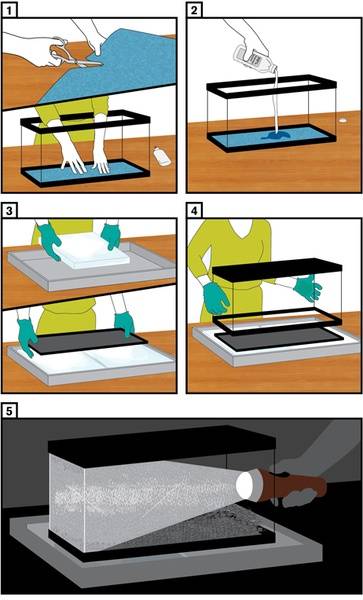
CloudChamberSteps_0.jpg

My question is, what kind of magnets are strong enough to deflect the particles? Will a small neodymium magnet be sufficient?
Americium 241 is an alpha radiation emitter.

Homework Equations


-none-

The Attempt at a Solution


I have no idea how strong a magnet can be in order to deflect it clearly.

Note: I know the dangers of radiation and chemicals like isopropanol, I take full responsibility of my actions.

Note 2: It is my first post, so please tell me if I made a mistake in posting- or a grammar mistake.
 
Physics news on Phys.org
The main decay channel of Americium 241 is via emission of alpha particles.
Alpha particles have mass ##m=6.64*10^{-27} \,\text{kg}##, charge ##q=3.2 *10^{-19} \,C##, and you can estimate the speed to be ##v=15\,000 \,\text{km}/\text{s}##.

Knowing that the radius of curvature ##R## for the trajectory of a charged particle in a magnetic field ##B##, is
R=\dfrac{2 m v}{q B}
you can put in the equation a value for ##R##, such that a bent trajectory can be easily seen inside your box, and extract a lower bound for ##B##.

P.S. keep in mind that your ##B## is not uniform throughout the box...
 
Thank you very much

http://bit.ly/1DuDBvh

I found a text explaining magnetic fields of a neodymium magnet.
Quotation from the pdf:
"The material is defined by its maximum energy product. The symbol N42 of a magnet means that the maximum value of negative prouct of the magnetic field B and H of 42.10^6 GOe (Gauss-Oersted) = 334 kJ/m^3. The letter N means that the magnets remain operational under 80° celsius.
The magnetisation is very strong: whereas AlNiCo shows the remanence of nearly 0.2 T it is 1.3 T with Neodymium magnets. One should note that the magnetic field B is the same only in the middle of a long bar magnet. On pole surfaces it is nearly half as big. (image 1: https://keep.google.com/media/1293mkHnP5rgfYLSoVtIAowcCicy-pA )
A neodymium magnet develops to a second magnet or a piece of iron in small distances up to 50 Newton per cm^2 polearea. Magnets from 2cm^2 Pole-areas can cause painful injuries.
Because of the 1/r^3-dependence strenght of a dipolar field of neodymium magnets, more than 1mT (a dangeorus magnetic field that is capable of harming electronics) magnetic fields occur if the magnet is nearly more than 15 centimeters long."

I tried to translate as best as I could.
So, I want to do something like this (image 2: https://keep.google.com/media/1gSvUjipL9dUSa-6BmN2laEGgm7C4XQ )

1) So how can I calculate the B field in of a particle that moves in the middle (between two magnets)?

2) Does Lorentz force effect the particle? Is the reason of its curvature because of Lorentz force? (image 3: https://keep.google.com/media/1jzwKLOEK-5iPhR8GfsNBAn9NorFbTg )
 
As far as I know alpha particles will travel quite a short distance in air before it interacts with the gas molecules
and cause subsequent ionizations. These will more likely be observed over longer distances. You migh also
observe cosmic particles occasionally shooting through the fog. So creating a magnetic field over a larger
region migh be a better option. Since you are experimenting this could be part of the investigation.

Here is a website that gives more info on how to construct and use a cloud chamber (without a magnetic field)
http://www.sciencebuddies.org/science-fair-projects/project_ideas/Phys_p087.shtml#summary

Here is some info on the interaction of a charged particle and a magnetic field
http://hyperphysics.phy-astr.gsu.edu/hbase/magnetic/forchg.html#c1

Hope this helps!
 
Garlic:

2) yes, it is just Lorentz force.
1) The question does not make any sense. The B field is given by the magnet, not by the particle. If you go to serious magnet manufacturers they usually quote some surface field
 
Sorry for the wait..
I am reuploading the images from my comment:
1st :
media-20150302.jpg
2nd:
media-20150302 (3).jpg
3rd:
media-20150302 (4).jpg


I want to add something, in a bbc documentary, I saw they used a magnet to make it have a curved trail. (link: )

Thanks for answering.
matteo137 , I think I wrote the first question wrong. And I found somewhere that says N42 class neodymium magnets have a magnetic field of 1.3 T in the mittel. (see image 1)

andrevdh , thanks, I think I'm going to buy a search coil to calculate the magnetic field.
 
I have found some magnetic field meters, but they seem too expensive (which I'm going to use one time), is the search coil you mentioned something I can build myself?
 
Hi Garlic, nice and ambitious project !

Comments:
2nd link (picture) this is for electric fields. Curved trajectory and field direction are in the same plane.
In a magnetic field the force is perpendicular to the velocity and to the field.

3rd link: As you saw in the documentary, they kept the tracks close to the magnet (like 1 cm or so). Two magnets at 15 cm doesn't help much. And at 1 or 2cm apart they obstruct the view.

As Andrev posted, alpha particles don't travel far (see e.g. here) and as you calculated (post #2), the radius of curvature will be pretty big for the 241Am. You might ask teacher if the school (or a nearby university) has a ##\beta## emitter for you to use (but they'll be all over you about radiation hygiëne).

Fortunately, looking at cosmic radiation is exciting enough by itself.
Best thing to do: discuss with teacher.
 
  • #10
Garlic, you might be overthinking the project.
Just begin by doing it and learning as you go.
Here is a nice link to info on a search or field coil - look at the bottom of the page in the Investigation:
https://books.google.co.za/books?id=r8I1gyNNKnoC&lpg=PT290&ots=qQjI78pJ3r&dq=measuring magnetic field using a search coil&pg=PT290#v=onepage&q=measuring magnetic field using a search coil&f=false
Another interesting link on Wilson's Cloud Chamber (its inventor) is on this page:
http://www-outreach.phy.cam.ac.uk/camphy/index.htm
 
Last edited:
  • #11
The only beta emitter I found available is tritium/radium painted watch hands. Well, I'll try to contact universites nearby. Will they trust me if I say I'll put the radioactive material in a lead pig? Or is more protection necessary?
 
  • #12
I don't know if they will trust you, but they might trust your teacher. It'll be a nice enterprise, so give it a try !
And otherwise: If the source can't come to your chamber, perhaps your chamber can go to the source ...

As I said earlier, cosmics are easier and also quite fascinating. Bit harder to do quantitively (they go really fast...)

Well, as @andrevdh says: just begin and see where you can come ! Good luck !
 
  • #13
Thanks..
 
  • #14
See this document page 27 for info and notes on handling the radioactive source safely
http://www.cleapss.org.uk/download/L93.pdf
 
Last edited by a moderator:
  • #15
Today was the last day to give the project to the teacher, I have successfully done the project.
I really want to thank you to all of you guys for your answers.. I really appreciate it.
 
  • #16
Good ! Congrats ! :smile:
 
  • #17
Any photos, posters, videos, results or notes on your project?
We would like to see them.
 
  • #18
andrevdh said:
Any photos, posters, videos, results or notes on your project?
We would like to see them.


:)
 

Similar threads

  • · Replies 1 ·
Replies
1
Views
852
  • · Replies 4 ·
Replies
4
Views
3K
  • · Replies 3 ·
Replies
3
Views
3K
  • · Replies 2 ·
Replies
2
Views
2K
  • · Replies 2 ·
Replies
2
Views
2K
  • · Replies 3 ·
Replies
3
Views
3K
  • · Replies 28 ·
Replies
28
Views
27K
  • · Replies 4 ·
Replies
4
Views
2K
  • · Replies 2 ·
Replies
2
Views
2K
Replies
5
Views
4K