Current Across R2 Resistor in Multi-Loop Circuit

  • Context: Engineering 
  • Thread starter Thread starter joel amos
  • Start date Start date
  • Tags Tags
    Circuit
Click For Summary
SUMMARY

The current across the R2 resistor in the given multi-loop circuit is calculated to be 2.7 mA. This conclusion is derived from applying Kirchhoff's Voltage Law (KVL) and Ohm's Law, with both voltage sources V1 and V2 set at 1.5 V. The voltage across R2 is equal to V2, which leads to the formula I2 = V2 / R2, resulting in I2 = 1.5 V / 560 Ω. The analysis confirms that there is no current through R1, as both sides of the resistor are at the same voltage level of 1.5 V.

PREREQUISITES
  • Understanding of Kirchhoff's Voltage Law (KVL)
  • Proficiency in Ohm's Law
  • Familiarity with series and parallel resistor configurations
  • Basic circuit analysis techniques
NEXT STEPS
  • Study advanced applications of Kirchhoff's laws in complex circuits
  • Learn about Thevenin's and Norton's theorems for circuit simplification
  • Explore the effects of varying voltage sources in multi-loop circuits
  • Investigate the impact of resistor tolerances on circuit performance
USEFUL FOR

Electrical engineering students, circuit designers, and anyone involved in analyzing or troubleshooting multi-loop circuits will benefit from this discussion.

joel amos
Messages
104
Reaction score
0
Ω

Homework Statement


In the following circuit, what is the current across the R2 resistor?
V1 = 1.5 V, V2 = 1.5 V, R1 = 470 Ω, R2 = 560 Ω
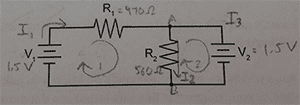
333x1z5.png


Homework Equations


Kirchhoff's laws

The Attempt at a Solution


I attempted to create a system of equations with the intention of finding R2, as was demonstrated in an example in class. Here are my equations:

Node A: I2 = I1 + I3
Loop 1: 1.5 V - I1 * 470 Ω - I2 * 560 Ω = 0
Loop 2: I2 * 560 Ω - 1.5 V = 0

V1 - I1 * R1 - I2 * R2 = 0 ⇒I1 * R1 = V - I2 * R2 ⇒ (V1 - I2 * R2) / R1 = (1.5 V - I2 * 560 Ω) / 470 Ω = I1

I've now expressed I1 in terms of I2. So I can write:

I2 = [(1.5 V - I2 * 560 Ω) / 470 Ω] + I3

However, I realized that I don't have enough equations to use to solve this system of equations for I2. In class we created a third loop that went around the whole outside. However, would that be possible in this case, as that isn't a path of current? And even if I were to add a third loop, I can't see how that'd help my cause.
 
Last edited:
Physics news on Phys.org
Take a step back and inspect the circuit again. Don't write any equations just ask yourself...

What is the voltage across R2?
What is the voltage on both sides of R1?
 
CWatters said:
Take a step back and inspect the circuit again. Don't write any equations just ask yourself...

What is the voltage across R2?
What is the voltage on both sides of R1?

The voltage drop across R2 is I2 * 560 Ω.
The voltage before R1 is 1.5 V and after is 1.5 V - I1 * 470 Ω.
Right?
 
The voltage drop across R2 is I2 * 560 Ω.

That's an equation. I said don't write any equations ;-)

What does a voltage source like V2 do?
 
CWatters said:
What does a voltage source like V2 do?

It creates a potential difference of 1.5 V.
 
V2 is connected in parallel with R2 so what's the voltage across R2?
 
-1.5 V ?
 
+1.5V eg same as V2

Sorry - I have to go out for a few hours.
 
Back again.

So what's the voltage on either side of R1?
 
  • #10
I think I may have solved it. I got I2 = 7.5 mA.
 
  • #11
That's not what I make it. Can you show your working.
 
  • #12
Req1 = 470 Ω + 560 Ω = 1030 Ω
I1 = 5 V / 1030 Ω = .00485 A
I3 = 1.5 V / 560 Ω = .00268 A
I2 = I1 + I3 = .00485 A + .00268 A = 7.5 mA
 
  • #13
Ah no that's somewhat mixed up. You can't work out I1 like that because V2 dictates the voltage across R2.

The first thing to notice about the circuit is that V2 is in parallel with R2. This means that the voltage across R2 must = V2 = 1.5V (as mentioned above). Then if the voltage across R2 is 1.5V the current through R2 must be what (according to Ohms law)?

Edit: Where do you get 5V from? Problem statement says both V1 and V2 are 1.5V. Is that a typo?
 
  • #14
CWatters said:
Then if the voltage across R2 is 1.5V the current through R2 must be what (according to Ohms law)?

I2 = V / R = 1.5 V / 560 Ω = 2.7 mA

CWatters said:
V2 dictates the voltage across R2.

How does the first loop work then? V1 adds 1.5 V and R2 drops 1.5 V. What about R1?

CWatters said:
Edit: Where do you get 5V from? Problem statement says both V1 and V2 are 1.5V. Is that a typo?

A typo indeed. Nice catch.
 
  • #15
How does the first loop work then? V1 adds 1.5 V and R2 drops 1.5 V. What about R1?

Indeed, hence my earlier question.. So what's the voltage on either side of R1? or if you prefer..What's the voltage drop across R1?
 
  • #16
CWatters said:
What's the voltage drop across R1?

I = 1.5 V / (470 Ω + 560 Ω) = 1.5 V / 1030 Ω = 0.001456 A
ΔV = 0.001456 A * 470 Ω = 680 mV
 
  • #17
It's not as complicated. You were closer with..

V1 adds 1.5 V and R2 drops 1.5 V"

That implies both sides of R1 are at 1.5V and there is no voltage drop across R1. What does that mean for I1?
 
  • #18
CWatters said:
What does that mean for I1?

Hmm. No current?
 
  • #19
I forgot to confirm that this...
joel amos said:
I2 = V / R = 1.5 V / 560 Ω = 2.7 mA
is correct.
 
  • #20
joel amos said:
Hmm. No current?

light bulb moment.jpg


In effect we have just written KVL for the outside loop, solved it for i1 and found it to be zero.
 
  • #21
So in short the circuit is a lot simpler than it looks.

V2//R2 implies the voltage on R2 = V2 so the current I2 = V2/R2 = 2.7mA

Both sides of R1 are 1.5V so i1 = 0

|I3| = |I2|
 
  • #22
CWatters said:
In effect we have just written KVL for the outside loop, solved it for i1 and found it to be zero.

Thanks for being part of the process!

CWatters said:
So in short the circuit is a lot simpler than it looks.

V2//R2 implies the voltage on R2 = V2 so the current I2 = V2/R2 = 2.7mA

Both sides of R1 are 1.5V so i1 = 0

|I3| = |I2|

This makes a lot of sense now. Thanks again!
 
  • #23
PS. If V1 had been 5V...

The voltage on R2 would still be 1.5V so I2 would still be 2.7mA.

Writing KVL for the outside loop would give...

+5 + (-I1*R1) + (-1.5) = 0

Rearrange to give

I1*R1 = 5 - 1.5

I1 = (5 - 1.5)/R1
= 3.5/470 = 7.5mA
 

Similar threads

  • · Replies 26 ·
Replies
26
Views
3K
  • · Replies 4 ·
Replies
4
Views
2K
  • · Replies 5 ·
Replies
5
Views
2K
  • · Replies 7 ·
Replies
7
Views
2K
  • · Replies 12 ·
Replies
12
Views
2K
  • · Replies 8 ·
Replies
8
Views
2K
Replies
4
Views
1K
  • · Replies 1 ·
Replies
1
Views
3K
Replies
7
Views
2K
  • · Replies 62 ·
3
Replies
62
Views
11K