Current change after inserting thin conductive foil into resistor

Click For Summary

Discussion Overview

The discussion revolves around the effect of inserting a thin conductive foil into a setup of resistors formed by two parallel metal plates filled with a conductive liquid. Participants explore how this insertion impacts the current flowing through the system, considering various configurations of resistors and the properties of the conductive foil.

Discussion Character

  • Homework-related
  • Technical explanation
  • Debate/contested

Main Points Raised

  • One participant attempted to calculate the current by splitting the system into four individual resistors and combining them in series and parallel, but found the current unchanged from the original.
  • Another participant provided a homework statement detailing the setup and asked for clarification on the calculations leading to the unchanged current.
  • A participant pointed out a potential oversight regarding a horizontal short-circuiting wire that may affect the calculations.
  • Some participants noted that the foil acts as an equipotential and suggested solving the circuit by considering it as a zero-ohm link across the resistors.

Areas of Agreement / Disagreement

There is no consensus on the correct approach to calculating the current change after inserting the foil, with multiple competing views and suggestions on how to account for the foil's properties and the circuit configuration.

Contextual Notes

Participants express uncertainty about how to incorporate the conductive foil and the short-circuiting wire into their calculations, indicating potential limitations in their current understanding of the circuit dynamics.

student_man
Messages
4
Reaction score
1
Homework Statement
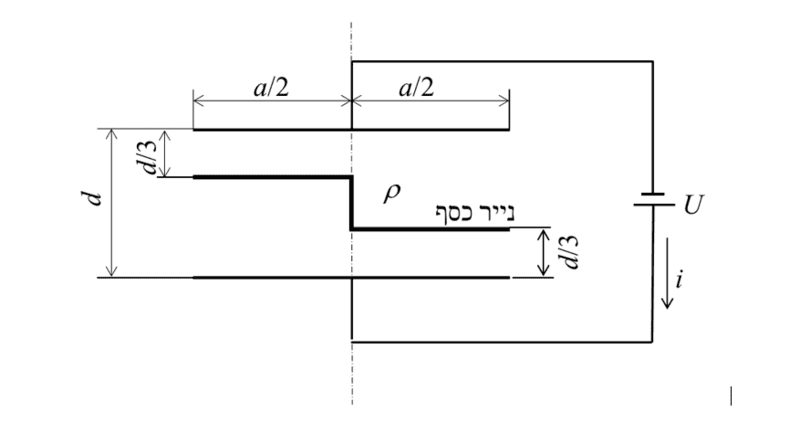
Given are two square parallel metal plates, with dimensions a×a whose distance between them is d where d≪a. The space between the plates is filled with a conductive liquid with resistivity p. The plates are connected to a constant voltage source U. How much will the current through the plates change when a conductive foil is inserted into the space between the plates and bent in the middle as shown in the figure? The current at any point between the plates flows in the direction perpendicular to the plane of the upper plate.
Relevant Equations
Circuit attached
I tried splitting it up into 4 individual resistors, adding them up (each side serially and then both sides with each other as parallel) and then using V=IR but it ended up being the same current as the original.
(The answer should end up being (9/8)* the original current)
Screenshot 2023-10-05 185408.png
 
Physics news on Phys.org
student_man said:
Homework Statement: Given are two square parallel metal plates, with dimensions a×a whose distance between them is d where d≪a. The space between the plates is filled with a conductive liquid with resistivity p. The plates are connected to a constant voltage source U. How much will the current through the plates change when a conductive foil is inserted into the space between the plates and bent in the middle as shown in the figure? The current at any point between the plates flows in the direction perpendicular to the plane of the upper plate.
Relevant Equations: Circuit attached

I tried splitting it up into 4 individual resistors, adding them up (each side serially and then both sides with each other as parallel) and then using V=IR but it ended up being the same current as the original.
(The answer should end up being (9/8)* the original current)View attachment 333071
Welcome to PF.

Interesting problem! Can you show your math where you ended up getting the same overall current?
 
berkeman said:
Welcome to PF.

Interesting problem! Can you show your math where you ended up getting the same overall current?
Here is my math
SmartSelect_20231005_194723_Samsung Notes.jpg

I hope it's understandable : )
 
I believe you left out the horizontal short-circuiting wire between the for 4 resistors... :wink:
 
berkeman said:
I believe you left out the horizontal short-circuiting wire between the for 4 resistors... :wink:
I'm not really sure how to take it into consideration in the equations😅
The only information I'm given about the piece of foil is that it's conductive.
 
The foil is an equipotential. It is a zero ohms link across a bridge of four resistors. Solve parallel then series, not series the parallel.
 
  • Love
Likes   Reactions: student_man
Baluncore said:
The foil is an equipotential. It is a zero ohms link across a bridge of four resistors. Solve parallel then series, not series the parallel.
Thank you! :biggrin:
 
  • Like
Likes   Reactions: berkeman

Similar threads

Replies
15
Views
2K
  • · Replies 3 ·
Replies
3
Views
2K
  • · Replies 4 ·
Replies
4
Views
2K
  • · Replies 6 ·
Replies
6
Views
4K
  • · Replies 3 ·
Replies
3
Views
2K
  • · Replies 2 ·
Replies
2
Views
5K
  • · Replies 1 ·
Replies
1
Views
3K
  • · Replies 3 ·
Replies
3
Views
3K
  • · Replies 2 ·
Replies
2
Views
2K
  • · Replies 2 ·
Replies
2
Views
2K