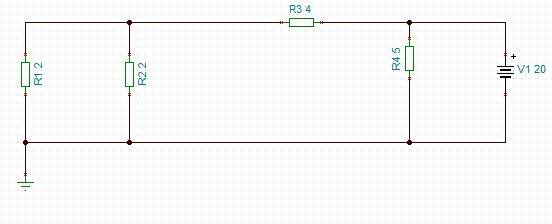
DC current through a resistor circuit

Click For Summary
SUMMARY

The discussion centers on calculating the current through a resistor (R1) in a mixed DC circuit, where the total source current is confirmed at 8A. The user initially miscalculated the current through R3 as 4.44A, which led to confusion regarding the current division between resistors. The correct approach involves recognizing that the current through R3 should be calculated using the total equivalent resistance of the circuit, leading to the conclusion that the current through R1 is indeed 2A when R1 and R2 are equal. The importance of Kirchhoff's Current Law and proper application of current division formulas is emphasized.

PREREQUISITES
  • Understanding of Ohm's Law and basic circuit theory
  • Familiarity with Kirchhoff's Current Law (KCL)
  • Knowledge of series and parallel resistor combinations
  • Experience with current division formulas in electrical circuits
NEXT STEPS
  • Study the application of Kirchhoff's Current Law in complex circuits
  • Learn about calculating equivalent resistance in series and parallel circuits
  • Explore current division techniques in electrical engineering
  • Practice circuit simulations using tools like LTspice or Multisim
USEFUL FOR

Electrical engineering students, circuit designers, and anyone involved in analyzing or designing DC circuits will benefit from this discussion.

Tim86
Messages
4
Reaction score
0
Thread moved from the technical forums, so no Homework Template is shown.
Summary:: Current through a certain resistor in a mixed dc circuit.

Hi, Sorry if this is the wrong forum.

I'm trying to work out the current through R1.The answer I need is 2 Amp, which I have confirmed with a simulation software.

Capture.JPG

I have calculated the source current as 8A, the current past R3 as 4.44...A and finally R1 as 2.22...A.

Can anyone tell me what I am doing wrong please?

thanks
 
Physics news on Phys.org
And how can be anyone able to say what you did wrong, without knowing what you did?

Do these numbers - 2, 3, 4, 5 - mean resistance in ohms? If so, the only number that looks OK is 8A total.
 
Tim86 said:
I have calculated the source current as 8A, the current past R3 as 4.44...A and finally R1 as 2.22...A.

Can anyone tell me what I am doing wrong please?
Yes, no, no.

No, we can only guess at what you might have done.

hint: what is the current through R4?
 
Tim86 said:
Can anyone tell me what I am doing wrong please?
If the current through R3 was to be 4.44 amp;
then the resistance of the R1,2,3 branch would need to be 20 / 4.44 = 4.505 ohms.

So the question is; How could you get ( ( R1 // R2 ) + R3 ) = 4.505 ohm ?
( Where the double diagonal symbol "//" represents resistors in parallel ).
Maybe you calculated the resistance of the parallel ( R1 // R2 ) as 0.5 ohm, NOT as 1 ohm.
Then, when added to R3 = 4 ohm you get 4.5 ohm which is wrong.

To find the the current through R1.
The current through R4 is irrelevant.
Current through R3 is 20 volt / ( R3 + ( R1 // R2) ) ohm = 20 / 5 = 4 amp.
Since R1 and R2 are equal, half that flows through each; 4 amp / 2 = 2 amp.
 
Baluncore said:
If the current through R3 was to be 4.44 amp;
then the resistance of the R1,2,3 branch would need to be 20 / 4.44 = 4.505 ohms.

So the question is; How could you get ( ( R1 // R2 ) + R3 ) = 4.505 ohm ?
( Where the double diagonal symbol "//" represents resistors in parallel ).
Maybe you calculated the resistance of the parallel ( R1 // R2 ) as 0.5 ohm, NOT as 1 ohm.
Then, when added to R3 = 4 ohm you get 4.5 ohm which is wrong.

To find the the current through R1.
The current through R4 is irrelevant.
Current through R3 is 20 volt / ( R3 + ( R1 // R2) ) ohm = 20 / 5 = 4 amp.
Since R1 and R2 are equal, half that flows through each; 4 amp / 2 = 2 amp.
Hi thanks for your response.

I think my mistake was not ignoring R4, what is the reason for that? Does the current not get divided between branch R3 and R4?

I took the 8 Amps and worked out the current division through R3 (R3/R3+R4*IS(8A))

This is where I got the 4.4...A from.

thanks for your help
 
Tim86 said:
Hi thanks for your response.

I think my mistake was not ignoring R4, what is the reason for that? Does the current not get divided between branch R3 and R4?

I took the 8 Amps and worked out the current division through R3 (R3/R3+R4*IS(8A))

This is where I got the 4.4...A from.

thanks for your help
So, the 8A is correct. But you don't use the current division formula if there is an infinite amount of current available from the source. It is actually much easier than that. The current doesn't divide, it just subtracts. Think about Kirchhoff's Current Law.

You know that the total current from the source is 8A (congratulations, BTW, that is maybe the hard part of this problem). Now, What is the current through R4? If the current from the voltage source is known and the current through R4 is know what must the current through R3 be?

I am focusing on the R4 current just to follow up on the part you got correct, the 8A total current. But R4 is kind of irrelevant if you only want to know about the current(s) through the other resistors. The voltage source will apply the same voltage to the R3-R4 node regardless of the value of R4.

Frankly, I'm a little confused about how you can correctly find the 8A total current but get the current through R3 wrong. But, we'll figure it out.
Tim86 said:
(R3/R3+R4*IS(8A))
Also, I think you're being sloppy with writing equations if you characterize this as a current divider formula. Anyway, it's a mess. Even adding the parentheses you left out won't fix it. Don't guess at applying equations, think about how the circuit actually works.
 
I know that this is too late to help the person who posed the question but it may help others: When doing voltage division at a node you need to calculate the equivalent resistance of both paths and use the current division formula. In this case we have correctly deduced that the total current is 8 amps. At node1 (junction of the 5 and 4 ohm resistors) you have assumed that the current divides in inverse proportion to the 5 and 4 ohm resistors like this: (8 amps) X (5/(4 + 5)) = 4.44 amps. That precisely is the error. That 8 amps is (correctly) seeing 5 ohms "vertically" but NOT 4 ohms "horizontally." Instead of 4 ohms the total equivalent resistance "horizontally" is (2 // 2) + 4 = 5 ohms. So you actually have an equivalent of 2 five ohms resistors in parallel dividing the 8 amps into 4 (not 4.44) amps in each limb. Not sure if I've made myself clear but the use of current division requires that the circuit be collapsed into only 2 possible paths. In this case there is more resistance to the left of node 1 to compare to R4 than just R3 (there is R1 and R2 as well).
 

Similar threads

  • · Replies 37 ·
2
Replies
37
Views
5K
Replies
15
Views
2K
Replies
1
Views
2K
  • · Replies 7 ·
Replies
7
Views
3K
  • · Replies 3 ·
Replies
3
Views
4K
  • · Replies 3 ·
Replies
3
Views
2K
Replies
5
Views
4K
  • · Replies 5 ·
Replies
5
Views
3K
  • · Replies 12 ·
Replies
12
Views
2K
Replies
21
Views
3K