Derivation of [itex] p = \frac{E}{c} [/itex] using Maxwell's light

Click For Summary

Discussion Overview

The discussion revolves around the derivation of the relationship between momentum and energy for electromagnetic waves, specifically the expression \( p = \frac{E}{c} \). Participants explore theoretical aspects, conservation laws, and the implications of electromagnetic interactions with charged particles.

Discussion Character

  • Exploratory
  • Technical explanation
  • Debate/contested
  • Mathematical reasoning

Main Points Raised

  • One participant describes the interaction of an electromagnetic wave with a charged particle, suggesting that the electric field induces motion, which subsequently leads to a magnetic force acting on the particle.
  • Another participant proposes using conservation of momentum to argue that the momentum gained by the particle must originate from the radiation, raising questions about whether the particle's motion would emit new radiation.
  • A later reply emphasizes that complete absorption of light is necessary for equating the particle's momentum and energy with that of the light.
  • Some participants discuss the concept of "handwaving," with one defining it as a lack of rigor in arguments, while others question why certain derivations, like those in Feynman's lectures, are labeled as such.
  • One participant mentions Noether's theorem and suggests that a deeper understanding of conservation laws requires advanced mathematics beyond standard textbooks.

Areas of Agreement / Disagreement

Participants express differing views on the rigor of certain derivations and the implications of conservation laws. There is no consensus on whether the derivation discussed is sufficiently rigorous or if it relies on handwaving arguments.

Contextual Notes

Some participants note that the derivation of conservation laws using Maxwell's equations may not lead to a deeper understanding of their origins, suggesting a limitation in the approach taken by standard textbooks.

Adesh
Messages
735
Reaction score
191
Imagine that we have an electromagnetic wave or light propagating in x direction, and \mathbf{E} is oscillating in z direction and \mathbf{B} in y direction. The picture looks something like this
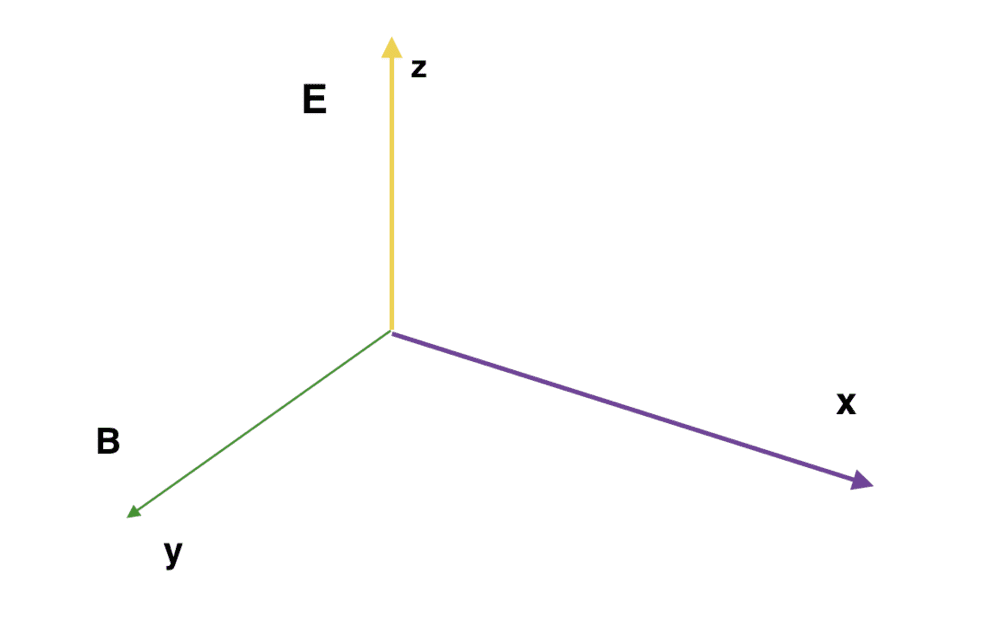
Screen Shot 2019-12-14 at 6.49.06 PM.png


Now, if there exists a charged particle q on the xx axis at rest, then our B field can't do anything, but the electric field E will pull it upwards and as soon as it starts moving the magnetic field B comes into action and it goes like this $$ \mathbf{F_{mag}} = q (\mathbf{v} \times \mathbf{B}) $$ Since, E is going to cause a velocity in z direction i.e. perpendicular to magnetic field B , therefore $$ F_{mag} = q~v~B$$
$$ F_{mag} = q~v~\frac{E}{c}$$
$$F_{mag} = v~\frac{(qE)}{c}$$
$$ F_{mag} = \frac{F_{electric}~v}{c}$$
$$ F_{mag} = \frac{dW_{electric}/dt}{c}$$ and after doing this he writes
That light carries energy we already know. We now understand that it also carries momentum, and further, that the momentum carried is always 1/c times the energy

After considering this line, I thought the last equation could be written as $$ \frac{dp}{dt} = \frac{1}{c} ~ \frac{dW}{dt}$$
$$ dp = \frac{dW}{c} $$
$$ p= \frac{E}{c}$$
But I find this thing sloppy because when I wrote F_{mag} = \frac{dp}{dt} it was for the particle, that is force applied on the particle was equated with the rate of change of particle's momentum and not the light's momentum and similarly dW is the energy imparted to the particle and not the energy of light itself.

So, these are my problems. I earnestly request you to please help me over here.
 

Attachments

  • Screen Shot 2019-12-14 at 6.49.06 PM.png
    Screen Shot 2019-12-14 at 6.49.06 PM.png
    4.1 KB · Views: 285
Last edited:
Physics news on Phys.org
Use conservation of momentum. The momentum the particle gets must come from the radiation. Same for the energy.
It is not completely free of hand-waving, because you can also ask if the motion of the particle will emit new radiation on its own, but that is a smaller effect.
 
mfb said:
Use conservation of momentum. The momentum the particle gets must come from the radiation. Same for the energy.
It is not completely free of hand-waving, because you can also ask if the motion of the particle will emit new radiation on its own, but that is a smaller effect.
But that should involve complete absorption of light then only we can call the charged particle’s momentum and energy to be equal to that of light, isn’t ?
 
The non-handwaving derivation of the conservation laws leads to Noether's theorem. However you need some more advanced mathematics than you find in the Feynman Lectures, i.e., Hamilton's principle for fields. Then the electromagnetic energy-momentum tensor follows from invariance under space-time translations (+ a gauge-symmetry argument to derive a manifestly gauge invariant symmetric energy-momentum tensor).
 
  • Like
Likes   Reactions: Adesh
Adesh said:
But that should involve complete absorption of light then only we can call the charged particle’s momentum and energy to be equal to that of light, isn’t ?
It doesn't matter how much energy transferred, as long as energy and momentum are transferred at a rate of pc=E. The remaining light will have the same energy-momentum relation as before, that is only possible if pc=E applies to the overall light as well.
 
  • Like
Likes   Reactions: Adesh
vanhees71 said:
The non-handwaving derivation of the conservation laws leads to Noether's theorem. However you need some more advanced mathematics than you find in the Feynman Lectures, i.e., Hamilton's principle for fields. Then the electromagnetic energy-momentum tensor follows from invariance under space-time translations (+ a gauge-symmetry argument to derive a manifestly gauge invariant symmetric energy-momentum tensor).
What is handwaving?
 
Adesh said:
What is handwaving?
Handwaving is being non-rigorous. I think it comes from the habit many people have of waving their hand in the air when dismissing a question about details of an argument. So non-handwaving is rigorous.
 
Last edited:
  • Like
Likes   Reactions: Adesh
Ibix said:
Handwaving is being non-rigorous. I think it comes from the habit many people have of waving their hand in the air when dismissing a question about details of an argument. So non-handwaving is rigorous.
Thank you. But why that derivation of Feynman was called hand-waving?
 
  • Like
Likes   Reactions: Ibix
Adesh said:
Thank you. But why that derivation of Feynman was called hand-waving?
Oh I see! Sorry - early in the morning. I'll have to let vanhees71 answer that.
 
  • #10
I haven't called it handwaving in the first place. I think, however, that most E&M textbooks just state the expressions for energy-momentum density and then derive the conservation laws by just using Maxwell's equations in a lengthy calculation using standard 3D vector analysis. That's fine but doesn't lead to a deeper understanding where the conservation laws come from, which is the great work by Emmy Noether of 1918. It's just relating the 10 general conservation laws to the symmetries of Galilei-Newton or Einstein-Minkowski spacetime.
 

Similar threads

  • · Replies 1 ·
Replies
1
Views
896
  • · Replies 1 ·
Replies
1
Views
2K
  • · Replies 3 ·
Replies
3
Views
1K
  • · Replies 66 ·
3
Replies
66
Views
28K
  • · Replies 1 ·
Replies
1
Views
2K
  • · Replies 7 ·
Replies
7
Views
812
  • · Replies 36 ·
2
Replies
36
Views
5K
  • · Replies 19 ·
Replies
19
Views
3K
  • · Replies 68 ·
3
Replies
68
Views
5K
  • · Replies 6 ·
Replies
6
Views
2K