Deriving motion equations for two blocks on a rough table

Click For Summary
SUMMARY

The discussion focuses on deriving motion equations for two blocks, A and B, connected by a string, with block A on a rough table and block B hanging off the edge. The coefficient of kinetic friction (μk) plays a crucial role in determining the acceleration of block B as it descends. The correct equation for acceleration is established as a = g(-μk), and the time taken for block B to strike the floor is derived as t = 2√(h/g). The importance of accounting for friction in motion equations is emphasized throughout the discussion.

PREREQUISITES
  • Understanding of Newton's second law of motion
  • Knowledge of kinetic friction and its coefficient (μk)
  • Familiarity with basic kinematic equations
  • Ability to simplify algebraic expressions involving mass
NEXT STEPS
  • Study the derivation of Newton's second law in various contexts
  • Learn about the effects of friction on motion in physics
  • Explore kinematic equations and their applications in real-world scenarios
  • Practice solving problems involving multiple connected bodies and forces
USEFUL FOR

Students of physics, particularly those studying mechanics, educators teaching motion equations, and anyone interested in understanding the dynamics of connected systems under friction.

TonyV
Two small blocks, each of mass m, are connected by a string of constant length 4h and negligible mass. Block A is placed on a very rough tabletop as shown below, and block B hangs over the edge of the table. The tabletop is a distance 2h above the floor. Block A is then released from rest at a distance h above the floor at time t = 0 and the system begins to move. The coefficient of kinetic friction is μk.
Express all algebraic answers in terms of μk, h, m1, m2, , and g.
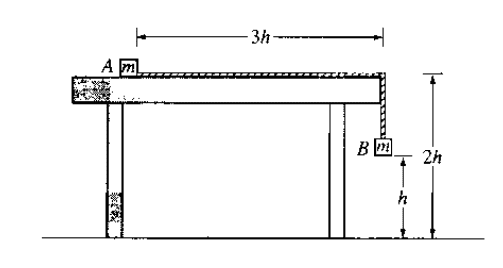
upload_2017-10-21_21-11-15.png

A) Write equations for the sum of forces in both directions.
From what I understand, the sum of all forces would be ΣF = (sum of forces) = ma.

B) Derive an equation for the acceleration of block B as it descends.
I thoughtlessly did this without accounting for friction and ended up with g/2. I did a similar problem for homework and was used that information to come up with this equation for acceleration... However, I am unsure of whether or not I am on the right path.
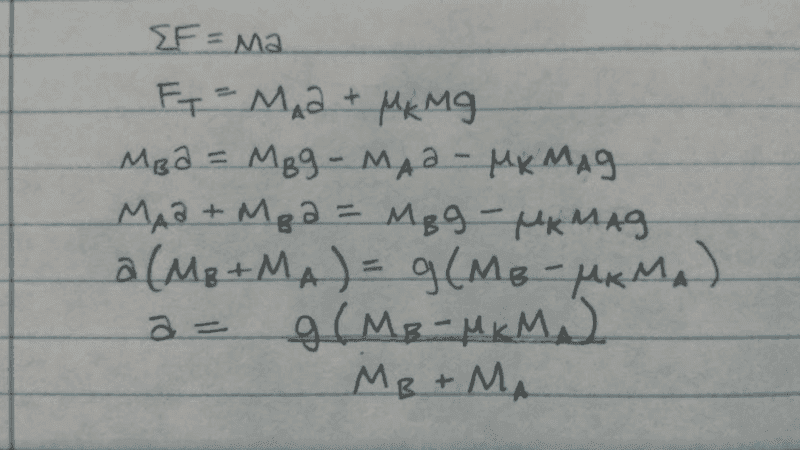
upload_2017-10-21_21-22-36.png


I would end up with variables canceling out in the final equation, correct??

C) Block B strikes the floor and does not bounce. Determine the time t at which block B strikes the floor.
For this I ended up with 2√h/g. However, since I got this equation by substituting acceleration with the equation from the previous step (g/2) in h=½at^2. I am unsure of how to proceed until I am certain of what I need to use for acceleration to solve for time.

I am grateful for any assistance and/or suggestions. I love physics but still have much to learn! However, I want to understand as much as possible.
:smile:
 

Attachments

  • upload_2017-10-21_21-11-15.png
    upload_2017-10-21_21-11-15.png
    3.4 KB · Views: 622
  • upload_2017-10-21_21-22-36.png
    upload_2017-10-21_21-22-36.png
    77.7 KB · Views: 537
  • upload_2017-10-21_21-27-36.png
    upload_2017-10-21_21-27-36.png
    77.7 KB · Views: 526
Physics news on Phys.org
There is a coefficient of friction given. You can't neglect friction.
 
  • Like
Likes TonyV
TonyV said:
unsure of how to proceed until I am certain of what I need to use for acceleration to solve for time.
Your second attempt at acceleration was correct. It is not unusual that some variables cancel out. In the present case, would you expect the acceleration or time to be different if both masses were doubled?
 
  • Like
Likes TonyV
haruspex said:
Your second attempt at acceleration was correct. It is not unusual that some variables cancel out. In the present case, would you expect the acceleration or time to be different if both masses were doubled?

Thank you... In this particular case no. At least I am pretty sure it is irrelevant in this case. So in the equation for a, both of my mass variables would cancel out? That would leave me with g(-μk)
 
mfb said:
There is a coefficient of friction given. You can't neglect friction.
The previous problem had negligible friction... This is why it's important to read the entire problem before attempting to solve.
 
TonyV said:
That would leave me with g(-μk)
No. Starting with the last equation in the image you posted, and setting the two masses equal, please post your steps.
 
Okay, here is what I have...
 

Attachments

  • 20171024_000306-2.jpg
    20171024_000306-2.jpg
    30.2 KB · Views: 471
TonyV said:
Okay, here is what I have...
That's what you posted before, but you know the two masses are equal, so what does it simplify to?
 
  • Like
Likes TonyV
haruspex said:
That's what you posted before, but you know the two masses are equal, so what does it simplify to?
2m
 
  • #10
TonyV said:
2m
Eh?
No. Take the final expression in the image you posted and use the fact that the two masses are equal. (You are told this.). What does that expression then simplify to?
 
  • #11
haruspex said:
Eh?
No. Take the final expression in the image you posted and use the fact that the two masses are equal. (You are told this.). What does that expression then simplify to?
Sorry, been a long week. Midterms. I know it's probably right in front of my face, obvious but I'm not seeing much else... Unless it cancels out...
 
  • #12
TonyV said:
Sorry, been a long week. Midterms. I know it's probably right in front of my face, obvious but I'm not seeing much else... Unless it cancels out...
I cannot understand your difficulty. You had ##a=g\frac{M_B-\mu_kM_A}{M_B+M_A}##. Just replace each MA and MB with m and simplify.
 

Similar threads

Replies
13
Views
3K
Replies
4
Views
836
  • · Replies 4 ·
Replies
4
Views
3K
Replies
6
Views
1K
Replies
17
Views
3K
  • · Replies 6 ·
Replies
6
Views
2K
Replies
15
Views
3K
  • · Replies 33 ·
2
Replies
33
Views
2K
  • · Replies 6 ·
Replies
6
Views
2K
Replies
61
Views
3K