Determine Posititive Feedback Gain in an Oscillator

Click For Summary
SUMMARY

The positive feedback gain expression for the oscillator circuit is defined as v2/v0 = 1/[3 + j(wL/R - R/WL)]. The discussion highlights the challenges faced in calculating this gain, particularly when combining resistors and inductors in series and parallel configurations. The correct approach involves applying a test current signal at Vo and recognizing that Vx cannot equal Vo. Additionally, calculating the gain from Vo to V2 can be effectively achieved by treating it as a cascade of two voltage dividers.

PREREQUISITES
  • Understanding of complex impedance in AC circuits
  • Familiarity with operational amplifier (op-amp) principles
  • Knowledge of voltage divider circuits
  • Basic proficiency in circuit analysis techniques
NEXT STEPS
  • Study complex impedance calculations in RLC circuits
  • Learn about operational amplifier configurations and feedback mechanisms
  • Explore voltage divider analysis in detail
  • Investigate the effects of feedback on oscillator stability and performance
USEFUL FOR

Electrical engineers, circuit designers, and students studying feedback systems in oscillators will benefit from this discussion, particularly those focusing on operational amplifier applications and circuit analysis techniques.

Fronzbot
Messages
58
Reaction score
0
NOTE- Images are thumbnails, click to enlarge

Homework Statement


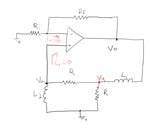
Show that the positive feedback gain expression for the circuit below is
v2/v0 = 1/[3 + j(wL/R - R/WL)]

(anything in red I added to the original problem)
th_circuit.jpg


Homework Equations


(above)

The Attempt at a Solution


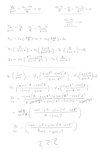
Along with the below calculations, I also attempted to combine the components but that didn't work either. I combined R and L2 in series, those in parallel with the other R and then in series with L1 (let's call all of that Zt). I then said (V2-V0)/Zt = 0 and proceeded to solve for V2/V0 but did not get the right answer. I thought that that should work since this is an ideal op-amp and no current is flowing between L2 and R, but alas I did not get the correct answer. Any guidance?
th_calcs.jpg
 
Physics news on Phys.org
One of your equations is (Vo-Vx)/jwL=0. This would mean that Vo=Vx which can't be true if you are applying a signal to Vo and then calculating the voltage resulting at V2. You have to imagine applying a test current signal (of unit value, say) at Vo, and then calculating the result at V2, and therefore Vx can't be equal to Vo. You would need to set (Vo-Vx)/jwL=1; from this you can calculate the voltage at V2 (and subsequently at Vo) from knowledge of the input impedance at V2.

Another way to do it would be to calculate the gain from Vo to V2 as a cascade of two voltage dividers.
 

Similar threads

  • · Replies 12 ·
Replies
12
Views
2K
  • · Replies 8 ·
Replies
8
Views
3K
  • · Replies 3 ·
Replies
3
Views
2K
  • · Replies 27 ·
Replies
27
Views
7K
  • · Replies 5 ·
Replies
5
Views
2K
  • · Replies 3 ·
Replies
3
Views
2K
  • · Replies 5 ·
Replies
5
Views
3K
  • · Replies 4 ·
Replies
4
Views
4K
Replies
4
Views
2K
  • · Replies 10 ·
Replies
10
Views
2K