tomcorker
- 4
- 0
As part of a lab report I have to determine the speed of a motor from the PWM waveform.
The motor in question is a lego motor, of type at disassembled at http://www.philohome.com/motors/motor.htm. It has three coils on the rotor and a 4 pole permanent magnet stator.
This is the waveform I have:
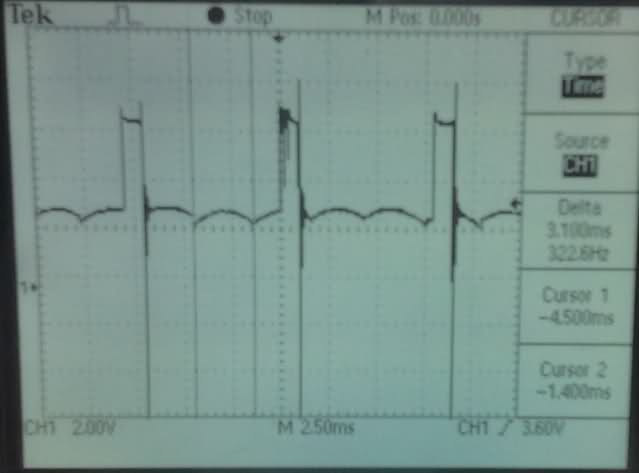
You can see the PWM pulses, and in between there is the output waveform of the motor acting as a generator when no voltage is being applied. I should be able to calculate the speed of the motor from the time of one of the generator pulses (not the PWM pulses). I measured this as 3.1ms (you can check on the image).
I suppose my question is how many pulses should there be per revolution of the rotor?This is what I thought:
I know what I am seeing is effectively rectified 3-phase AC from the three coils, so there should be 6 pulses per complete cycle on one coil. There are 2 pole pairs, so there will be 2 cycles per coil per revolution, giving a total of 12 per revolution.
At 3.1ms per pulse, one revolution should be 37.2ms per revolution. The motor has an internal 14:1 gearing, so the output shaft should be rotating at about 0.5s per rev, or about 120rpm.
But what I actually observed was 4s per revolution at the output shaft (15rpm), so I'm out by a factor of 8.
Any thoughts?
The motor in question is a lego motor, of type at disassembled at http://www.philohome.com/motors/motor.htm. It has three coils on the rotor and a 4 pole permanent magnet stator.
This is the waveform I have:
You can see the PWM pulses, and in between there is the output waveform of the motor acting as a generator when no voltage is being applied. I should be able to calculate the speed of the motor from the time of one of the generator pulses (not the PWM pulses). I measured this as 3.1ms (you can check on the image).
I suppose my question is how many pulses should there be per revolution of the rotor?This is what I thought:
I know what I am seeing is effectively rectified 3-phase AC from the three coils, so there should be 6 pulses per complete cycle on one coil. There are 2 pole pairs, so there will be 2 cycles per coil per revolution, giving a total of 12 per revolution.
At 3.1ms per pulse, one revolution should be 37.2ms per revolution. The motor has an internal 14:1 gearing, so the output shaft should be rotating at about 0.5s per rev, or about 120rpm.
But what I actually observed was 4s per revolution at the output shaft (15rpm), so I'm out by a factor of 8.
Any thoughts?