Determining Support Reactions at A&E: Get Help Now!

  • Thread starter Thread starter smr101
  • Start date Start date
  • Tags Tags
    Forces Moments
Click For Summary

Discussion Overview

The discussion revolves around determining support reactions at points A and E in a structural analysis problem. Participants explore the application of static equilibrium equations to solve for these reactions, addressing issues related to sign conventions and the correctness of their calculations.

Discussion Character

  • Technical explanation
  • Mathematical reasoning
  • Debate/contested

Main Points Raised

  • Some participants suggest writing equations of static equilibrium to find support reactions.
  • One participant reports having calculated vertical reaction at E as 50kN and horizontal and vertical reactions at A as -30kN and -50kN, respectively, but notes discrepancies in signs compared to provided answers.
  • A participant indicates that incorrect signs may arise from not establishing a convention for positive directions for forces and moments.
  • Another participant emphasizes the importance of explicitly defining the signs in equilibrium equations and suggests a method for rearranging the moment equation to clarify the sign of the unknown reaction E.

Areas of Agreement / Disagreement

Participants express differing views on the correctness of their signs and calculations, with no consensus reached on the proper approach to establishing sign conventions or resolving the discrepancies in their results.

Contextual Notes

Participants mention the need for a consistent sign convention and the potential for incorrect signs if such conventions are not established. There are unresolved aspects regarding the assumptions made in the calculations and the specific definitions of positive directions.

smr101
Messages
72
Reaction score
0
How do I determine the support reactions at A & E in this example?
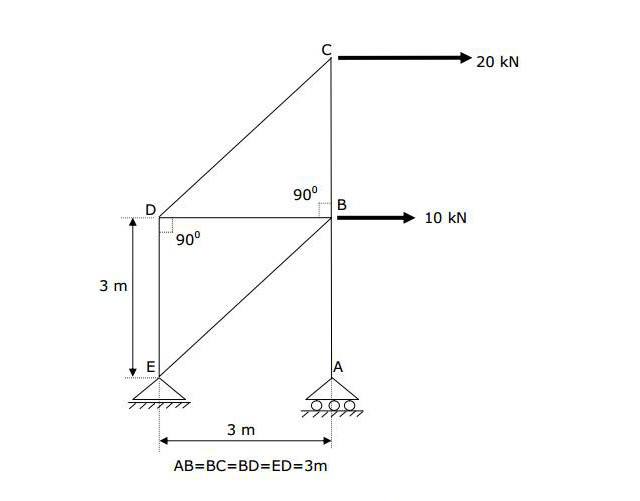
eJ9pR.jpg


Help is much appreciated.
 
Physics news on Phys.org
Have you tried writing equations of static equilibrium for this frame?
 
SteamKing said:
Have you tried writing equations of static equilibrium for this frame?

How?
 
Have you written equations of static equilibrium for any structure before?
 
SteamKing said:
Have you written equations of static equilibrium for any structure before?

Right I've worked it out.

I've got E vertical as 50kN.

A horizontal as -30kN, vertical as -50kN.

Only problem is the answers have them listed as these values but I have all of the signs wrong.
 
smr101 said:
Right I've worked it out.

I've got E vertical as 50kN.

A horizontal as -30kN, vertical as -50kN.

Only problem is the answers have them listed as these values but I have all of the signs wrong.
This indicates that the direction in which you assumed the reactions are acting is opposite of the direction in which they act.
 
SteamKing said:
This indicates that the direction in which you assumed the reactions are acting is opposite of the direction in which they act.

Yeah, I get that, I'm unsure why the answer is in correct.

Here's my working for vertical E:

About A

∑M = (10 x 3) + (20 x 6) - (E x 3)
= 150 - 3E
Ev = 50

The correct answer is - 50

Any idea where I've gone wrong?

Thanks.
 
If you don't set up a convention for what constitutes a positive direction for forces and a positive orientation for moments, your equilibrium equations often will give you incorrect signs in the results.

It helps to write both equilibrium equations. There should be an equation for the forces such that ∑F = 0, just as there is one for the moments, ∑M = 0.
 
∑M = (10 x 3) + (20 x 6) - (E x 3)

What SteamKing said. Its much better to write...

I define clockwise as +ve and then

(+10 x 3) + (+20 x 6) + (?E x 3) = 0

Note: I have explicitly written the sign in front of the 10 and 20N. The "+" sign before the E is because I am summing the moments, it is NOT because I have assumed E has any particular direction. To further clarify I have put a ? indicating the sign of E is unknown. I wouldn't normally put a ? mark but you can if it helps.

Rearrange

?E = - {(+10 x 3) + (+20 x 6)} / 3

?E = - 50

So the unknown sign of E is -ve. That means E acts anticlockwise (eg downwards).
 
Last edited:

Similar threads

  • · Replies 30 ·
2
Replies
30
Views
3K
  • · Replies 7 ·
Replies
7
Views
2K
  • · Replies 3 ·
Replies
3
Views
2K
  • · Replies 1 ·
Replies
1
Views
2K
  • · Replies 2 ·
Replies
2
Views
3K
  • · Replies 3 ·
Replies
3
Views
3K
  • · Replies 1 ·
Replies
1
Views
3K
  • · Replies 3 ·
Replies
3
Views
2K
  • · Replies 1 ·
Replies
1
Views
2K
  • · Replies 12 ·
Replies
12
Views
2K