Dielectric half-filled parallel plate capacitor

Click For Summary
SUMMARY

The discussion focuses on the behavior of electric fields in a dielectric half-filled parallel plate capacitor, specifically addressing Griffiths' Problem 4.19. It establishes that the electric fields remain constant regardless of the dielectric material due to the relationship between potential difference (PD) and spacing. The total charge is calculated using the formula σ_{tot} = ε_{0}E = ε_{0}V/d, and the capacitance is derived from the total charge as (\frac {A}{2})(σ_{tot} + σ_f). The analysis concludes that the system can be treated as two capacitors in series and parallel, depending on the configuration.

PREREQUISITES
  • Understanding of electric fields and potential difference in capacitors
  • Familiarity with capacitance calculations in series and parallel configurations
  • Knowledge of dielectric materials and their impact on capacitance
  • Proficiency in applying circuit theory to capacitor problems
NEXT STEPS
  • Study the derivation of capacitance formulas for capacitors in series and parallel
  • Explore the effects of different dielectric materials on electric field strength
  • Learn about the concept of potential dividers in electrical circuits
  • Investigate Griffiths' textbook for further problems related to capacitors and dielectrics
USEFUL FOR

Physics students, electrical engineers, and educators seeking to deepen their understanding of capacitor behavior in various dielectric environments.

unscientific
Messages
1,728
Reaction score
13
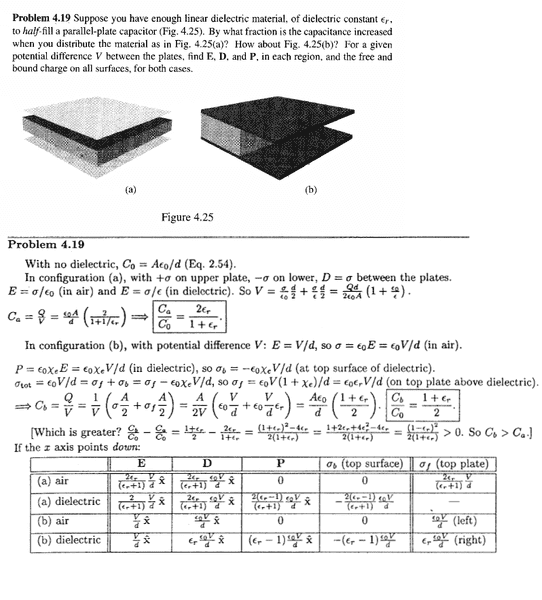
Question taken from Griffiths Pg 185, Problem 4.19:

For part (b):

-Why are the electric fields the same whether in dielectric or in air? In part (a), they are clearly different!

-Why is σ_{tot} = ε_{0}E = ε_{0}\frac{V}{d}

-In calculation of capacitance, why is the total charge (\frac {A}{2})(σ_{tot} + σ<br /> _f)?part (a) makes perfect sense, but in part (b) it is confusing..
4p6hi.png
 
Physics news on Phys.org
bumpp
 
The fields are the same for the same PD if you change the dielectric throughout because Field is PD/spacing (volts per metre).
When you have two different sections, you can treat it as two capacitors in series, each with the same value of Q. The potential across each bit is no longer fixed by the power supply PD but the PD is shared between the two series capacitors according to 1/C. (Remember V=Q/C). Then each field is given by PD/width. (It's just another version of the potential divider thing only with Cs instead of Rs.

If you just apply the right formula at the right time, the right answer pops out.
 
You can use circuit theory for that one.
(a) can be seen as two capacitors in series.
one with a capacity of A * e0 / (0.5 * d) and the other A * er * e0 / (0.5 * d).
And part (b) can be seen as two capacitors in parallel.
One with 0.5 * A * e0 / d and the other 0.5 * A * er * e0 / d.
 

Similar threads

  • · Replies 9 ·
Replies
9
Views
2K
  • · Replies 3 ·
Replies
3
Views
1K
  • · Replies 7 ·
Replies
7
Views
2K
  • · Replies 5 ·
Replies
5
Views
2K
  • · Replies 1 ·
Replies
1
Views
2K
  • · Replies 16 ·
Replies
16
Views
2K
  • · Replies 7 ·
Replies
7
Views
20K
  • · Replies 4 ·
Replies
4
Views
2K
  • · Replies 2 ·
Replies
2
Views
3K
  • · Replies 6 ·
Replies
6
Views
2K