Engineering Differential Mode Gain and 1/2 circuit

Click For Summary
The discussion revolves around a problem involving differential mode gain and the challenges of using a half-circuit model. The original poster struggles to match the solution manual's answer, particularly missing a term in the denominator. Participants suggest avoiding the half-circuit model due to the coupling at the emitters and collectors, recommending the use of standard equations instead. A key point raised is the importance of considering all currents, including those from dependent sources, when calculating voltages. The conversation highlights the complexity of the analysis, emphasizing the need for careful consideration of circuit interactions.
perplexabot
Gold Member
Messages
328
Reaction score
5
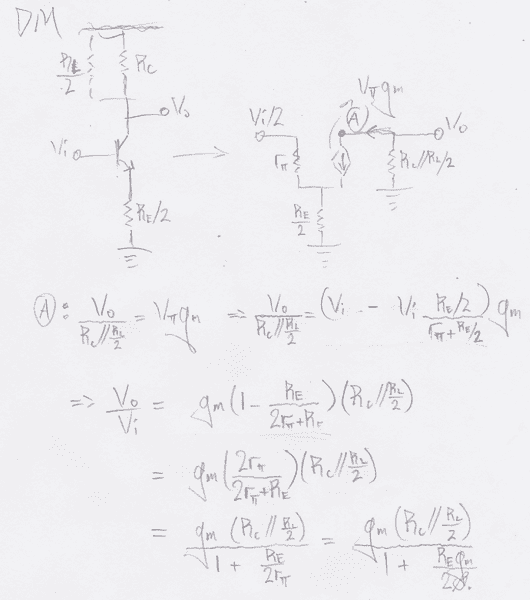
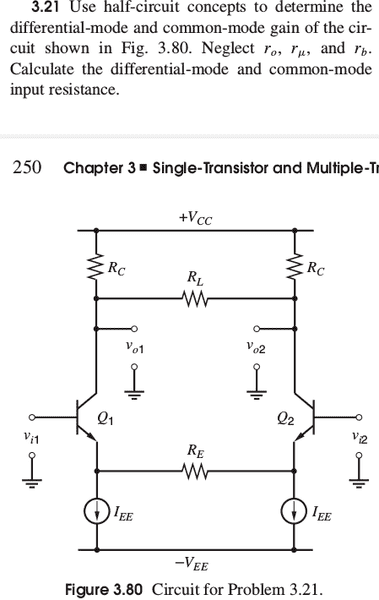
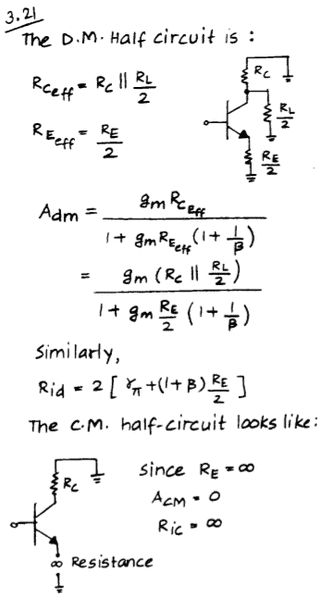
Hey all! I have been trying this problem for a while and can't seem to get the same answer as the solution. If someone can tell me where I am going wrong, that would be much appreciated. I am very close to the solution, but I am missing a term in the denominator. Everything is shown below! Thank you for your time.
Homework Statement


crkt_andQ.png


Homework Equations

(the solution from the solution manual)[/B]
theSol.png


The Attempt at a Solution


myT.png


I am getting stumped. Please help : /
Thanks for reading.
 
Physics news on Phys.org
Since the two halves are coupled both at the emitters and collectors I would not try to use the "1/2 d.m. model" at all. Write the usual equations, I would go with kvl (actually I just sum currents to zero at every dependent junction which is basically the same set of equations.)

If you HAVE to use the d.m model I cannot be of help.
 
  • Like
Likes berkeman and perplexabot
rude man said:
Since the two halves are coupled both at the emitters and collectors I would not try to use the "1/2 d.m. model" at all. Write the usual equations, I would go with kvl (actually I just sum currents to zero at every dependent junction which is basically the same set of equations.)

If you HAVE to use the d.m model I cannot be of help.
Hmmm, ok. I will consider trying without half circuits. I don't have to use the 1/2 crkt model, I just thought it would be easier.

Thank you
 
perplexabot said:
Hmmm, ok. I will consider trying without half circuits. I don't have to use the 1/2 crkt model, I just thought it would be easier.
Thank you
It would have been except for RL and RE.
I will keep the answers to myself until you come up with your answers, then let you know how they look.
 
  • Like
Likes perplexabot
pallidin said:
I agree with Integral. This scheme involves no more than a power distribution network, and a very poor one at that.
To "charge" the Earth with any measurably useful non-local extracting force would require a placement of an earth-charging generation device likely to boggle the imagination, and likely far surpassing any ability we have.
Furthermore, what would be the point?
A considerable amount of energy would be required to charge the earth, for one, and the Earth's exceptionally poor conductivity would create current losses far exceeding the rationality of efficient distribution.
In my opinion, the idea is dead from the start.
Ok, thank you. I'm in the middle of finals week, I will post an answer, just not too soon. I appreciate your help.
 
perplexabot said:
Ok, thank you. I'm in the middle of finals week, I will post an answer, just not too soon. I appreciate your help.
?
Different thread.
 
rude man said:
?
Different thread.
Lol, I wonder where that quote came from?! That is weird, I was trying to quote your previous reply. My reply is still valid, except the quote is wrong. Let me try and remove it. I apologize for that.
 
perplexabot said:
Lol, I wonder where that quote came from?! That is weird, I was trying to quote your previous reply. My reply is still valid, except the quote is wrong. Let me try and remove it. I apologize for that.
No prob.
Actually a pretty involved analysis. 7 equations, 7 unknowns.
For c.m. gain a hint: consider symmetry!
 
  • Like
Likes perplexabot
The main problem I see is that you have calculated the voltage across RE/2 using the voltage divider formula applied to the input voltage Vi. But the current into RE/2 isn't just the current flowing down through rπ; you also have to include the current flowing down from the dependent current source, so you can't just use the voltage divider formula.
 
  • Like
Likes perplexabot

Similar threads

  • · Replies 6 ·
Replies
6
Views
2K
  • · Replies 1 ·
Replies
1
Views
3K
  • · Replies 3 ·
Replies
3
Views
3K
  • · Replies 2 ·
Replies
2
Views
3K
  • · Replies 12 ·
Replies
12
Views
3K
  • · Replies 8 ·
Replies
8
Views
2K
  • · Replies 16 ·
Replies
16
Views
2K
  • · Replies 4 ·
Replies
4
Views
1K
  • · Replies 9 ·
Replies
9
Views
3K
  • · Replies 1 ·
Replies
1
Views
2K