Digital Electronics: BJT Flip Flop Circuit Diagram

Click For Summary

Discussion Overview

The discussion revolves around the implementation of BJT (Bipolar Junction Transistor) flip flop circuits, specifically focusing on various types such as RS (set-reset) flip flops. Participants seek circuit diagrams and explore the relevance of BJT technology in contemporary applications compared to MOS technology.

Discussion Character

  • Technical explanation
  • Debate/contested
  • Exploratory

Main Points Raised

  • One participant requests a circuit diagram for a BJT implementation of a flip flop.
  • Another participant mentions different types of flip flops (RS, D, JK) and questions which specific type is being sought.
  • Concerns are raised about the declining use of BJT technology in favor of MOS technology, suggesting difficulty in finding BJT flip flop circuits online.
  • A participant describes a common bistable flip flop used as a divide-by-2 circuit, noting its component complexity and the need for careful bias resistor adjustments.
  • One participant expresses gratitude for the information provided and requests book recommendations for beginners in digital electronics.
  • A suggestion is made to refer to an online description of RS flip flops, along with a link to a tutorial site that covers digital devices.
  • There is a mention of the interchangeable use of terms "flip-flop" and "bistable flip-flop," with a participant reflecting on the term "monostable flip-flop."

Areas of Agreement / Disagreement

Participants express varying levels of familiarity and preference for different types of flip flops, and there is no consensus on the best resources or the relevance of BJT technology in current applications. The discussion remains unresolved regarding the specific BJT flip flop circuit implementation requested.

Contextual Notes

Some participants note the challenges of finding modern resources on BJT circuits due to the shift towards MOS technology, and there is a suggestion that older books may not be readily available or recommended.

kuchun
Messages
11
Reaction score
1
I want to know the BJT implementation of flip flop with the help of proper circuit diagram..
 
Engineering news on Phys.org
There are RS (set-reset) flip flops, D flip flops, JK flip flops, and maybe a few others that have no useful function or advantage over those already given.

Which one did you have in mind?

As BJT technology has waned over the past couple two or three decades, given over to MOS technology, you may have trouble finding an online BJT equivalent circuit for a flip flop of any sort.
 
If you go to Google and set it to IMAGES, you can get lots of flip flop circuits.

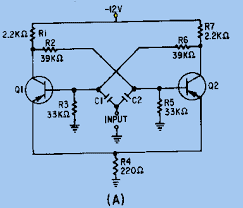
The common one used as a divide-by-2 is the bistable flip flop.
images?q=tbn:ANd9GcTcsLvIo8sICs6dHB-gFBMkXjGhA0_Sf1BeipSmgXv0ogK3GnHWOA.png


As you can see, it uses a lot of components and also requires careful adjustment of the bias resistors. After that, it is quite reliable. I know of one that was made in 1972 and is still operating.

These days you would certainly use an integrated circuit.
 
Phrak said:
There are RS (set-reset) flip flops, D flip flops, JK flip flops, and maybe a few others that have no useful function or advantage over those already given.

Which one did you have in mind?

As BJT technology has waned over the past couple two or three decades, given over to MOS technology, you may have trouble finding an online BJT equivalent circuit for a flip flop of any sort.
I want to know the BJT implementation of RS flip flop...Thanks for ur reply
 
vk6kro said:
If you go to Google and set it to IMAGES, you can get lots of flip flop circuits.

The common one used as a divide-by-2 is the bistable flip flop.

images?q=tbn:ANd9GcTcsLvIo8sICs6dHB-gFBMkXjGhA0_Sf1BeipSmgXv0ogK3GnHWOA.png


As you can see, it uses a lot of components and also requires careful adjustment of the bias resistors. After that, it is quite reliable. I know of one that was made in 1972 and is still operating.

These days you would certainly use an integrated circuit.
Thanx for your reply...it was really helpful for me...Can u suggest me some good books on digital electronics, I am at beginner level..
 
You could read this description of R-S flip flops:
http://www.hobbyprojects.com/flip_flop/a_transistor_RS_flip_Flop.html

It describes this circuit:

trflop.gif


I have several books on digital techniques, but most of them are pretty old and possibly unavailable now. I wouldn't really recommend any of them.

This is a topic where you really need to get into a class and have someone cover it for you in a logical way.

That site above is part of a bigger tutorial on digital devices here:
http://www.hobbyprojects.com/flip_flop.html#flip-flop
It seems quite well done and you might like to start there.
 
vk6kro said:
The common one used as a divide-by-2 is the bistable flip flop.

Good grief. I've so long heard flip-flop and bistable flip-flop used synonymously that I don't recall every hearing the term "monostable flip-flop" used-- I had to look it up to see if it really was the same thing as a one shot.
 

Similar threads

Replies
16
Views
2K
  • · Replies 3 ·
Replies
3
Views
2K
Replies
17
Views
3K
Replies
10
Views
5K
  • · Replies 20 ·
Replies
20
Views
3K
  • · Replies 43 ·
2
Replies
43
Views
9K
  • · Replies 5 ·
Replies
5
Views
5K
Replies
4
Views
3K
  • · Replies 10 ·
Replies
10
Views
5K
Replies
29
Views
2K