Dipole moment from electrostatic potential equation

Click For Summary
SUMMARY

The discussion focuses on deriving the dipole electric moment from the electrostatic potential equation for multipoles. Participants emphasize the importance of understanding "multipole expansion" and its relation to Dirac delta functions. The commonly known dipole moment equation, P = Qr, is identified as a specific case of a broader multipolar moment framework. Users are encouraged to conduct preliminary research on dipole moments and multipole expansions to facilitate deeper understanding.

PREREQUISITES
  • Understanding of multipole expansion in electrostatics
  • Familiarity with Dirac delta functions
  • Basic knowledge of electric dipole moments
  • Concept of electrostatic potential equations
NEXT STEPS
  • Research "multipole expansion" in electrostatics
  • Study the application of Dirac delta functions in physics
  • Explore detailed definitions and derivations of dipole moments
  • Examine advanced electrostatic potential equations
USEFUL FOR

Students and professionals in physics, particularly those studying electromagnetism, as well as researchers looking to deepen their understanding of dipole moments and multipole expansions.

Iriasrol
Messages
3
Reaction score
1
Homework Statement
Define the dipole moment starting from the elctrostatic potential equation for a multipole of order n step by step solution.
Relevant Equations
Potential equation V_n=\frac{P^{(n)}}{4\pi\epsilon_1r^{n+1}}P_n\cos{\theta}.

Final Dipole moment equation: P^{(n)}=\sum_{i=1}^Nq_id_i^n
Hello to everyone. The question or debate here is how you obtain the commonly known equation of dipole electric moment:
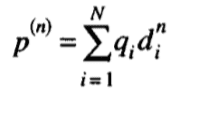
1571077749343.png

from the electrostatic potential equation for a multipole of order n:
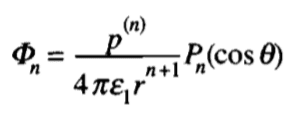
1571077758073.png

I understand it is related with Dirac delta functions but a step by step solution might be helpful.Thank you very much
 
Physics news on Phys.org
Please read our guidelines here. We do not provide step-by-step solutions, but help you reach one after you show some effort at it.
 
sounds awesome but I really do not know were to start :D
 
Iriasrol said:
sounds awesome but I really do not know were to start :D
You start by researching "multipole expansion" on the web. Choose a site that suits your level of understanding. Try to relate what you read to this particular problem. Then if you have a specific question, post it here and, if it is well posed, someone is likely to answer it. Makes sense, no? By the way, what is the definition of ##d_i^n## and what is ##n## for a dipole in the "commonly known" equation?
 
Last edited:
For you to know it is the separation of the point charges constituting the n^th linear multipolar distribution on a multipolar moment of order n as its shown in this picture. And it is generalization for the COMMON dipole moment equation P=Qr. But sure you can start your research by looking for "dipole moment" on the web and choose a site that suits your level of understanding then you will find in a more complex definition the equation I wrote before...

Thanks for the help any way. If I am asking here its because I couldn't find exactly what I am looking for in a common basic electromagnetism book...
1571093683412.png
 

Similar threads

Replies
7
Views
2K
Replies
4
Views
3K
  • · Replies 16 ·
Replies
16
Views
2K
Replies
1
Views
3K
Replies
1
Views
2K
  • · Replies 17 ·
Replies
17
Views
3K
  • · Replies 25 ·
Replies
25
Views
2K
  • · Replies 9 ·
Replies
9
Views
3K
  • · Replies 22 ·
Replies
22
Views
4K
  • · Replies 7 ·
Replies
7
Views
5K