Direction of Torque and Angular Momentum

Click For Summary

Discussion Overview

The discussion centers on the nature of torque and angular momentum as vectors, specifically addressing their perpendicular directions relative to the forces and motions involved in rotating objects. Participants explore theoretical concepts, visualizations, and the implications of these vector properties in mechanics.

Discussion Character

  • Exploratory
  • Technical explanation
  • Conceptual clarification
  • Debate/contested

Main Points Raised

  • Some participants express confusion about why torque and angular momentum are defined as vectors and why they point in directions that seem unrelated to the motion of the objects involved.
  • One participant visualizes the concept using a bowling ball and strings to illustrate the relationship between angular momentum and motion.
  • Another participant suggests that the direction of angular momentum is simply a mathematical tool that indicates a direction perpendicular to the plane of motion.
  • There is a discussion about the right-hand rule and how it is used to determine the direction of torque, with some participants emphasizing that this is a convention rather than a physical propagation of motion.
  • A participant introduces the idea of bivectors as a potentially more intuitive way to understand angular quantities, referencing Kepler's treatment of angular momentum in terms of area.
  • Some participants note the importance of the perpendicular direction as the axis of rotation and relate it to broader conventions in physics regarding area and flux.
  • Concerns are raised about the teaching of torque as a vector, with one participant arguing that it leads to misunderstandings among students who might think torque propagates in the direction of the vector.
  • Another participant clarifies that in two-dimensional systems, torque can be treated as clockwise or anticlockwise moments, but three-dimensional systems require a vector treatment.

Areas of Agreement / Disagreement

Participants express a range of views on the nature of torque and angular momentum, with some agreeing on the conventions used while others contest the clarity and implications of these definitions. The discussion remains unresolved regarding the best way to conceptualize torque and its teaching.

Contextual Notes

Some participants highlight the limitations of current teaching methods and the potential for confusion when torque is treated strictly as a vector. There is also mention of the need for precise language in discussing torque versus force.

quebecois22
Messages
23
Reaction score
0
Hello,
I've been reviewing some of my old mechanics stuff recently and I've finally come across rotating objects, more specifically about torque and angular momentum. I understand that they are both vectors perpendicular to the radius and the force (for torque) and angular velocity (for momentum).
However, I just don't get why they are vectors, specifically why they go in that direction.
This picture here:
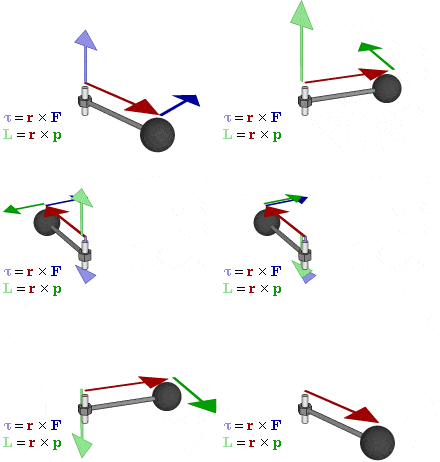
Torque_animation.gif
clearly shows the magnitude and directions of the different things going on as the particle rotates.
But how can the angular momentum of the particle be perpendicular to the movement it's doing? How can the tendency of the force applied to rotate the object be perpendicular to this force?

If someone could clear this up for me, it'd be very appreciated

Thank you,
 
Last edited by a moderator:
Physics news on Phys.org
I visualize it as two strings (or just one, I guess) secured to a ceiling (or flat surface) and to a bowling ball on the other ends of the strings. Spin the bowling ball, and the strings will coil up, lifting the ball higher and higher. Then, when all the angular momentum is lost in the ball, the ball will stop, then start to drop while starting to move faster and faster around its vertical axis. The speed at which it drops (which can be pictured as the magnitude of the angular momentum vector) determines how fast it will be spinning.
 
The direction of the angular momentum simply tells us the direction perpendicular to the plane of motion.
I wouldn't try to imagine it as anything more than that. In classical mechanics, its simply a helpful mathematical tool.
In fact, in classical mechanics, you could simply use a spherical coordinate system to do your calculations, instead of using vector angular momenta. (But the spherical coordinate system is a bit more long-winded).
 
think this way.
when opening bottle you apply a tangential force which produces a upward or downward motion of cap.
 
BruceW has it. The force and the radial distance define a plane and a neat way of describing the orientation of a plane is by giving a unit vector normal to the plane. There are two such vectors, so we use a right hand rule to choose just one. Cleverly, we multiply this unit vector by the scalar Fr sin (theta) and we get a vector which includes both the magnitude of the torque, and its direction - assigned purely by convention, using the right hand rule.

So don't try to imagine the twisting as producing motion in the direction of this vector. [The translational motion of the screw cap on the bottle is just a way or remembering the right hand rule, correlating rotational motion, torque, etc with a direction in space.]

The interesting thing is that, having defined torques and so on as vectors in this seemingly somewhat arbitrary way, torques, angular momenta and so on can be added vectorially. And the vector sum of angular momenta of particles in a closed system is conserved [if the forces between each pair of particles act along the line joining the particles.]
 
The OP asked an insightful question. There have been several excellent answers, especially those by Philip Wood and BruceW.

After using torque and angular momentum in practical calculations, we tend to forget how bizarre it is that the vector points in that particular direction -- a direction which has nothing whatsoever to do with the quantity being measured!

In fact, it's possible to do better. Bivectors are the key: roughly, you can think of these like vectors, except they represent planes, or areas, instead of lines. A concept of "area" is at the very heart of the quantities listed by the OP -- just recall Kepler's original treatment of angular momentum in terms of "the area swept out per unit time"!

Once I learned how to think in terms of bivectors, all these angular quantities became much easier to grasp intuitively. A good reference from the physics side of things is Lasenby and Doran, "Geometric Algebra for Physicists".
 
Thanks for the Lasenby & Doran reference.
 
I also think it is very important to note that the perpendicular direction is the axis about which the object rotates or tends to rotate.
 
There's a general tradition of indicating the orientation of an area by indicating a line that is perpendicular to the area. Electric flux and magnetic flux crossing a surface are defined by using angles relative to a normal line to the surface. Likewise, Snell's Law for the refraction of a ray of light could have been originally defined with angles measured to a tangent line to a surface, and saying "cosine", but instead it was defined with angles measured to the normal line, and saying "sine." I think the vector nature of angular velocity, angular momentum and torque is carried over from that tradition.
 
  • #10
Thank you very much for the answers... it was a question I always wondered because I simply learned how it was perpendicular, without any explanation as to why.
So if I understand correctly, it is simply a convention to show the plane in which the object rotates and a way to show if angular momentum is conserved? In no way is it related to a motion that the rotating object is experiencing?
 
  • #11
quebecois22 said:
Thank you very much for the answers... it was a question I always wondered because I simply learned how it was perpendicular, without any explanation as to why.
So if I understand correctly, it is simply a convention to show the plane in which the object rotates and a way to show if angular momentum is conserved? In no way is it related to a motion that the rotating object is experiencing?

Yep, you got it!

In fact, you can think of it as indicating the (rotational) motion that the object is not experiencing. :)

(Not to say that an object can't experience motion along that direction. For example, it could also be translating along the axis of rotation. But the point is that the direction of the cross product indicates the points not affected by the rotation.)
 
  • #12
This still drives me nuts in my Statics class, I got in a huge argument with my prof when I stated that the direction of torque(as in + or -, k-hat), was by convention and that as long as you kept your work uniform you could work it either way. I still don't understand why in many classes torque is taught as a vector rather than a rotational force about a given axis, I find it causes many misunderstandings with my class mates when they think it actually is propagating in the k-hat direction. I simply do not understand what is so hard about saying that torque is acting along an arc?
 
  • #13
If the system is two-dimensional, with all the forces in the plane of the object they're acting on, then it's fine to work with clockwise and anticlockwise torques (moments) about a chosen point. Only when you're dealing with three dimensional systems, where forces aren't all in the same plane, do you need to treat torques as vectors, defining the direction of a torque as that of rxF, i.e. by a right hand rule.

Incidentally, I'd avoid the term 'rotational force'. Torque is obtained essentially by multiplying a force by a (perpendicular) distance and has the unit Nm. It's a different animal from a force. Call me a pedant if you like, but I've seen many cases where failure to use words precisely leads to confusion.
 
Last edited:

Similar threads

  • · Replies 6 ·
Replies
6
Views
1K
  • · Replies 1 ·
Replies
1
Views
1K
  • · Replies 10 ·
Replies
10
Views
2K
  • · Replies 16 ·
Replies
16
Views
1K
  • · Replies 2 ·
Replies
2
Views
2K
  • · Replies 3 ·
Replies
3
Views
2K
  • · Replies 2 ·
Replies
2
Views
3K
  • · Replies 3 ·
Replies
3
Views
3K
  • · Replies 30 ·
2
Replies
30
Views
4K
Replies
4
Views
2K