Distance between two cities on earth

  • Thread starter Thread starter vizakenjack
  • Start date Start date
  • Tags Tags
    Earth Trigonometry
Click For Summary

Homework Help Overview

The discussion revolves around calculating the distance between two cities, Dubuque, Iowa, and Guatemala City, while considering the Earth's curvature. The problem involves understanding the implications of using different formulas for distance based on spherical geometry.

Discussion Character

  • Conceptual clarification, Assumption checking, Problem interpretation

Approaches and Questions Raised

  • Participants explore the use of two different formulas for calculating distance, questioning their applicability based on the problem's context. There is confusion regarding whether the first formula yields arc length or the straight-line distance between the cities.

Discussion Status

The discussion is ongoing, with participants expressing differing views on which formula is appropriate given the problem's constraints. Some participants suggest that the curvature of the Earth must be considered, while others are examining the implications of their geometric interpretations.

Contextual Notes

Participants note that the problem statement advises not to neglect the Earth's curvature, leading to questions about the intended meaning of the distance to be calculated. There is also mention of potential ambiguity in the problem's wording regarding the nature of the distance required.

vizakenjack
Messages
57
Reaction score
4
User informed about mandatory use of the homework template.
Assume that the Earth is spherical and recall that latitudes range from 0° at the Equator to 90° N at the North Pole. Consider Dubuque, Iowa (42.50° N latitude), and Guatemala City (14.62° N latitude). The two cities lie on approximately the same longitude. Do not neglect the curvature of the Earth in determining the following.
(c)

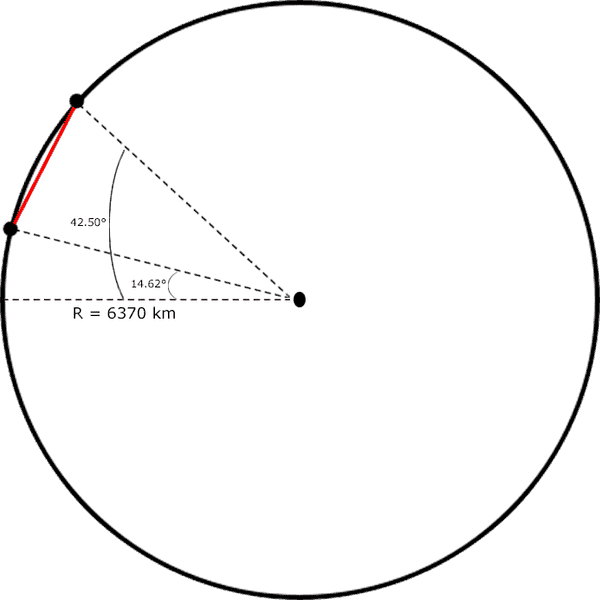
Here's the visual representation of the problem:
kV3W12k.png
For simplicity sake, we take a look at the Earth when the two cities are about to disappear from our field of view, so they kinda lie on the left edge of the earth... (I don't know how to say it better).

Anyhow,
I need to find the length of the red line, right?

I know what the correct formulas are:
R * (ΔΘ * pi/180), in other words radius times the difference between the angles in radians.

2nd formula to finding the answer is:
2 * R * sin(ΔΘ/2)

I kinda get the second formula, but why is the 1st formula correct?
Doesn't it find the arc length? Since ΔΘ is converted to radians?

Or did I draw the positions of the two cities incorrectly? Should the second city, Guatemala, be located exactly below Dubuque? But in that case, they would have different length from the center of the circle. So I really doubt they should be drawn in the same vertical axis.Let's plug in some values into the 2nd formula.
ΔΘ = 42.50°- 14.62° = 27.88° is the angle of a formed isosceles triangle with the red line as the base.
However, we don't need the whole angle of this newly formed triangle because it's easier to divide the triangle into two parts, and then find the missing side (x/2).
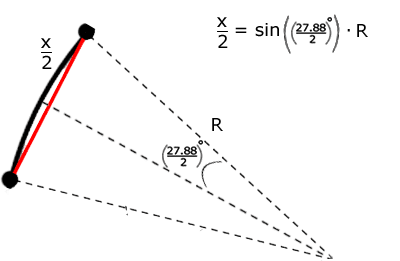
F1CstZG.png
in which case, x = sin(27.88°/2) * R * 2
 
Physics news on Phys.org
The formulas are not equivalent. One of them computes the length of the red line and the other the length along the Earth's surface. Which one to use depends on what is actually being asked for.
 
The fact that the problem statement says not to neglect the curvature of the Earth suggests which formula is the correct one to use. Which one do you think it is?
 
Orodruin said:
The formulas are not equivalent. One of them computes the length of the red line and the other the length along the Earth's surface. Which one to use depends on what is actually being asked for.
So, like I said,
vizakenjack said:
I kinda get the second formula, but why is the 1st formula correct?
Doesn't it find the arc length? Since ΔΘ is converted to radians?
first formula yields the arc length.
vela said:
The fact that the problem statement says not to neglect the curvature of the Earth suggests which formula is the correct one to use. Which one do you think it is?
2nd one.
 
It's very easy... Both cities are approximately on the same meridian, and the difference in latitude is 42.50º - 14.62º = 27.88º.

Now, 360º along the meridian will be 6370 km × 2π = 40024 km.

Calculating the proportion 27.88º/360º, the answer is...
 
Last edited:
NTW said:
It's very easy... Both cities are approximately on the same meridian, and the difference in latitude is 42.50º - 14.62º = 27.88º.

Now, 360º along the meridian will be 6370 km × 2π = 40024 km.

Calculating the proportion 27.88º/360º, the answer is...
So the proportions are: 27.88/360 = x/40024km
x = 3099.64 km
But the answer given by the 2nd formula yields 3069 km. Which formula yields a more precise answer?
 
vizakenjack said:
2nd one.
No. The second one does neglect curvature !
 
SammyS said:
No. The second one does neglect curvature !
Why couldn't anyone just simply say that an arc length is needed to be found.

So I'm guessing, in my triangle drawing, the red line isn't what I needed to find, right?
That means the answer given here was incorrect, no?
 
vizakenjack said:
Why couldn't anyone just simply say that an arc length is needed to be found.

So I'm guessing, in my triangle drawing, the red line isn't what I needed to find, right?
That means the answer given here was incorrect, no?

No, it is not incorrect. Unlike your statement here, it clearly specifies "if one could burrow through the Earth".

I have made no definite statement on which is "correct" simply because I do not think your problem statement actually identifies which distance is intended. "Do not neglect the Earth curvature" could be taken to mean that you might compute the arc length if the straight segment was intended or vice versa.
 

Similar threads

  • · Replies 22 ·
Replies
22
Views
2K
  • · Replies 18 ·
Replies
18
Views
4K
  • · Replies 6 ·
Replies
6
Views
3K
Replies
13
Views
2K
  • · Replies 2 ·
Replies
2
Views
7K
  • · Replies 2 ·
Replies
2
Views
3K
  • · Replies 19 ·
Replies
19
Views
20K
  • · Replies 2 ·
Replies
2
Views
3K
  • · Replies 5 ·
Replies
5
Views
2K
  • · Replies 6 ·
Replies
6
Views
2K