Does Tension Do Work on a Particle Rotating Around a Cylinder?

Click For Summary

Discussion Overview

The discussion revolves around the mechanics of a particle rotating around a vertical cylinder attached to a rope, specifically examining whether tension does work on the particle. Participants explore the implications of tension, gravity, and the trajectory of the particle, engaging in both theoretical and mathematical reasoning.

Discussion Character

  • Exploratory
  • Technical explanation
  • Mathematical reasoning
  • Debate/contested

Main Points Raised

  • Some participants argue that tension acts perpendicular to the displacement of the particle, suggesting that no work is done by the tension.
  • Others propose that as the particle moves closer to the cylinder, the tension direction changes, potentially allowing for work to be done.
  • One participant presents a mathematical formulation involving vectors and angles, questioning the relationship between the particle's velocity and the tension direction.
  • There are requests for assistance in deriving the equation of the particle's trajectory, with suggestions that polar coordinates may be useful.
  • Some participants assert that the trajectory of the particle is an involute of the circle, referencing external resources for further details.
  • Concerns are raised about the conservation of angular momentum, with discussions on how tension and torque affect the system.
  • Participants express uncertainty about the implications of their analyses and seek clarification on mathematical steps.

Areas of Agreement / Disagreement

There is no consensus on whether tension does work on the particle, with multiple competing views presented. Some participants maintain that no work is done due to the perpendicular nature of tension to velocity, while others challenge this notion. The discussion on the trajectory and angular momentum also remains unresolved, with differing interpretations of the mechanics involved.

Contextual Notes

Participants express limitations in their mathematical understanding, particularly regarding vector differentiation and the implications of their analyses. The discussion includes unresolved mathematical steps and varying assumptions about the system's dynamics.

Who May Find This Useful

This discussion may be of interest to those studying mechanics, particularly in the context of rotational motion, tension in ropes, and trajectory analysis in physics.

Titan97
Gold Member
Messages
450
Reaction score
18
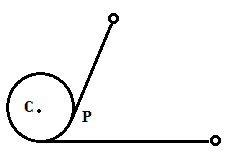
When a particle is attached to a rope and rotated, then tension acts perpendicular to displacement and work done is zero. But I am thinking about this case (top view):
Untitled-1.png

Here, the rope is attached to a vertical cylinder and the particle is given a velocity perpendicular to the rope. The length of rope that's in motion decreases and the particle comes closer and closer to the cylinder. Hence, can I say that the particle moves towards the point P which is along the direction of T. Hence Tension does work. Am I correct?
Another problem is gravity. The particle can go downwards (into the plane of webpage) due to gravity. Let me assume that there is no acceleration due to gravity.
(I have not taken this from any book. I used MS paint to draw this)
 
Physics news on Phys.org
Titan97 said:
When a particle is attached to a rope and rotated, then tension acts perpendicular to displacement and work done is zero. But I am thinking about this case (top view):
View attachment 87968
Here, the rope is attached to a vertical cylinder and the particle is given a velocity perpendicular to the rope. The length of rope that's in motion decreases and the particle comes closer and closer to the cylinder. Hence, can I say that the particle moves towards the point P which is along the direction of T. Hence Tension does work. Am I correct?
Yes.
 
  • Like
Likes   Reactions: Titan97
But here is the problem:
Let theta be the angle between the line joining C and bottomost point of cylinder and the line CP.
Let C be origin. And the particle be N
The vector along CP is ##\vec r_{CP}=R(\sin\theta \hat i - \cos\theta \hat j)##
The vector along T is ##\vec r_{PN}=(l-R\theta)(cos\theta \hat i + \sin\theta \hat j)##
The vector ##r_{CN}=\vec r_{PN}+\vec r_{CP}##
So the position vector of the particle is ##r = r_{CP}+r_{T}##. The tangent vector to the path of the particle is
$$\frac{dr}{d\theta}=(L-R\theta)(-\sin\theta,\cos\theta)$$
which is perpendicular to the direction of tension.
But since I haven't learned vector differentiation yet, I am getting doubts on what I did o0).
Is the particle supposed to have velocity along tangent?
 
Can you help me find the equation of trajectory of the particle? I thought It might be useful to find the equation for further analysis.
I think its easier to find the equation in polar coordinates.
 
There is no work done by the the string tension. Here is a solution, in the attached PDF. As for the equation of the trajectory in the plane, the particle travels on an involute of the circle.
 

Attachments

  • Like
Likes   Reactions: Titan97
What about @Chestermiller 's post?
Also, can you show me how you found dr/dθ?
Can I say that the centripetal force increases as radius decreases and hence tension, which provides centripetal force also increases and velocity of particle increases?
 
Last edited:
Regarding Chester's post, what can I say except that Chester is mistaken in this case?

In my PDF, I showed you the full development of dr/dθ. What else do you need?

As the particle approaches the fixed cylinder, the particle velocity will increase. The acceleration in the direction of the cord is v^2/R where R is progressively getting smaller.

Without any math at all, simply observe:
1) The tension in the cord must act along the cord;
2) As long as the cord remains taut, the only possible motion of the particle is perpendicular to the cord;
Since the force and the motion are at right angles, there is no work done.
 
  • Like
Likes   Reactions: Titan97
Can you help me find the equation of the particles trajectory? I thought it would be useful.
The trajectory is like a spiral. So polar coordinates might be better.
 
OldEngr63 said:
Regarding Chester's post, what can I say except that Chester is mistaken in this case?
Yes. I was too hasty in saying what I said. Your analyses both show that the tension is normal to the velocity, and no work is done by the cord. Sorry for any confusion I may have caused.

Chet
 
  • Like
Likes   Reactions: Titan97
  • #10
Chestermiller said:
Yes. I was too hasty in saying what I said. Your analyses both show that the tension is normal to the velocity, and no work is done by the cord. Sorry for any confusion I may have caused.

Chet
That's OK. But can you help me find the equation of trajectory?
I am stuck here.
WP_20150831_00_22_05_Pro.jpg
 
  • #11
Titan97 said:
Can you help me find the equation of the particles trajectory? I thought it would be useful.
The trajectory is like a spiral. So polar coordinates might be better.
From your original post, the vector velocity is given by:

$$\vec{v}=(L-Rθ)[-sinθ\vec{i}_x+cosθ\vec{i}_y]\frac{dθ}{dt}$$

Since no work is being done, the KE should be constant.
$$KE=\frac{1}{2}(L-Rθ)^2\left(\frac{dθ}{dt}\right)^2$$
So, for constant kinetic energy,
$$(L-Rθ)\frac{dθ}{dt}=v_0$$
where v0 is the initial velocity. So,

$$Lθ-R\frac{θ^2}{2}=v_0t\tag{*}$$

When θ=L/R, the cord is fully wound. This occurs when ##t=L^2/(2Rv_0)##

Chet
 
Last edited:
  • Like
Likes   Reactions: Titan97
  • #12
I found the time it takes to hit the cylinder. I was trying to make the situation interesting. For example, someone could take this situation and ask "find the equation of trajectory". I want to find the equation of trajectory to make things clear. I am stuck in the steps shown in post #10. The trajectory is like a spiral.
 
  • #13
The equation tagged with a * in post #10 can be used to solve for θ at any arbitrary value of t by applying the quadratic formula. Once you know θ vs t, you know the entire trajectory (since you know ##\vec{r}(θ)##).

Chet
 
  • Like
Likes   Reactions: Titan97
  • #14
  • #15
As I mentioned in #5, the trajectory is an involute of the circle. You can look this up on-line for more details about the involute.
 
  • Like
Likes   Reactions: Titan97
  • #16
On a side note, in this case it would appear that angular momentum isn't conserved, until you take into account that the tension on the post creates a torque on the post and whatever the post is attached to, such as the earth, and only by considering the entire system, particle, rope (if it has mass), post, and earth, is angular momentum conserved.
 
  • Like
Likes   Reactions: Titan97
  • #17
rcgldr said:
On a side note, in this case it would appear that angular momentum isn't conserved.
##L=m(v\times r)##
v is constant while r changes and the angle between v and r also changes. So the angular momentum is not conserved right?
 
  • #18
OldEngr63 said:
As I mentioned in #5, the trajectory is an involute of the circle. You can look this up on-line for more details about the involute.
In post 10, I got the equation for x in terms of ##\phi##. But how do I bring it to the form of ##x=r(\sin\theta - \theta\cos\theta)##?
 
  • #19
Titan97 said:
In post 10, I got the equation for x in terms of ##\phi##. But how do I bring it to the form of ##x=r(\sin\theta - \theta\cos\theta)##?
$$r^2=x^2+y^2$$
$$\tanθ=\frac{y}{x}$$
$$x = r\cosθ$$
$$y = r \sin θ$$

Chet
 
  • Like
Likes   Reactions: Titan97

Similar threads

  • · Replies 2 ·
Replies
2
Views
1K
  • · Replies 4 ·
Replies
4
Views
3K
  • · Replies 12 ·
Replies
12
Views
2K
  • · Replies 10 ·
Replies
10
Views
4K
  • · Replies 16 ·
Replies
16
Views
3K
  • · Replies 7 ·
Replies
7
Views
3K
Replies
4
Views
1K
  • · Replies 15 ·
Replies
15
Views
4K
  • · Replies 10 ·
Replies
10
Views
2K
  • · Replies 13 ·
Replies
13
Views
3K