ECG Circuit Analysis: Calculating Contribution of Eint to Vout

Click For Summary

Discussion Overview

The discussion centers on the analysis of an ECG circuit, specifically focusing on calculating the contribution of the internal voltage source Eint to the output voltage Vout. Participants explore methods for isolating Eint's contribution and the implications of circuit loading on voltage calculations.

Discussion Character

  • Technical explanation
  • Mathematical reasoning
  • Homework-related

Main Points Raised

  • One participant proposes a method to calculate the contribution of Eint by removing other voltage sources and using voltage dividers to find Vbody, V1, and V2.
  • Another participant agrees that isolating Eint is valid but points out that the voltage divider for Vbody is not isolated due to loading effects from other dividers, suggesting the use of nodal analysis instead.
  • A participant attempts nodal analysis but finds that it leads to equations that depend on Vbody, complicating the calculation of Vbody in terms of Eint.
  • Another participant emphasizes the need for simultaneous equations for the three nodes and suggests ignoring V1 and V2 initially to focus on calculating Vbody while accounting for loading effects.

Areas of Agreement / Disagreement

Participants express differing views on the validity of using voltage dividers versus nodal analysis, indicating that multiple competing approaches exist without a consensus on the best method for calculating Vbody.

Contextual Notes

Participants note the interdependence of node equations and the importance of considering loading effects, but there are unresolved mathematical steps and assumptions regarding the amplifier's gain and input impedance.

Ariastity
Messages
3
Reaction score
0
What is the contribution of Eint
to the output voltage Vout?
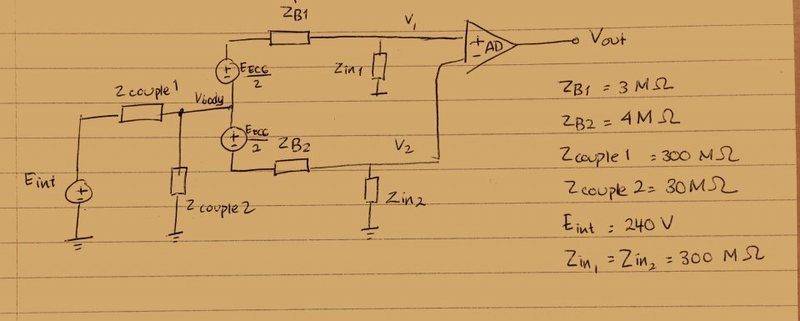
Picture1.jpg

Homework Equations

The Attempt at a Solution


To calculate the contribution of Eint, I removed the other two voltage sources.
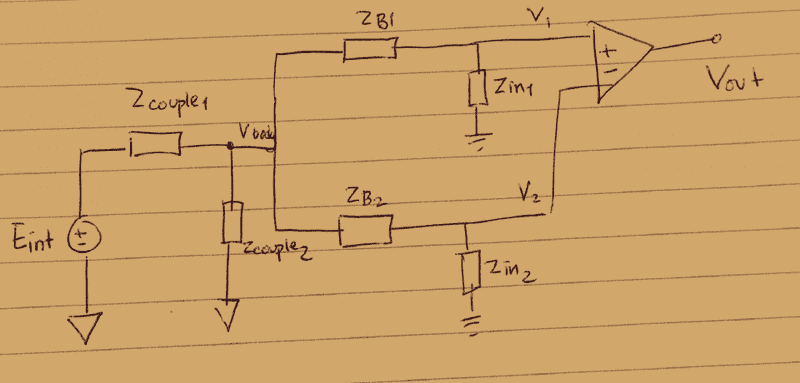
Picture2.png

Then, I divided them into three potential dividers, giving me:
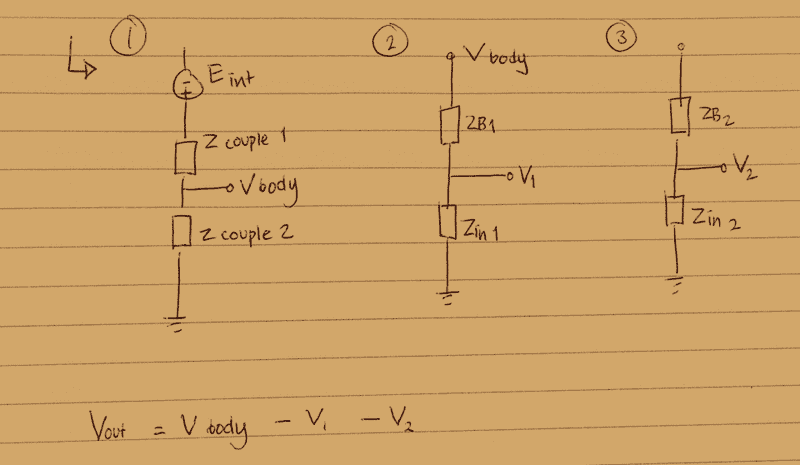
Picture3.png


Vbody= (ZC2/ZC2+ZC1) x Eint;
V1=(Zin1/ZB1+Zin1) x Vbody;
and V2=(Zin2/ZB2+Zin2 )x Vbody

Lastly, Vout= Vbody- V1-V2.

Is this method valid?
 
Physics news on Phys.org
You can isolate the contribution of Eint by suppressing the other sources as you've done. That's fine.

The Vbody voltage divider is not isolated. It's loaded by the two other voltage dividers. So you can't rely on the voltage divider equation to produce the true value for Vbody. That mucks up the calculation of V1 and V2 since they both depend on Vbody.

Use nodal analysis for the three nodes (V1, V2, Vbody) to handle the dependencies.

You haven't yet specified what the gain of the amplifier is, so it's not possible to say what Vout will be given V1 and V2.
 
  • Like
Likes   Reactions: berkeman
Thanks for your reply!

gneill said:
Use nodal analysis for the three nodes (V1, V2, Vbody) to handle the dependencies.

I tried using nodal analysis only to get Vbody without applying voltage divider, and it gives me:
icouple1=(Eint-Vbody)/Zcouple1
and icouple2=Vbody/Zcouple2,
with icouple1=icouple2+ibody.

I don't really know how to go on from there and quantify Vbody in terms of Eint, as further nodes only give me equations that depend on the value of Vbody.
 
If you have three nodes you need to write three node equations. They will be be interdependent (simultaneous equations) that need to be solved together.

In this case, since it is assumed that the amplifier input impedance is being represented by the external impedances Zin, you could ignore V1 and V2 for now and treat the ZB and Zin pairs as branches of the Vbody node. You'd have to go back and solve for V1 and V2 later. But the important thing is that you can't ignore the loading effects of these branches on the Vbody node when you solve for Vbody. The single-node version of the circuit would look like this:

upload_2016-12-10_10-6-30.png


Note how the two ZB branches parallel the ZC2 impedance. You can write a single node equation to solve for Vbody in this case, taking into account all the branches.,
 

Similar threads

  • · Replies 1 ·
Replies
1
Views
2K
  • · Replies 1 ·
Replies
1
Views
2K
  • · Replies 7 ·
Replies
7
Views
4K
Replies
15
Views
3K
  • · Replies 2 ·
Replies
2
Views
2K
  • · Replies 16 ·
Replies
16
Views
4K
  • · Replies 6 ·
Replies
6
Views
10K
  • · Replies 3 ·
Replies
3
Views
3K
  • · Replies 2 ·
Replies
2
Views
2K
  • · Replies 5 ·
Replies
5
Views
2K