SUMMARY
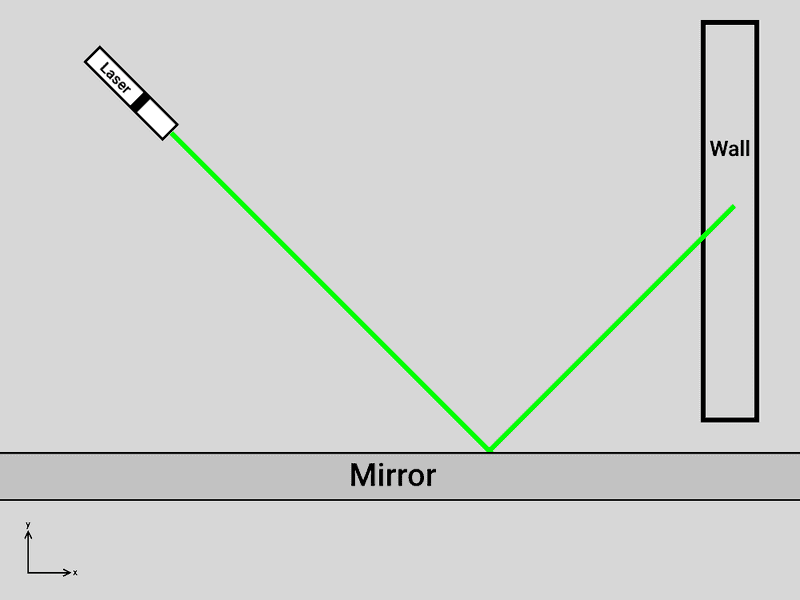
The discussion centers on the effects of a moving mirror on the path of a ray of light, specifically when the mirror moves at subluminal speeds along the x-axis. Participants concluded that the reflected dot from the light beam will not rise over time if the mirror moves at constant subluminal speed. The angle of incidence and reflection remain equal, and the distance between the light source and the wall changes, but the hit point remains consistent across different frames of reference. The consensus is that no observable effect occurs in everyday scenarios involving reflections.
PREREQUISITES
- Understanding of the law of reflection and angles of incidence
- Familiarity with the principles of special relativity
- Knowledge of frame of reference in physics
- Basic trigonometry for analyzing angles and distances
NEXT STEPS
- Research "relativistic effects on light reflection" for deeper insights
- Study "Doppler effect in light" to understand frequency shifts upon reflection
- Examine "frame of reference transformations" in special relativity
- Explore experimental setups for testing light reflection with moving mirrors
USEFUL FOR
Physicists, students of optics, and anyone interested in the implications of special relativity on light behavior and reflection mechanics.