Electric Fan, when Not Spinning, gets Hot?

Click For Summary
SUMMARY

The discussion centers on the overheating issue of an electric fan that fails to spin without manual assistance. The primary cause identified is the lack of starting torque in single-phase asynchronous motors, which is typically generated by two out-of-phase windings. When the motor is stalled, it draws excessive current, leading to overheating of the motor housing. Solutions include oiling the motor bearings and checking for debris around the motor spindle, which can impede rotation and cause overheating.

PREREQUISITES
  • Understanding of single-phase asynchronous motors
  • Knowledge of motor winding configurations and their effects
  • Familiarity with electrical concepts such as current draw and back EMF
  • Basic troubleshooting skills for electric appliances
NEXT STEPS
  • Research the operation of shaded-pole motors and their applications
  • Learn about the effects of bearing friction on motor performance
  • Investigate the role of capacitors in starting torque for electric motors
  • Explore methods for safely disassembling and cleaning electric fan motors
USEFUL FOR

Electricians, appliance repair technicians, and DIY enthusiasts looking to troubleshoot and repair electric fans experiencing overheating and stalling issues.

tade
Messages
720
Reaction score
26
I have an electric fan that looks like this:
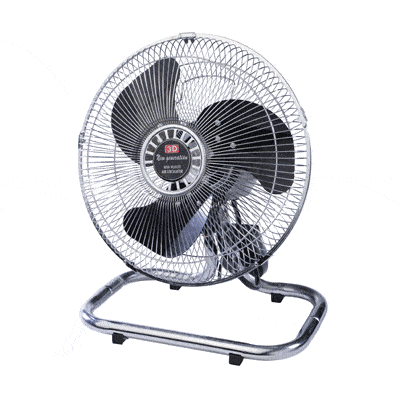
CHV-12.gif


Recently, when I flip the switch, the fan blades won't start spinning without any initial assistance. I have to manually push the blades to get them going. But this is not due to too much friction, the friction is the same.

When I flip the switch, the motor starts humming, and the blades don't turn. I leave it like that and wait. When I return, the blades are still not moving, but the motor housing is freakin' hot.

If the blades were given some assistance and carried on spinning, the housing would not heat up.

Why does it heat up? What's the cause?
 
Engineering news on Phys.org
In order to get a starting torque in single-phase asynchronous motors, you need two out-of-phase windings. As you only have one ac source, the phase shift is created by a number or ways: a capacitor (for example in some washing machine motors), shading coils, etc. Once the motor is started, the motor gets a torque because the "operation torque" of the two windings are not symmetrical and do not cancel each other.
The probleme here is that you have current in the "main" winding, but for some reason not in the other. So the winding heats up and no starting torque is available until you push the blades manually.When the blades are spinning, the air flow cools down the motor.
Check for example https://en.wikipedia.org/wiki/Shaded-pole_motor
 
i had one doing same thing.
A drop of 3-in-One oil on each motor bearing made it good as new.
I think it was the bearing on blade end causing the trouble. It has to support weight of blade.
Let us know.

If you let it overheat it will destroy the windings. When you get that "burnt varnish smell" damage has begun.
 
Much simpler and probably true.
 
Fan heaters sometimes have the same problem . Usually due to a coil of debris winding itself around the motor spindle in the gap between motor and fan . Mostly hair and clothing fibres .
 
tade said:
Why does it heat up? What's the cause?
For whatever reason the motor is stalled, ie. it is not rotating. So it is drawing more current (much more) than when it is rotating. So the resistive loss in the windings is much greater (P = I2R)
Normally a rotating motor creates a back emf opposing the current and keeping it to a safe level.

As for the cause/ cure of the stall: I have experienced the same as Jim and effected the same cure, but there was palpable friction. Worth a try anyhow.
Failing that, Xareu has a likely culprit. Check out the capacitor.

(Edit:typo)
 
@xareu I'm not sure if its due to airflow that cools it, because the wind behind the fan feels much weaker than the wind coming from the front of the fan. (I'm also wondering why that is the case :wideeyed:)
 
Well, as Merlin said, once the motor is running, current and thus losses are much lower, no need for a big airflow. Did you try oiling the bearings?
 

Similar threads

  • · Replies 38 ·
2
Replies
38
Views
3K
  • · Replies 2 ·
Replies
2
Views
1K
  • · Replies 7 ·
Replies
7
Views
3K
Replies
33
Views
5K
Replies
11
Views
4K
Replies
6
Views
5K
  • · Replies 7 ·
Replies
7
Views
2K
  • · Replies 1 ·
Replies
1
Views
2K
Replies
27
Views
6K
  • · Replies 5 ·
Replies
5
Views
4K