zrek
- 115
- 0
The electric field direction can be measured by the force affected on a test charge.
Let's put a point-like charge not far from a material, that is polarized by it.
See the figure:
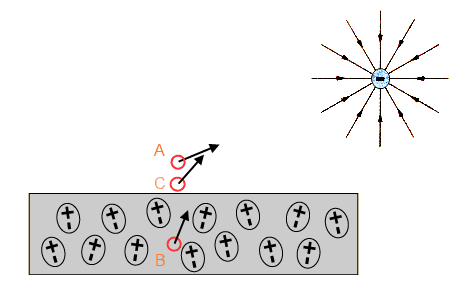
The test force on the test charge A points exactly to the charge.
I think that because the surface is full of polarized particles in one direction, the test charge next to the surface (C) will behave differently, the force on it will points more perpendicular to the surface.
And also the inner test charges (like B) will be under the effect of the neighbour particles, so the direction of the force will point a little towards the surface.
Is this effect possible? Can the permittivity affect to the direction of the force?
Thank you for your toughts.
Let's put a point-like charge not far from a material, that is polarized by it.
See the figure:
The test force on the test charge A points exactly to the charge.
I think that because the surface is full of polarized particles in one direction, the test charge next to the surface (C) will behave differently, the force on it will points more perpendicular to the surface.
And also the inner test charges (like B) will be under the effect of the neighbour particles, so the direction of the force will point a little towards the surface.
Is this effect possible? Can the permittivity affect to the direction of the force?
Thank you for your toughts.