Electric field due to n charges

6 replies · 2K views · last reply
member 731016
Homework Statement
Please see below.
Relevant Equations
Please see below.
For this problem,
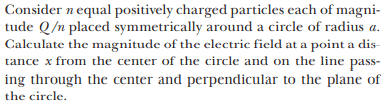
Physics diagram text: Consider n equal positively charged particles each of magnitude Q/n placed symmetrically around a circle of radius a. Calculate the magnitude of the electric field at a point a distance x from the center of the circle and on the line passing through the center and perpendicular to the plane of the circle.

The solution is,
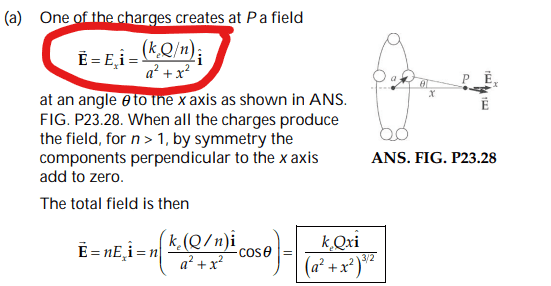
Textbook solution for the electric field at point P from n equal charges on a ring, showing a boxed expression for one charge's field, a ring diagram with angle theta and the ANS. FIG. P23.28 label, and the total field E = nE_x i = k_e Qx i / (a^2 + x^2)^(3/2).

However, should they be a vertical component of the electric field for the expression circled in red? I do understand that assuming that when the nth charge is added it is placed equal distant for the other charges so that a component of the electric field cancels which would be the y-component from how they defined the coordinate system.

I also note how they could have just used the formula for the E-field produced by a discrete number of charges.
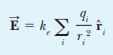
Equation for the electric field from n point charges: E vector equals k_e times the sum over i of q_i divided by r_i squared, times the unit vector r-hat_i.


Many thanks!
 
I assume that by "vertical" you mean a component in the plane parallel to the plane of the circle. Consider a point on the x-axis. If there were such a component of the field at that location, at what "o' clock" position relative to the circle would it point? To make it easy, assume that there are 12 charges on the circle labeled 1 - 12.
 
kuruman said:
I assume that by "vertical" you mean a component in the plane parallel to the plane of the circle. Consider a point on the x-axis.
Thanks for the reply @kuruman , and sorry for the late reply!

Yep, correct was what I meant by "vertical" :)

If there were such a component of the field at that location, at what "o' clock" position relative to the circle would it point? To make it easy, assume that there are 12 charges on the circle labeled 1 - 12.
If there was a positive charge on the x-axis, then I think there would be a electric field surrounding the charge. If there was a spherical Gaussian surface then then there would be a postive electric flux since there would only be electric field lines leaving the charge. But if there were charges on the circle, I think their vertical component will cancel from symmetry. I think the same is true for an even number of charges.

Is there a way to prove that the vertical component of the electric fields cancels from symmetry?

Many thanks!
 
If the unit vector ## \hat{i} ## is supposed to mean the unit vector along the x axis the formula outlined in red is wrong. The field of any individual charge is not along the x axis but at an angle, as shown in the figure. This field does have a component perpendicular to the x axis. Only when you add all contributions the off-axis components cancel out.
 
  • Like
Likes   Reactions: member 731016 and topsquark
nasu said:
If the unit vector ## \hat{i} ## is supposed to mean the unit vector along the x axis the formula outlined in red is wrong. The field of any individual charge is not along the x axis but at an angle, as shown in the figure. This field does have a component perpendicular to the x axis. Only when you add all contributions the off-axis components cancel out.
Thanks for you reply @nasu ! So really that formula shown in red for the individual charge n should be,

Handwritten derivation: E = k_e q / (a^2 + x^2) r-hat; since q = Q/n and r-hat = (x i-hat + a j-hat)/(a^2 + x^2)^(1/2), then E = k_e Q (x i-hat + a j-hat) / (n (a^2 + x^2)^(3/2)).

Correct?

However, how do we prove without using intuition that y-component of the radical fields cancel for n > 1 to give a resultant electric field of
Handwritten equation: E vector = k_e Q x hat divided by (a^2 + x^2) raised to the power 3/2, with the E vector and x hat written with vector arrows.

for n charges?

I think the easiest situation to prove this for is for n = 2.
I'll assume that the two charges are separately symmetrically from each other by a distance 2a.
Hand-drawn red annotations labelled Q1 and Q2 above and below a black circle, with a red dot on the circle at the top and another at the bottom.

Then,
Equations for the net electric field of two charges at x = a and x = -a: E_net = E_Q1 + E_Q2, then E_net = (k_e Q / n)(x-hat + a-hat)/(a^2 + x^2)^(3/2) plus (k_e Q / n)(x-hat - a-hat)/(a^2 + x^2)^(3/2), which simplifies to 2k_e Q x-hat / (n(a^2 + x^2)^(3/2)).

However, this does not give
Equation for the electric field vector E from a ring of charge: E = k_e Q x hat over (a^2 + x^2)^(3/2).
mentioned in the solutions. Do you please know what I did wrong?

Thank you!