Electric field due to two charges

Join the discussion
Registration is free. Ask a follow-up in this thread, or start your own.
16 replies · 3K views · last reply
member 731016
Homework Statement
Please see below
Relevant Equations
Please see below
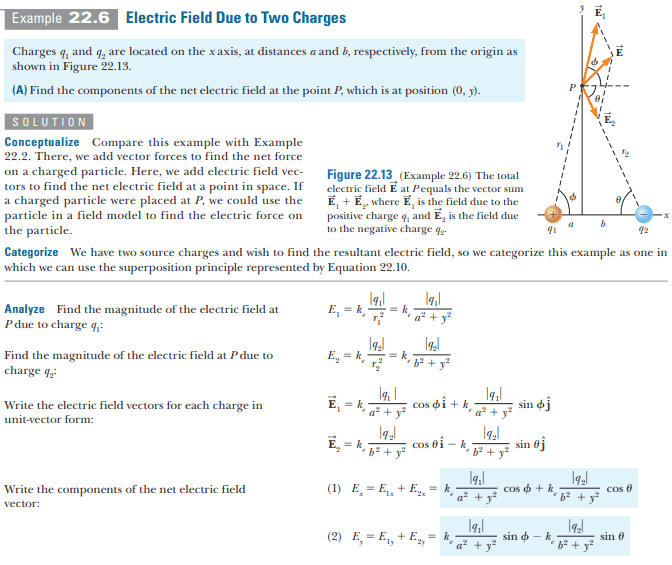
The problem and solution is,
Textbook worked example 22.6 on electric field due to two charges: diagram with charges q1 and q2 on the x axis at distances a and b from the origin, point P at (0, y), with field vectors E1, E2 and resultant E, followed by solution equations for the field magnitudes and vector components.

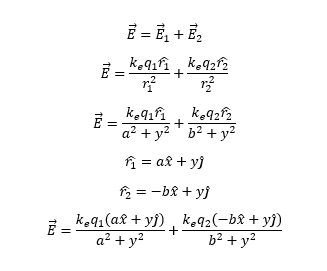
However, I would like to know why it cannot be solved like this:
Stacked equations deriving the electric field from two point charges: E = E1 + E2, then E = (k_e q1 r1-hat)/r1^2 + (k_e q2 r2-hat)/r2^2, then with r1-hat = (a x-hat + y y-hat)/(a^2 + y^2) and r2-hat = (-b x-hat + y y-hat)/(b^2 + y^2) substituted, ending in the combined expression with denominators a^2 + y^2 and b^2 + y^2.

Thanks for any help!
 
Physics news on Phys.org
TSny said:
View attachment 320263
Are these unit vectors?
Thanks for your reply @TSny! Yes the two r hat vectors are unit vectors. I guess then they should both have a magnitude of 1. How would you write the x hat and y hat unit vectors in terms of the r hat vectors?
 
Last edited by a moderator:
Your expression is dimensionally incorrect. The spatial dependence goes as the inverse length not as the inverse length squared. As @TSny noted, you need unit vectors.

If you have a point charge ##q## at position ##\mathbf{r'}##, the electric field vector at a point located at ##\mathbf{r}## is given by $$\mathbf{E}=\frac{k_e~ q(\mathbf{r}-\mathbf{r'})}{|\mathbf{r}-\mathbf{r'}|^3}.$$ To see how it works in this case, consider the negative charge ##q_2##.
Its position is ##~~\mathbf{r'}_2=b~\hat i##
The point of interest is at ##~~\mathbf{r}=y~\hat j##
Then
##\mathbf{r}-\mathbf{r'}_2=-b~\hat i+y~\hat j~;~~## ##|\mathbf{r}-\mathbf{r'}_2|=(b^2+y^2)^{1/2}##
With this mind, the electric field due to ##q_2## is $$\mathbf{E_2}=\frac{k_e ~q_2(-b~\hat i+y~\hat j)}{ \left(b^2+y^2\right)^{3/2}}.$$ Note that this expression is a magnitude $$E_2=\frac{k_e ~q_2}{ b^2+y^2}$$ multiplied by a unit vector $$\mathbf{\hat e}_2=\frac{(-b~\hat i+y~\hat j)}{ \left(b^2+y^2\right)^{1/2}}.$$Your expression was almost there.
 
  • Like
Likes   Reactions: MatinSAR and member 731016
kuruman said:
Your expression is dimensionally incorrect. The spatial dependence goes as the inverse length not as the inverse length squared. As @TSny noted, you need unit vectors.

If you have a point charge ##q## at position ##\mathbf{r'}##, the electric field vector at a point located at ##\mathbf{r}## is given by $$\mathbf{E}=\frac{k_e~ q(\mathbf{r}-\mathbf{r'})}{|\mathbf{r}-\mathbf{r'}|^3}.$$ To see how it works in this case, consider the negative charge ##q_2##.
Its position is ##~~\mathbf{r'}_2=b~\hat i##
The point of interest is at ##~~\mathbf{r}=y~\hat j##
Then
##\mathbf{r}-\mathbf{r'}_2=-b~\hat i+y~\hat j~;~~## ##|\mathbf{r}-\mathbf{r'}_2|=(b^2+y^2)^{1/2}##
With this mind, the electric field due to ##q_2## is $$\mathbf{E_2}=\frac{k_e ~q_2(-b~\hat i+y~\hat j)}{ \left(b^2+y^2\right)^{3/2}}.$$ Note that this expression is a magnitude $$E_2=\frac{k_e ~q_2}{ b^2+y^2}$$ multiplied by a unit vector $$\mathbf{\hat e}_2=\frac{(-b~\hat i+y~\hat j)}{ \left(b^2+y^2\right)^{1/2}}.$$Your expression was almost there.
Thanks for your reply @kuruman ! Sorry where did you get this expression from?
Equation for the electric field E as a vector: E = k_e q(r - r') / |r - r'|^3, where k_e is Coulomb's constant, q is the charge, r is the field point and r' is the source position.


I think I did see it once it Kevin Zhou's handouts but I have not really formally learnt it.

I have only learnt about:
Textbook equation (22.9): electric field E vector = k_e (q / r^2) r-hat at distance r from charge q, with text explaining r-hat points from the charge toward the point and field is radially outward for positive charge, inward for negative.


I see by inspection that r hat vector is equal to r^ = r - r'. However, why is the absolute value of r - r' cubed?

Many thanks!
 
Equation: r-hat 1 = a x-hat + y j-hat, where r-hat 1 is written with a hat symbol and the right-hand side is a x-hat plus y j-hat.

The magnitude of the right-hand side is ## |a \hat x + y \hat j| = \sqrt{a^2+y^2}##. This is not equal to 1, so ##a \hat x + y \hat j## is not a unit vector.

But we can get a unit vector representing ##\hat r_1## by dividing ##a \hat x + y \hat j## by ##\sqrt{a^2+y^2}##. Thus, $$\hat r_1 = \frac{a \hat x + y \hat j}{\sqrt{a^2+y^2}}$$ Now, consider the x-component of ##\hat r_1##: $$\frac{a }{\sqrt{a^2+y^2}}$$ How is this related to the angle ##\phi##?
 
  • Like
Likes   Reactions: MatinSAR and member 731016
kuruman said:
The spatial dependence goes as the inverse length not as the inverse length squared.
Did you mean that the other way around?
It seems @Callumnc1 intended ##\hat r_1## etc. as unit vectors, but failed to normalise to ensure that they are.
 
  • Like
Likes   Reactions: MatinSAR and member 731016
haruspex said:
Did you mean that the other way around?
I meant that the spatial dependence of @Callumnc1's goes as the inverse length when it ought to go as the inverse length squared. Yes, the expression has the right direction but was not properly normalized. That is why I said that his expression was "almost there."
 
  • Like
Likes   Reactions: MatinSAR and member 731016
Callumnc1 said:
Thanks for your reply @kuruman ! Sorry where did you get this expression from?
Equation for electric field: E = k_e q (r - r') / |r - r'|^3, with E in bold as a vector, k_e and q in the numerator and the magnitude cubed in the denominator.
It's the most general expression for the electric field at an arbitrary point due to a point charge placed at another arbitrary point. It can be found in any intermediate-level E&M textbook and on the web.
Callumnc1 said:
think I did see it once it Kevin Zhou's handouts but I have not really formally learnt it.

I have only learnt about:
Textbook equation (22.9): electric field E = k_e (q / r^2) r-hat at distance r from a point charge q, where r-hat is a unit vector from the charge toward the point.
Perhaps now is the time to learn it. The one you know, equation (22.9), is not general enough because it assumes that the point charge is located at the origin. How would you express the electric field vector if the origin has already been chosen for you and the charge is not at it?

Callumnc1 said:
I see by inspection that r hat vector is equal to r^ = r - r'.
That equation has problems
1. It is not a vector equation
2. The right hand side is not a unit vector.

Question: How would you write a unit vector in the direction of an arbitrary vector?
Answer: You divide the vector by its magnitude. See posts #4 and #6.
 
  • Like
Likes   Reactions: MatinSAR and member 731016
TSny said:
The magnitude of the right-hand side is ## |a \hat x + y \hat j| = \sqrt{a^2+y^2}##. This is not equal to 1, so ##a \hat x + y \hat j## is not a unit vector.

But we can get a unit vector representing ##\hat r_1## by dividing ##a \hat x + y \hat j## by ##\sqrt{a^2+y^2}##. Thus, $$\hat r_1 = \frac{a \hat x + y \hat j}{\sqrt{a^2+y^2}}$$ Now, consider the x-component of ##\hat r_1##: $$\frac{a }{\sqrt{a^2+y^2}}$$ How is this related to the angle ##\phi##?
Thanks for your replies @TSny, I think
Equation: Phi = arctan(y/a), written as Φ = tan⁻¹(y/a).
. But since you said that the x-component of the
1673584393103.png
was
Fraction with numerator a and denominator the square root of a squared plus y squared, a typical factor in an electric field x-component calculation.
then a =
Fraction with numerator a and denominator the square root of a squared plus y squared, a typical factor in an electric field x-component calculation.
so
Equation: Φ = tan^-1( y(a^2 + y^2)^(1/2) / a ), an inverse tangent expression in y and a.

But to be honest, it dose seem a bit strange that a =
Fraction with numerator a and denominator the square root of a squared plus y squared, a typical factor in an electric field x-component calculation.
, did I do something wrong?

Many thanks!
 
haruspex said:
Did you mean that the other way around?
It seems @Callumnc1 intended ##\hat r_1## etc. as unit vectors, but failed to normalise to ensure that they are.
Thank you @haruspex!
 
You are complicating things unnecessarily. Look at the ratio ##\dfrac{a }{\sqrt{a^2+y^2}}##. Now look at the drawing. The denominator is the hypotenuse of the right triangle on the left with ##q _1## at its corner. Right side ##a## is adjacent to given angle ##\phi##. So the ratio is $$\rm{Ratio}=\frac{\rm{Adjacent}}{\rm{Hypotenuse}}.$$ Does this ring a bell?
 
  • Like
Likes   Reactions: MatinSAR and member 731016
kuruman said:
It's the most general expression for the electric field at an arbitrary point due to a point charge placed at another arbitrary point. It can be found in any intermediate-level E&M textbook and on the web.

Perhaps now is the time to learn it. The one you know, equation (22.9), is not general enough because it assumes that the point charge is located at the origin. How would you express the electric field vector if the origin has already been chosen for you and the charge is not at it?That equation has problems
1. It is not a vector equation
2. The right hand side is not a unit vector.

Question: How would you write a unit vector in the direction of an arbitrary vector?
Answer: You divide the vector by its magnitude. See posts #4 and #6.
Thank you for your help @kuruman ! That is a useful expression you mentioned! So I see that the equation 22.9 that I mentioned is a special case of your equation when the r' = 0 when the charge is at the origin. Then the equation simplifies to
Equation: E = k_e q r / r^3 = k_e q / r^2, where k_e, q and r are written as plain symbols with r in the numerator of the first fraction.
, however, where do they get the unit vector from that is shown in equation 22.9?

Also how is my equation not a vector equation since r hat is a unit vector and both r and r' are position vectors?
Handwritten expression r-hat equals (r minus r-prime) with a hat over the r, showing a vector difference between two position vectors.


Many thanks!
 
Callumnc1 said:
I think ##\phi = \tan^{-1} \frac y a##.
Yes, this is correct. Can you express ##\frac a {\sqrt{a^2 + y^2}}## as some trig function of ##\phi##?
Callumnc1 said:
But to be honest, it dose seem a bit strange that ## a = \frac a {\sqrt{a^2+y^2}}## , did I do something wrong?
Right, this equation is not correct. I don’t see how you arrived at it. Remember, your original equation ##\hat r_1 =a \hat i+ y \hat j## for the unit vector ##\hat r_1## is not correct. So the x-component of ##\hat r_1## is not equal to ##a##.
 
  • Like
Likes   Reactions: MatinSAR and member 731016
kuruman said:
I meant that the spatial dependence of @Callumnc1's goes as the inverse length when it ought to go as the inverse length squared. Yes, the expression has the right direction but was not properly normalized. That is why I said that his expression was "almost there."
Ah, ok - it was just ambiguous as to which was which in post #4.
 
  • Like
Likes   Reactions: MatinSAR and member 731016
TSny said:
Yes, this is correct. Can you express ##\frac a {\sqrt{a^2 + y^2}}## as some trig function of ##\phi##?

Right, this equation is not correct. I don’t see how you arrived at it. Remember, your original equation ##\hat r_1 =a \hat i+ y \hat j## for the unit vector ##\hat r_1## is not correct. So the x-component of ##\hat r_1## is not equal to ##a##.
Thank you @TSny and @kuruman for your replies! So I assume that the only way to find the x-component of the unit vector is to set y = 0 (let me know if you guys know any other ways), therefore the x-component is of the r hat unit vector is
Fraction x divided by the square root of (x squared plus y squared), written as a handwritten expression for the x-component of a unit vector.
. I now think that the trig function can be expressed as cos (phi) =
Fraction with numerator a and denominator the square root of (a squared plus y squared), written in handwriting-style mathematics.
.

Many thanks!
 
kuruman said:
You are complicating things unnecessarily. Look at the ratio ##\dfrac{a }{\sqrt{a^2+y^2}}##. Now look at the drawing. The denominator is the hypotenuse of the right triangle on the left with ##q _1## at its corner. Right side ##a## is adjacent to given angle ##\phi##. So the ratio is $$\rm{Ratio}=\frac{\rm{Adjacent}}{\rm{Hypotenuse}}.$$ Does this ring a bell?
Yes sorry @kuruman , I understand now. :)