[Electrical force] Electrical charge in equilateral triangle

Join the discussion
Registration is free. Ask a follow-up in this thread, or start your own.
12 replies · 2K views
sea333
Messages
50
Reaction score
2
Homework Statement
In each corner of equilateral triangle there is a charge with 5 nAs. What force works on the e3 charge (see image). Length of a side is 5 cm. e1 is charged with negative charge.
Relevant Equations
F = (1/(4*Pi*eps0))*(e*e)/r^2
20210726_120444.jpg
Capture3.PNG
 
Physics news on Phys.org
F23 is a force on the 3rd charge from 2nd charge
F13 is a force on the 3rd charge from the 1st charge
Fr is a sum of both (Pythagorean theorem).
 
sea333 said:
F23 is a force on the 3rd charge from 2nd charge
F13 is a force on the 3rd charge from the 1st charge
Fr is a sum of both (Pythagorean theorem).
Doesn't Pythagoras only apply to right-angled triangles?
 
  • Like
Likes   Reactions: sea333
PeroK said:
Doesn't Pythagoras only apply to right-angled triangles?
I will check if forces are right-angled
 
PeroK said:
There is a generalisation called the "rule of cosines", which is very useful.
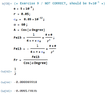
I have used Cosines to calculate Fr and I still don't get the correct result:
Capture4.PNG

20210726_193620.jpg
 

Attachments

  • Capture4.PNG
    Capture4.PNG
    6.9 KB · Views: 163
Should I use the Law of cosines ? c^{2}=a^{2}+b^{2}-2ab*cos
Then I would need angle gamma?
I have updated the picture
20210726_195429.jpg
 
I have used for gamma = 60 and got correct result but how do you know that gamma = 60 ?
I don't know why I thought that any of the angles is 90 degrees.
The correct result:
Capture4.PNG
 
If you want to use Pythagorean theorem or Cos/Sin function you need one angle to be 90 degrees.