Energy flow into and around a slowly charging capacitor

Click For Summary

Discussion Overview

The discussion revolves around the energy flow in and around a slowly charging capacitor, exploring the nature of electric and magnetic fields, energy transfer from a battery, and the implications of circuit resistance. Participants examine theoretical models, practical implications, and visual representations of energy flow in this context.

Discussion Character

  • Exploratory
  • Technical explanation
  • Debate/contested
  • Mathematical reasoning

Main Points Raised

  • One participant describes the energy flow vector field around a charging capacitor, suggesting it originates from the battery and questioning how to visualize this flow.
  • Another participant prefers analyzing the circuit as a transmission line problem, noting oscillations when the battery is connected and eventual settling to zero current.
  • Concerns are raised about energy losses in the circuit, with one participant stating that at least half the energy drawn from the battery may not be stored in the capacitor due to resistance and radiation losses.
  • A participant introduces the idea of considering the circuit as a fully 3D object, discussing the implications of fringing fields and quasi-static approximations on energy flow.
  • There is a suggestion to visualize energy flow patterns from a source to a capacitor, with a specific example involving charged and uncharged capacitors connected by resistors.
  • Discussion includes the distinction between electron drift and accelerating electrons, with implications for energy loss in the system.

Areas of Agreement / Disagreement

Participants express various viewpoints on energy flow, losses, and modeling approaches, indicating that multiple competing views remain and the discussion is unresolved.

Contextual Notes

Participants note limitations related to parasitic losses in circuits, the dependence on circuit resistance, and the implications of quasi-static approximations on energy flow analysis.

Spinnor
Gold Member
Messages
2,231
Reaction score
419
Picture a charging capactor, you know the E field, and the induced B field, the energy flow is just EXB.
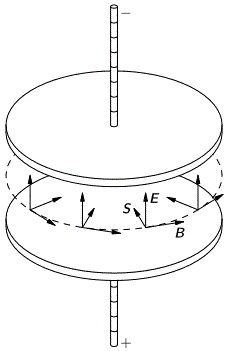
capacitor.gif


Please describe for me in rough terms the energy flow vector field near and far from the slowly charging capacitor? The flow of energy must ultimately come from the source of energy that charges the capacitor, say a battery? Has anyone ever seen an image of such a flow of energy for this system? Can you roughly sketch what it should look like? Do you simply draw lines of S from the battery to the entrance of the gap of the capacitor? Let the only resistance of the circuit be the internal resistance of the battery. Feynman goes into this here,

http://www.feynmanlectures.caltech.edu/II_27.html

Thanks!

Edit, where in space and time can one safely say that the field S should be zero?
 
Last edited:
Physics news on Phys.org
There was a recent response in the Forum showing a Poynting Vector spreading out from the battery and converging on the capacitor.
As an engineer, however, I prefer to see circuits such as this analysed as transmission line problems. When treated in this way, there is oscillation when the battery is connected, and then conditions gradually settle down to zero current at full battery voltage. The oscillations are absorbed by the battery resistance.
 
The moment you throw the switch, the capacitor looks like a short circuit to the battery, so a slowly charging capacitor would infer a high resistance, or high inductance in series with the cap.

If there is no significant inductance in the circuit then some of the energy will be dissipated in I2R loss. If the resistance is small then some of the energy will be electromagnetically radiated into space. Either way at least half the energy drawn from the battery will not get stored in the capacitor.
 
  • Like
Likes   Reactions: Spinnor
I have not thought deeply about this, but feel that the answer may lie in thinking of the circuit as a fully 3D object.

Between the capacitor plates, sure that's where E and B are pointing, but outside the plates you have a fringing field and E has a radial component, which must mean S must have an axial component (the axis of the cylindrical capacitor plates in the diagram). That's a good starting point to retracing the origin of the vector.

There is another subtlety here. You said "slowly" charge the capacitor. This implies a quasi-static approximation where higher order field effects (e.g. secondary E and B fields). In this approximation I don't expect any far field energy flow, since far field energy flow would be radiative (which requires the secondary and higher field effects). Maybe I misunderstood this part...
 
David Lewis said:
Either way at least half the energy drawn from the battery will not get stored in the capacitor.

Is that easy to show? I guess a solid state device could control the current to minimize energy lost to space though you say it is going to be at least half.

Still would be interesting to see the energy flow pattern from the energy source to the capacitor. Probably just need a simple specific example.

Thanks!
 
It's not easy to show. The sources of parasitic losses in a pure capacitance circuit are not obvious and, due to energy conservation laws, unavoidable.
 
So there will be loses. I am still interested in the flow from the source to the sink. Consider the following specific example,

upload_2016-8-6_13-51-29.png


We initially have a charged and a uncharged capacitor with wires that nearly touch. Then we span the two gaps with two resistors R. Energy will flow from one capacitor to the other and energy will also flow to infinity. If we were to carefully account for the electric and magnetic fields should we be able to plot power flow to and from the capacitors and also the power flow towards infinity?

Thanks!
 

Attachments

  • upload_2016-8-6_13-50-15.png
    upload_2016-8-6_13-50-15.png
    8.8 KB · Views: 499
Electron drift moving at constant speed is impeded by loss resistance.
Whereas accelerating electrons that generate an EM wave are impeded
by both loss resistance and radiation resistance.

We had a discussion concerning energy lost when one capacitor charges another in the thread Potential Difference. across capacitors in the General Physics forum, which I think you will find helpful.
 
Last edited:

Similar threads

  • · Replies 7 ·
Replies
7
Views
2K
  • · Replies 1 ·
Replies
1
Views
2K
  • · Replies 4 ·
Replies
4
Views
2K
  • · Replies 16 ·
Replies
16
Views
5K
  • · Replies 4 ·
Replies
4
Views
3K
  • · Replies 3 ·
Replies
3
Views
3K
  • · Replies 103 ·
4
Replies
103
Views
9K
  • · Replies 10 ·
Replies
10
Views
3K
  • · Replies 7 ·
Replies
7
Views
2K
  • · Replies 4 ·
Replies
4
Views
2K