Engineering mechanics problem about shear and moment in beams

Click For Summary
SUMMARY

The discussion focuses on solving shear and moment problems in beams, specifically at midspan and various distances from ROLLER "A". The reactions at points A and B are determined to be 13 kN and 15.5 kN, respectively. For shear calculations, participants are advised to express the shear force starting from point A and account for the distributed load. The moment is calculated using a similar approach, emphasizing the importance of understanding the relationship between shear forces and moments in structural analysis.

PREREQUISITES
  • Understanding of shear and moment diagrams in structural engineering
  • Familiarity with static equilibrium and reaction forces
  • Knowledge of distributed loads and their effects on beams
  • Proficiency in using engineering mechanics principles for beam analysis
NEXT STEPS
  • Learn how to construct shear and moment diagrams for various loading conditions
  • Study the effects of different types of supports on beam reactions
  • Explore advanced topics in beam deflection and bending stress analysis
  • Investigate software tools for structural analysis, such as SAP2000 or ANSYS
USEFUL FOR

Structural engineers, civil engineering students, and professionals involved in beam analysis and design will benefit from this discussion.

vulivu001
Messages
3
Reaction score
0
fresh out of ideas. Need help.
1) Solve for shear and moment at the given distances
a) at midspan
b) 5m from ROLLER "A"
1.png

SO FAR I GOT THE REACTIONS AT POINT A AND B. 13KN AND 15.5KN RESPECTIVELY
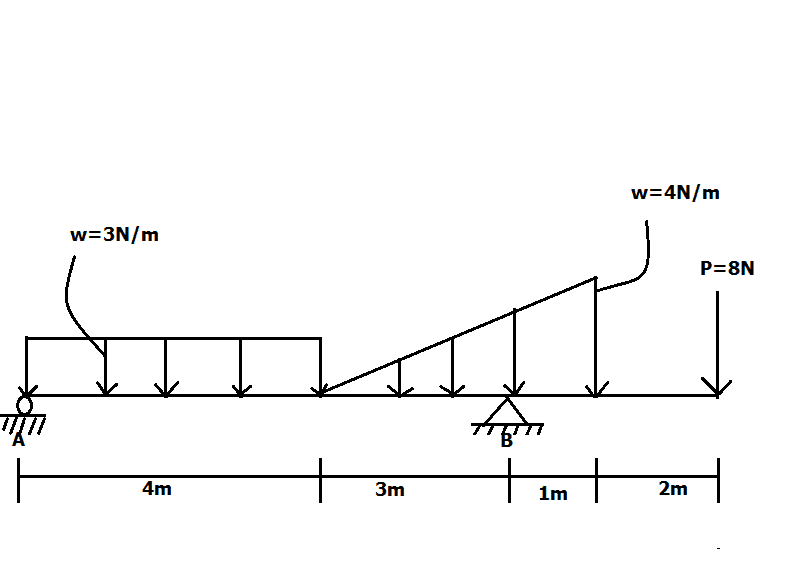
2) Solve for shear and moment at the given distances
a) 5m from ROLLER "A"
b) 9m from ROLLER "A"
SO FAR I GOT THE REACTIONS AT POINT A AND B. 5.525N AND 22.475N RESPECTIVELY
2.png

 
Physics news on Phys.org
Hint on probem A for shear: Write an expression for the shear force starting from point A and moving to the right. You have the reaction at A as 13KN. So at point A the shear force is the upward reaction force, 13N. Beginning at point A you have a varying downward load. It would be the product of the distributed load function and the distance from point A that is of interest. Combine for shear at any point of interest.

The moment is handled in analogous fashion.
 
Last edited:

Similar threads

  • · Replies 2 ·
Replies
2
Views
3K
  • · Replies 1 ·
Replies
1
Views
2K
  • · Replies 2 ·
Replies
2
Views
2K
  • · Replies 4 ·
Replies
4
Views
2K
Replies
4
Views
4K
  • · Replies 1 ·
Replies
1
Views
3K
  • · Replies 3 ·
Replies
3
Views
2K
  • · Replies 8 ·
Replies
8
Views
3K
Replies
5
Views
4K
  • · Replies 1 ·
Replies
1
Views
2K