Why Doesn't Centrifugal Force Act in the Direction of Velocity?

Click For Summary
Centrifugal force is not a real force but a mathematical concept used in rotating systems. It is often confused with centripetal force, which is the actual force acting towards the center of rotation, causing objects to move in a circular path. According to Newton's first law, objects in motion will continue in a straight line unless acted upon by an external force, which explains why centrifugal force does not act in the direction of velocity. The discussion critiques the term "reactive centrifugal force," arguing it lacks relevance in modern physics and is not widely recognized in peer-reviewed literature. Understanding circular motion requires recognizing that the only force acting on an object in uniform circular motion is the centripetal force, which is always perpendicular to the object's velocity.
adjacent
Gold Member
Messages
1,552
Reaction score
62
We all know that the Centrifugal force is not a real force.However,we can use it mathematically.
This Wikipedia Article on Centrifugal force
States that:
The concept of centrifugal force is applied in rotating devices such as centrifuges, centrifugal pumps, centrifugal governors, centrifugal clutches, etc., as well as in centrifugal railways, planetary orbits, banked curves, etc. These devices and situations can be analyzed either in terms of the fictitious force in the rotating coordinate system of the motion relative to a center, or in terms of the centripetal and reactive centrifugal forces seen from a non-rotating frame of reference; these different forces are equal in magnitude, but centrifugal and reactive centrifugal forces are opposite in direction to the centripetal force.
But,
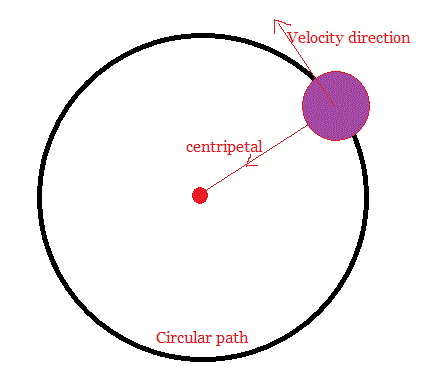
attachment.php?attachmentid=65065&stc=1&d=1387910569.gif

According to Newton's first law,objects tend to move in a straight line or stay at rest at a constant velocity unless no external force is acted.
The Centrifugal force should act on the velocity direction.If so,Why does the wikipedia article says this.
Moreover,There have been many ideas of artificial Gravity using centrifugal force.(So,in favor of wikipedia article)

Whatever the Wikipedia,My question is why does not the force act at velocity direction?
 

Attachments

  • Untitled.gif
    Untitled.gif
    6 KB · Views: 4,856
Physics news on Phys.org
The centrifugal force is actually Newton's first law, centripetal and centrifugal force's act opposite to each other because the ball is trying to go straight, not go around in a circle. In the reference frame of the circle, that straight line is like a force. The forces balance and result in a velocity perpendicular to them.

And remember, the tangential velocity is not increasing, so there's no reason there should be acceleration (i.e. force) in the direction of the ball's motion.
 
  • Like
Likes 1 person
To avoid confusion, I suggest you forget about "centrifugal force" (because, as you said, it is not a real force) until you thoroughly understand how circular motion at constant speed (or constant angular velocity, which is the same thing) is caused by a real (centripetal) force and Newton's laws of motion.

Remember that Newton's laws of motion are only valid in an inertial reference frame, or coordinate system - i.e. one that is not rotating. "Centrifugal force" (and also the Coriolis force) are just extra terms added to Newton's "F = ma" equation, to make the math work in a coordinate system rotating at constant angular velocity. They are not physical forces.

And as for "reactive centrifugal force" mentioned in your quote from Wiki, I have said before on PF that IMO anybody using that term as if it meant something should be put before a firing squad. I have never seen it in any peer reviewed literature, the Wiki reference to it in a book published in the 19th century is irrelevant in the 21st century, and every website I have seen that uses it appears to be quoting the wiki page, with or without acknowledgment.

The force you feel that causes "artificial gravity" in a rotating spacecraft is just the real centripetal force that is accelerating you towards the center of rotation. The only difference between this and a mass on a string, is that the string is pulling on the mass from "inside" its circular orbit, but the space station is pushing on your feet from "outside". Both forces act in the same direction - towards the center of rotation.

If a real force acts along the tangent to the circle, it changes the speed of the object. The only possible direction a force can act which does not change the speed is perpendicular to the velocity vector, and the centripetal force (towards the center of the circle) is perpendicular to the velocity.
 
Last edited:
  • Like
Likes 1 person
adjacent said:
According to Newton's first law,objects tend to move in a straight line or stay at rest at a constant velocity unless no external force is acted. The Centrifugal force should act on the velocity direction. If so, why does the wikipedia article says this.
Netwon third law pair of forces do not act on the same object, these are the forces that two objects exert on each other. The inertial frame "reactive centrifugal force" is the force the object exerts on the end of the string in reaction to centripetal acceleration coexisting with the string exerting a centripetal force on the object. The object only experiences a centripetal force, so it's speed remains constant, and only it's direction changes. The string experiences two forces, the "reactive centrifugal force" exerted by the object at the end of the string, and an inwards force holding the string in place at the center, so the string is under tension. If the string was massless, then the tension would be the same at all points within the string.
 
  • Like
Likes 1 person
1-What force makes the ball go perpendicular to the direction of centripetal force?

First a force should make the ball move in that direction.Only then centripetal force only can change it's direction.
Am I wrong?
 
adjacent said:
1-What force makes the ball go perpendicular to the direction of centripetal force?

First a force should make the ball move in that direction.Only then centripetal force only can change it's direction.
Am I wrong?
No, you're not wrong. But it's irrelevant here. It is asumed the ball already has got some velocity. Whatever force made the ball move at some time in the past, is now gone.
Since it already does, the ball will keep moving with constant speed and direction unless some force acts on it. And unless there's some component of the force that is NOT exactly perpendicular to the direction it moves, it will not change its magnitude.
 
  • Like
Likes 1 person
I see.All my questions are now answered.Thank you all

400th yay
 
Last edited:
AlephZero said:
And as for "reactive centrifugal force" mentioned in your quote from Wiki, I have said before on PF that IMO anybody using that term as if it meant something should be put before a firing squad. I have never seen it in any peer reviewed literature, the Wiki reference to it in a book published in the 19th century is irrelevant in the 21st century, and every website I have seen that uses it appears to be quoting the wiki page, with or without acknowledgment.

Well said. I agree completely.

AM
 
AlephZero said:
And as for "reactive centrifugal force" mentioned in your quote from Wiki, I have said before on PF that IMO anybody using that term as if it meant something should be put before a firing squad. I have never seen it in any peer reviewed literature, the Wiki reference to it in a book published in the 19th century is irrelevant in the 21st century, and every website I have seen that uses it appears to be quoting the wiki page, with or without acknowledgment.
https://www.google.com/search?q="centrifugal+reaction"&btnG=Nach+Büchern+suchen&tbm=bks&tbo=1
 
  • #10
A.T. said:
The objection is not to the contention that a centripetal force has a "reaction" force as required by Newton's third law. The problem is really with the confusion and misinformation surrounding this term as illustrated by many of the "authorities" that your google link points to. That is probably why reputable physics texts avoid the term.

The links provided illustrate the point that AlephZero made. Which ones qualify as peer reviewed literature?

The first link is to what appears to be a high school textbook which states:

"It is important to note that centrifugal reaction is not centrifugal force. Centrifugal reaction is a reaction force according to Newton's third law of motion, whereas centrifugal force is a pseudo force in a non-inertial frame."​

Does anyone here think that this explanation means anything let alone anything that will help the student understand the physics of circular motion?

There is a link http://www.mathpages.com/home/kmath633/kmath633.htm talks about the repulsive force between two electrons approaching each other as a "centrifugal reaction" force. The drawing shows non-existent centripetal and centrifugal forces that can only cause confusion to a student and anyone trying to learn about centripetal forces.

The authority cited in the Wikipedia article, "www.books.google.ca/books?id=QnJqIyk_dzIC&pg=PA47&dq=%22reactive+centrifugal+force%22&lr=&as_brr=0&sig=EDmHHDZRZB4AC37tklWe03SD_tY&redir_esc=y#v=onepage&q=%22reactive%20centrifugal%20force%22&f=false" uses an example that is simply wrong:

"Similarly the sun will feel such a reactive, centrifugal force from each of the planets that it holds in an orbit by its force of gravity."​

AM
 
Last edited by a moderator:
  • #11
We are not rehashing this for the hundredth time.
 

Similar threads

  • · Replies 22 ·
Replies
22
Views
3K
  • · Replies 15 ·
Replies
15
Views
3K
  • · Replies 1 ·
Replies
1
Views
2K
  • · Replies 37 ·
2
Replies
37
Views
5K
  • · Replies 5 ·
Replies
5
Views
5K
  • · Replies 8 ·
Replies
8
Views
4K
  • · Replies 1 ·
Replies
1
Views
3K
  • · Replies 7 ·
Replies
7
Views
2K
Replies
3
Views
1K
  • · Replies 8 ·
Replies
8
Views
9K