Discussion Overview
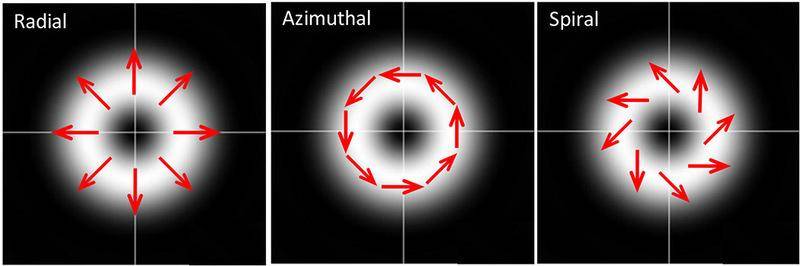
The discussion revolves around the behavior of a radially polarized beam when it is extremely focused to a single point. Participants explore concepts related to interference, diffraction, and the resultant field patterns produced by such focusing.
Discussion Character
- Exploratory
- Technical explanation
- Debate/contested
Main Points Raised
- One participant questions whether a radially polarized beam disappears upon extreme focusing due to the cancellation of electric fields in opposite directions.
- Another participant suggests that the inquiry may relate to constructive and destructive interference, specifically asking if destructive interference occurs in this context.
- A further response indicates that while focusing a beam to a single point may suggest cancellation, diffraction limits how small the focus can be, and the resultant field is a vector sum of all parts of the beam.
- It is noted that there is no single point of total focus; rather, a pattern emerges around the nominal focus point, and off-axis points will not experience total cancellation.
- A participant references a specific measurement related to the local field polarization vector mapping of a focused radially polarized beam, providing a source for further reading.
Areas of Agreement / Disagreement
Participants express differing views on the implications of focusing a radially polarized beam, particularly regarding cancellation and diffraction effects. The discussion remains unresolved, with multiple competing perspectives presented.
Contextual Notes
Participants mention the limitations of focusing optics and the inherent diffraction effects that influence the resultant beam pattern. The discussion also touches on the mathematical relationships involved, such as the 'sinx/x' pattern, without reaching a consensus on the implications.