Faraday Cage in Ionic Solution

Click For Summary
SUMMARY

The discussion centers on the interaction between Faraday cages and ionic solutions, specifically saltwater. It concludes that a Faraday cage, modeled as an ideal hollow conductor, does not interfere with the dispersion of ions in a solution. The resistance of seawater (~0.2 Ohms) is significantly lower than that of air (approximately 2 GOhms), suggesting that ions outside the cage will not enter at a different rate due to the cage's presence. The implications of removing positive ions from within the cage and the resulting negative charge are also explored, indicating that the charge may persist longer than without the cage.

PREREQUISITES
  • Understanding of Faraday cages and their properties
  • Basic knowledge of ionic solutions and conductivity
  • Familiarity with electrical resistance measurements
  • Concept of charge distribution in conductive materials
NEXT STEPS
  • Research the principles of Faraday cages and their applications in electromagnetic shielding
  • Study the conductivity of various ionic solutions, focusing on seawater
  • Learn about the effects of charge distribution in conductive materials
  • Explore the relationship between ion flow and resistance in different mediums
USEFUL FOR

Students and professionals in physics, electrical engineering, and chemistry, particularly those interested in electromagnetic theory and ionic conductivity.

Samson4
Messages
242
Reaction score
15
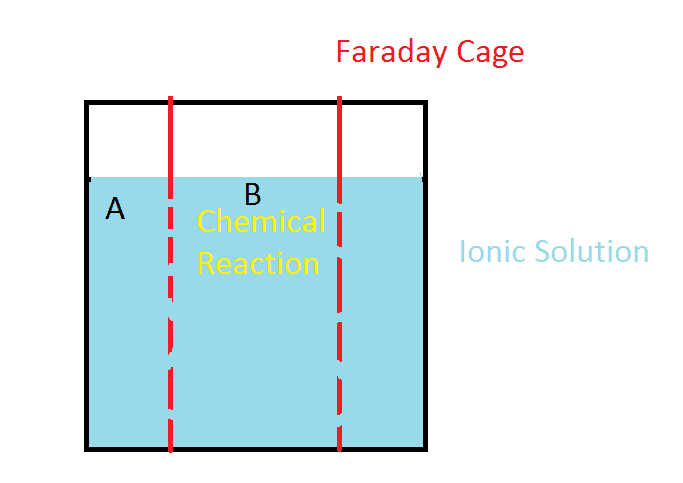
Another question and a another terrible illustration.
So my question: do faraday cages interfere with dispersion of ionic solutions?
In the illustration, a chemical reaction or some other cause for a lower concentration of ions is happening inside a faraday cage at B. Will the solution disperse into the cage as if it was not there?

A specific example: Let's say the solution is salt water. Inside the faraday cage, we are somehow removing ions from solution.
Will the ions outside the cage, move inside at a rate different than if there was no cage?

What if we only took positive ions from inside the cage? Now the area inside the cage is negatively charged. Will it stay that way for longer than it would without a cage present?
Untitled.png
 
Physics news on Phys.org
A Faraday cage is often modeled as an ideal hollow conductor. Hollow in the sense of air or vacuum in the "hollow". So, I do not see that what you have is a Faraday cage. Hopefully someone who knows more can give you a better answer. Also note that seawater has ~.2 Ohms resistance.
Air (standard meteorological atmostphere at STP )has resistance on the order of gigaOhms - circa 2 gOhms which is many orders of magnitude greater than seawater.
 
jim mcnamara said:
A Faraday cage is often modeled as an ideal hollow conductor. Hollow in the sense of air or vacuum in the "hollow". So, I do not see that what you have is a Faraday cage. Hopefully someone who knows more can give you a better answer. Also note that seawater has ~.2 Ohms resistance.
Air (standard meteorological atmostphere at STP )has resistance on the order of gigaOhms - circa 2 gOhms which is many orders of magnitude greater than seawater.

This is one of the things that puzzles me. I'm thinking that, because they both conduct through the flow of ions, it can be considered a faraday cage. I don't know for sure though, I hope someone can help.
 

Similar threads

  • · Replies 4 ·
Replies
4
Views
3K
  • · Replies 7 ·
Replies
7
Views
7K
  • · Replies 1 ·
Replies
1
Views
1K
  • · Replies 4 ·
Replies
4
Views
4K
  • · Replies 1 ·
Replies
1
Views
4K
  • · Replies 12 ·
Replies
12
Views
11K
  • · Replies 10 ·
Replies
10
Views
3K
  • · Replies 0 ·
Replies
0
Views
851
  • · Replies 36 ·
2
Replies
36
Views
7K
Replies
2
Views
2K