Fin/Extended surface differential equation for temperature

Click For Summary
SUMMARY

The discussion focuses on deriving the differential equation for temperature in a triangular fin using heat transfer principles. The key equations include the heat balance equation, which incorporates conduction and convection terms: kA(x) \frac{d^2T(x)}{dx^2} = h_eP(T(x)-T_e). The participants clarify that for a triangular fin, the area A is a function of x, leading to the modified equation \frac{dA(x)}{dx} \frac{d^2\theta(x)}{dx^2} = m^2\theta(x). The final form of the equation is identified as an Euler differential equation, which participants express confidence in solving.

PREREQUISITES
  • Understanding of heat transfer principles, specifically conduction and convection.
  • Familiarity with differential equations, particularly Euler differential equations.
  • Knowledge of variable area concepts in thermal analysis.
  • Proficiency in mathematical modeling and solving ordinary differential equations (ODEs).
NEXT STEPS
  • Study the derivation of the heat equation for non-rectangular fins.
  • Learn about the application of variable area in thermal conduction problems.
  • Explore methods for solving Euler differential equations.
  • Investigate numerical methods for solving ODEs in thermal analysis.
USEFUL FOR

Mechanical engineers, thermal analysts, and students studying heat transfer and differential equations will benefit from this discussion, particularly those focused on fin design and thermal efficiency optimization.

roughwinds
Messages
11
Reaction score
0
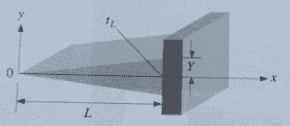
I'm trying to deduce the differential equation for temperature for a triangular fin:
phpjpZDsu.png


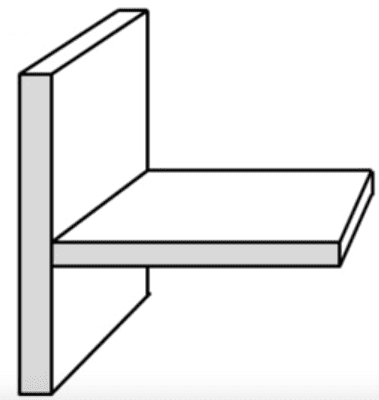
I know that for a rectangular fin, such as:
k1WrY.png


I can do:
Energy entering the left:
q_x= -kA\frac{dT(x)}{dx}

Energy leaving the right:
q_{x+dx} = -kA\frac{dT(x)}{dx} - kA\frac{d² T(x)}{dx²}dx

Energy lost by convection:
dq_{conv} = h_eA(T-T_e)
dq_{conv} = h_eP(T-T_e)dx

q_x - q_{x+dx} - dq_{conv} = 0

q_x = q_{x+dx} + dq_{conv}

-kA\frac{dT(x)}{dx} = -kA\frac{dT(x)}{dx} - kA\frac{d²T(x)}{dx²}dx + h_eP(T-T_e)dx

kA\frac{d²T(x)}{dx²}dx = h_eP(T-T_e)dx

\frac{d²T(x)}{dx²} = \frac{h_eP(T-T_e)}{kA}

But I don't understand why A = Pdx on the energy lost by convection, so I don't know how to adapt that for a triangular fin.

Seems to me that T(x,y,z) still changes predominantly on the x axis, so I assume the other two equations remain unchanged.
 
Physics news on Phys.org
There are two areas involved here, one perpendicular to the flow of heat in the x direction (which you call A), and the other perpendicular to the flow of heat from the fin surface into the surrounding air (which is Pdx). For a fin with triangular shape, A is decreasing with x, and P is about constant. Also, since A is a function of x, when you do your heat balance on a differential section of fin, the area A must stay inside the heat flux derivative.

Chet
 
  • Like
Likes   Reactions: roughwinds
Chestermiller said:
There are two areas involved here, one perpendicular to the flow of heat in the x direction (which you call A), and the other perpendicular to the flow of heat from the fin surface into the surrounding air (which is Pdx). For a fin with triangular shape, A is decreasing with x, and P is about constant. Also, since A is a function of x, when you do your heat balance on a differential section of fin, the area A must stay inside the heat flux derivative.

Chet
So this is correct
121rdht.png

?

q_x = -kA(x)\frac{dT(x) }{dx}
q_{x+dx} = -kA(x)\frac{dT(x) }{dx} - k\frac{dA(x)}{dx}\frac{d²T(x)}{dx²}
dq_{conv} = h_eP(T(x)-T_e)dx
-kA(x)\frac{dT(x) }{dx} = -kA(x)\frac{dT(x) }{dx} - k\frac{dA(x)}{dx}\frac{d²T(x)}{dx²} + h_eP(T(x)-T_e)dx
k\frac{dA(x)}{dx}\frac{d²T(x)}{dx²} = h_eP(T(x)-T_e)dx
\frac{dA(x)}{dx}\frac{d²T(x) }{dx²} = \frac{h_eP(T(x)-T_e)}{k}
T(x)-T_e = θ(x)
m² = \frac{h_eP}{k}
\frac{d²T(x)}{dx²} = \frac{d²θ(x)}{dx²}
\frac{dA(x)}{dx}\frac{d²θ(x) }{dx²} = m²θ(x) (1)

What I've posted here is just a portion of an exercise I was doing, I would then have to solve the ODE to find an equation for T(x). So now I need to get rid of this derivative of A(x). To be honest the only thing I can think of to proceed from here is to find an equation for A(x) and derivate it.

otg6bk.png

A(x) = 2h(x)P
c² = h² + x²
h(x) = sqrt(c²-x²)
A(x) = 2sqrt(c²-x²)P
\frac{dA(x)}{dx} = \frac{-2Px}{sqrt(c²-x²)}
\frac{d²θ(x) }{dx²} = -\frac{m²θ(x)sqrt(c²-x²)}{2Px}

And this is feeling too awkward to be correct, lol. Can you integrate back at (1)?
------
Just thought of
n²(x) = -\frac{m²sqrt(c²-x²)}{2Px}
\frac{d²θ(x)}{dx²} = n²(x)θ(x)
\frac{d²θ(x)}{dx²} - n²(x)θ(x) = 0
θ(x) = c_1e^{nx} + c_2e^{-nx}
I know how to continue from here, but I'm having the sensation that this is wrong.
 
Last edited:
If P is the dimension shown on your diagram, then the differential heat balance should read:
$$k\frac{\partial}{\partial x}\left(A(x)\frac{\partial T}{\partial x}\right)-2Ph(T-T_e)=0$$
Also, from the figure, A(x) = P t(x), where t is the thickness of the fin at location x. So:
$$k\frac{\partial}{\partial x}\left(t(x)\frac{\partial T}{\partial x}\right)-2h(T-T_e)=0$$
 
  • Like
Likes   Reactions: roughwinds
Chestermiller said:
If P is the dimension shown on your diagram, then the differential heat balance should read:
$$k\frac{\partial}{\partial x}\left(A(x)\frac{\partial T}{\partial x}\right)-2Ph(T-T_e)=0$$
Also, from the figure, A(x) = P t(x), where t is the thickness of the fin at location x. So:
$$k\frac{\partial}{\partial x}\left(t(x)\frac{\partial T}{\partial x}\right)-2h(T-T_e)=0$$
I don't think I expressed myself properly before but anyway, finally managed to get it in the way I wanted:
http://i.share.pho.to/0a247f78_o.jpeg
http://i.share.pho.to/57739467_o.jpeg
T(x) - T_e = θ(x)
m = \frac{h_e(L/e)(1+(e/L)²)^{1/2}}{k}
xθ'' + θ' - mθ = 0
Just need to solve that now.
 
roughwinds said:
I don't think I expressed myself properly before but anyway, finally managed to get it in the way I wanted:
http://i.share.pho.to/0a247f78_o.jpeg
http://i.share.pho.to/57739467_o.jpeg
T(x) - T_e = θ(x)
m = \frac{h_e(L/e)(1+(e/L)²)^{1/2}}{k}
xθ'' + θ' - mθ = 0
Just need to solve that now.
This is an Euler differential equation.
 
Chestermiller said:
This is an Euler differential equation.
Wouldn't it have to be
x²θ′′+xθ′−mθ=0
for it to be an Euler differential equation?

I tried to do power series but I got stuck in the end:
y=\sum_{n=0}^\infty a_k x^k
θ'=\sum_{n=1}^\infty ka_k x^{k-1}
θ''=\sum_{n=2}^\infty k(k-1)a_k x^{k-2}
\sum_{n=2}^\infty k(k-1)a_k x^{k-1} + \sum_{n=1}^\infty ka_k x^{k-1} - \sum_{n=0}^\infty m²a_k x^k = 0
\sum_{n=1}^\infty k(k+1)a_{k+1} x^{k} + \sum_{n=0}^\infty (k+1)a_{k+1} x^{k} - \sum_{n=0}^\infty m²a_k x^k = 0
a_1 - m²a_o + \sum_{n=1}^\infty k(k+1)a_{k+1} x^{k} + \sum_{n=1}^\infty (k+1)a_{k+1} x^{k} - \sum_{n=1}^\infty m²a_k x^k = 0
a_1 - m²a_o = 0
a_1 = m²a_o
\sum_{n=1}^\infty k(k+1)a_{k+1} x^{k} + \sum_{n=1}^\infty (k+1)a_{k+1} x^{k} - \sum_{n=1}^\infty m²a_k x^k = 0
\sum_{n=1}^\infty[k(k+1)a_{k+1} x^{k} + (k+1)a_{k+1} x^{k} - m²a_k x^k]= 0
\sum_{n=1}^\infty[k(k+1)a_{k+1} + (k+1)a_{k+1} - m²a_k]x^{k}= 0
\sum_{n=1}^\infty[(k+1)(ka_{k+1} + a_{k+1}) - m²a_k]x^{k}= 0
\sum_{n=1}^\infty[(k+1)(k+1)a_{k+1} - m²a_k]x^{k}= 0
\sum_{n=1}^\infty[(k+1)²a_{k+1} - m²a_k]x^{k}= 0
(k+1)²a_{k+1} - m²a_k= 0
a_{k+1}= \frac{m²a_k}{(k+1)²}
k = 1, a_2 = \frac{m²a_1}{4} = \frac{m^{4}a_0}{2!}
k = 2, a_3 = \frac{m²a_2}{9} = \frac{m^{6}a_0}{(3!)²}
k = 3, a_4 = \frac{m²a_3}{16} = \frac{m^{8}a_0}{(4!)²}
k = 4, a_5 = \frac{m²a_4}{25} = \frac{m^{10}a_0}{(5!)²}
a_{2k}= \frac{m^{4k}a_0}{(2k!)²}
a_{2k+1}= \frac{m^{2(2k+1)}a_0}{((2k+1)!)²}
θ(x) = a_0\sum_{n=0}^\infty \frac{m^{4k}x^{2k}}{(2k!)²} + a_0\sum_{n=0}^\infty \frac{m^{2(2k+1)}x^{2k+1}}{((2k+1)!)²}
 
roughwinds said:
Wouldn't it have to be
x²θ′′+xθ′−mθ=0
for it to be an Euler differential equation?
Ooops. Sorry. My mistake.
 

Similar threads

Replies
2
Views
2K
  • · Replies 4 ·
Replies
4
Views
2K
Replies
1
Views
2K
Replies
2
Views
2K
  • · Replies 1 ·
Replies
1
Views
2K
  • · Replies 8 ·
Replies
8
Views
2K
  • · Replies 3 ·
Replies
3
Views
2K
  • · Replies 1 ·
Replies
1
Views
1K
  • · Replies 7 ·
Replies
7
Views
8K
Replies
2
Views
2K