SUMMARY
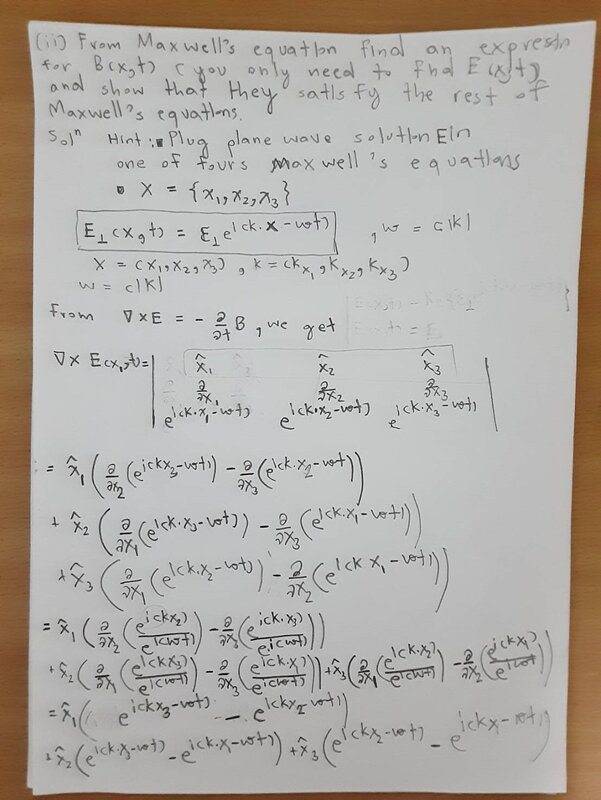
The discussion focuses on deriving an expression for the magnetic field from a given electric field, referencing Zangwill's "Modern Electrodynamics." A key point is the correct representation of the electric field components, specifically the \(\mathbf{x}_1\) component, which should be expressed as \(\epsilon_1 e^{i(k_1x_1 + k_2x_2 + k_3x_3 - \omega t)}\). The curl of the electric field can be computed using the chain rule, leading to the formula \(\nabla \times (\mathbf{c}f(\zeta(\mathbf{x}))) = f'(\zeta) ((\nabla \zeta) \times \mathbf{c})\).
PREREQUISITES
- Understanding of vector calculus, specifically curl operations.
- Familiarity with electromagnetic theory as outlined in Zangwill's "Modern Electrodynamics."
- Knowledge of complex exponentials and their application in physics.
- Ability to work with scalar and vector fields in three-dimensional space.
NEXT STEPS
- Study the application of the curl operator in electromagnetic fields.
- Explore the implications of the chain rule in vector calculus.
- Review the derivation of Maxwell's equations from electric and magnetic field relationships.
- Investigate the role of complex numbers in electromagnetic wave propagation.
USEFUL FOR
This discussion is beneficial for physics students, researchers in electromagnetism, and educators seeking to deepen their understanding of the relationship between electric and magnetic fields.