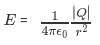
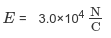
Find an expression for the electric field(Mastering Physics)

Click For Summary
SUMMARY

The discussion focuses on solving Problem 26.40 from Mastering Physics (3rd edition), which involves calculating the electric field strength due to a thin rod of length L with total charge Q. The solution includes deriving the expression for the electric field on the axis of the rod at a distance r from its center, confirming the expected behavior when r is much greater than L, and evaluating the electric field at specific values (r = 3.6 cm, L = 5.0 cm, Q = 2.2 nC). The final expression incorporates the variables Q, r, and constants π and ε0.

PREREQUISITES
  • Understanding of electric fields and Coulomb's law
  • Familiarity with calculus for deriving expressions
  • Knowledge of electrostatics concepts, particularly charge distributions
  • Ability to work with significant figures and unit conversions
NEXT STEPS
  • Study the derivation of electric fields from continuous charge distributions
  • Learn about the behavior of electric fields at large distances compared to charge dimensions
  • Practice problems involving electric field calculations for different geometries
  • Explore the application of Gauss's law in electrostatics
USEFUL FOR

Students in physics, particularly those studying electromagnetism, educators looking for problem-solving techniques, and anyone preparing for exams involving electric field calculations.

Eric Fossum
Messages
1
Reaction score
0
I just wanted to post a solution for anyone interested. Any notes on how to solve would be nice for others.

1. Homework Statement


Mastering Physics (3rd edition) Problem 26.40

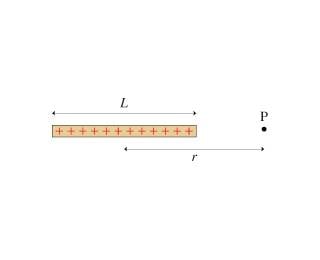
The figure (Figure 1) shows a thin rod of length L with total charge Q.
27.P42.jpg

Part A) Find an expression for the electric field strength on the axis of the rod at distance r from the center.

Part B) Verify that your expression has the expected behavior if r≫L.
Express your answer in terms of variables Q, rand constants π, ε0.

Part C) Evaluate E at r = 3.6cm if L = 5.0 cm and 2.2nC .
Express your answer to two significant figures and include the appropriate units.

3. The solution
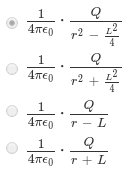
Part A)
43OtHyO.png

Part B)
FizgQgb.png

Part C)
1auRv5Y.png
 
Physics news on Phys.org
It is usually more help to post the method for obtaining solutions, the reasoning etc., rather than the bare answer as you have done here.
Why are those the correct answers? How would someone figure those out for themselves?
 

Similar threads

  • · Replies 7 ·
Replies
7
Views
2K
  • · Replies 2 ·
Replies
2
Views
3K
  • · Replies 11 ·
Replies
11
Views
4K
  • · Replies 3 ·
Replies
3
Views
2K
  • · Replies 35 ·
2
Replies
35
Views
4K
Replies
6
Views
4K
  • · Replies 5 ·
Replies
5
Views
7K
  • · Replies 3 ·
Replies
3
Views
6K
  • · Replies 2 ·
Replies
2
Views
1K