Find Max Power From Circuit: 33 Ohm Resistor

  • Thread starter Thread starter maobadi
  • Start date Start date
  • Tags Tags
    Resistor Value
Click For Summary

Discussion Overview

The discussion revolves around determining the resistor value that would draw maximum power from a circuit containing a 33 ohm resistor. Participants explore concepts related to maximum power transfer, circuit analysis techniques, and the application of Thevenin's theorem.

Discussion Character

  • Homework-related
  • Technical explanation
  • Mathematical reasoning

Main Points Raised

  • One participant expresses confusion about how to solve the problem despite understanding power dissipation and current flow using Maxwell mesh network analysis.
  • Another participant notes that maximum power transfer occurs when the load resistance matches the internal resistance of the voltage source.
  • There is a suggestion to analyze the circuit from the perspective of the 33 ohm resistor and calculate the total resistance of the circuit excluding the 33 ohm resistor.
  • Participants discuss the possibility of applying Thevenin's theorem by replacing batteries with short circuits to find the equivalent resistance.

Areas of Agreement / Disagreement

Participants generally agree on the principle of maximum power transfer but have not reached a consensus on the specific approach to calculate the required resistor value or the application of Thevenin's theorem.

Contextual Notes

Some assumptions about circuit configurations and the nature of the voltage source are not explicitly stated, which may affect the analysis. The discussion also reflects uncertainty regarding the application of Thevenin's theorem in this context.

maobadi
Messages
22
Reaction score
0
resistor value ...

Homework Statement


power.JPG

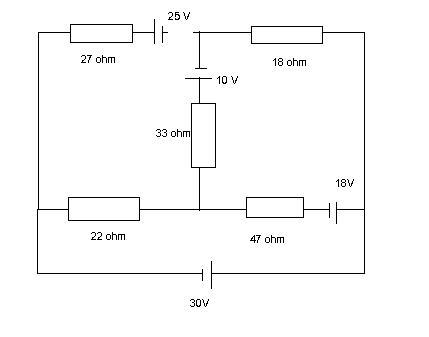
see the attached diagram

Homework Equations


What value of resistor in the place of the 33 ohm resistor would draw maximum power from the rest of the circuit and what power would it draw?

The Attempt at a Solution


I can figure out the currents flowing in different branches of the circuit using maxwell mesh network analysis. But I did not have a clue of how to solve the problem. I know what power dissipation is and how to work it out, but the given question is giving me headaches.
 
Last edited:
Physics news on Phys.org


somebody help...please


Nobody can see your attachment yet, pending administrator approval. You could always host it somewhere else, and then link to it.


Ah, your attachment has been approved!

I don't know if you're still looking for help or not, but I'll guide you a bit:

1) Under what load conditions does maximum power transfer occur?

2) How would you black box the rest of the circuit, making it a block that you could attach this resistor to?

EDIT: For future reference, you may want to host your picture elsewhere and post a link, instead of waiting for moderator approval.


MATLABdude first thanks for the reply,

I know that the maximum power transfer occurs when the load resistance is equal to that of the voltage source internal resistance.

Are you saying that looking from the 33ohm resistor point of view and calculating the total resistance of all the resistor(not including 33ohm resistor) and hence that will be the valueof the resistor that the 33 ohm resistor should be?
Do you mean to calculate the total resistance(obviously ommiting 33 ohm resistor) by replacing the batteries with short circuits. It sounds like thevenin problem or is it?


maobadi said:
MATLABdude first thanks for the reply,

I know that the maximum power transfer occurs when the load resistance is equal to that of the voltage source internal resistance.

Are you saying that looking from the 33ohm resistor point of view and calculating the total resistance of all the resistor(not including 33ohm resistor) and hence that will be the valueof the resistor that the 33 ohm resistor should be?
Do you mean to calculate the total resistance(obviously ommiting 33 ohm resistor) by replacing the batteries with short circuits. It sounds like thevenin problem or is it?

My job here is done!

(But strictly speaking, you should also have an equivalent voltage in a Thevenin equivalent, even though you don't need it for this question).
 

Similar threads

  • · Replies 37 ·
2
Replies
37
Views
6K
Replies
15
Views
3K
  • · Replies 17 ·
Replies
17
Views
13K
  • · Replies 3 ·
Replies
3
Views
3K
  • · Replies 3 ·
Replies
3
Views
2K
  • · Replies 7 ·
Replies
7
Views
2K
  • · Replies 5 ·
Replies
5
Views
2K
  • · Replies 4 ·
Replies
4
Views
2K
  • · Replies 1 ·
Replies
1
Views
2K
  • · Replies 9 ·
Replies
9
Views
2K