Find the electric field from charge density

Click For Summary
SUMMARY

The discussion focuses on deriving the electric field from charge density in an npn BJT using Gauss's law instead of Coulomb's law. The initial approach involved calculating the electric field using the integral of charge density, which was identified as incorrect due to the assumption of linear charge density. The correct method involves applying Gauss's law in differential form, leading to the equations $$\nabla\cdot\mathbf{E}=\frac{\rho}{\epsilon_0}$$ for the first slab and $$\nabla\cdot\mathbf{E}=\frac{-\rho}{\epsilon_0}$$ for the second slab. Simplifying assumptions regarding the dimensions of the charge slabs allow for a straightforward solution of the electric field.

PREREQUISITES
  • Understanding of npn BJT operation and charge density concepts
  • Familiarity with Gauss's law and its differential form
  • Knowledge of vector calculus and partial differential equations
  • Basic principles of electrostatics, including Coulomb's law
NEXT STEPS
  • Study the application of Gauss's law in electrostatics
  • Learn about the derivation of electric fields from continuous charge distributions
  • Explore vector calculus techniques for solving differential equations
  • Investigate the behavior of electric fields in semiconductor devices
USEFUL FOR

Electrical engineers, physicists, and students studying semiconductor physics or electrostatics will benefit from this discussion, particularly those focusing on the behavior of electric fields in BJTs and charge density effects.

PhysicsTest
Messages
256
Reaction score
27
Homework Statement
To calculate the electric field from the charge density inside the BJT.
Relevant Equations
##dE = \frac {dq} {4\pi\epsilon r^2}##
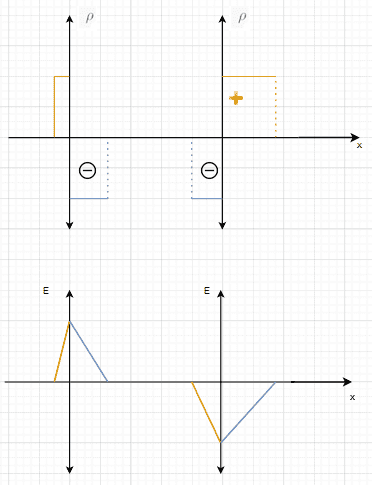
There is a section in the BJT explanation the charge density and the corresponding electric field graphs. But i was not sure how the electric field is derived and hence i started deriving it. Please correct me if my understanding is wrong in posting the question
1607147875100.png

It is an ##npn## BJT. My derivation is
##dE = \frac {dq} {4\pi\epsilon r^2}##
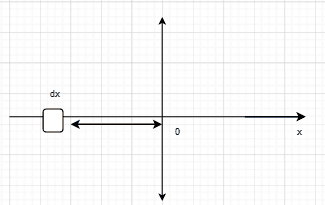
If i only calculate only for the 1st region
1607148175673.png


##dq = \rho dx##
I am assuming at some distance x1,
##dE = \int_0^{x1}\frac{\rho dx} {4\pi\epsilon x^2}##
##E = [\frac{\rho} {4\pi\epsilon x}]_0^{x1}##
I am really not sure if I am proceeding properly?
 
Last edited:
  • Like
Likes   Reactions: Delta2
Physics news on Phys.org
No unfortunately you are not calculating what you want to calculate. The way you setup that integral, what you calculate is the electric field at point 0 (the origin) of a constant linear charge density that extends from the origin to point x1 along the x-axis. But I am sure this is not what you intended to calculate as the charge density inside the transistor is not linear(by linear i mean here one dimensional 1D line) though it is constant.

I believe it is a strategical mistake to use coulomb's law to integrate for the electric field (cause that's what you trying to do here, though you are not doing it correctly). This problem can be solved by using Gauss's law in differential form ,where, instead of calculating an integral, you solve a simple differential equation with proper boundary conditions and some additional assumptions.
 
Last edited:
  • Like
Likes   Reactions: PhysicsTest
Essentially your problem is that of determining the electric field from two slabs of charge density ##\rho## and ##-\rho## that meet along the x-axis. Gauss law in differential form will be for the region of the first slab $$\nabla\cdot\mathbf{E}=\frac{\rho}{\epsilon_0}$$ and for the region of the second slab $$\nabla\cdot\mathbf{E}=\frac{-\rho}{\epsilon_0}$$.

Now the solution to these differential equations with the two slabs having finite dimensions along the x,y,z axis is what i call the coulomb integral that is $$\mathbf{E}=\int_{slab region}\rho \frac{\mathbf{r-r'}}{|\mathbf{r-r'}|^3}d^3\mathbf{r'}$$
However here , instead of calculating this integral over the slab region, we can make some simplifying assumptions that simplify the differential equations and make their solution straightforward. The first differential equation is in cartesian coordinate system $$\frac{\partial E_x}{\partial x}+\frac{\partial E_y}{\partial y}+\frac{\partial E_z}{\partial z}=\frac{\rho}{\epsilon_0}$$
Now the simplifying assumption is that if the slab of charge density ##\rho## is extending in the y and z directions much more than in the x direction, then we can take ##E_y,E_z\approx 0## and thus the differential equation simplifies to $$\frac{\partial E_x}{\partial x}=\frac{\rho}{\epsilon_0}$$ which is very easy and has straightforward solution.
 
  • Like
Likes   Reactions: PhysicsTest

Similar threads

  • · Replies 1 ·
Replies
1
Views
960
Replies
6
Views
1K
Replies
11
Views
1K
  • · Replies 11 ·
Replies
11
Views
1K
Replies
9
Views
790
  • · Replies 18 ·
Replies
18
Views
1K
Replies
3
Views
1K
Replies
1
Views
2K
  • · Replies 26 ·
Replies
26
Views
3K
Replies
1
Views
1K