Find the resistance of a resistor using Ohm's Law?

Click For Summary
SUMMARY

The discussion focuses on calculating the resistance of a resistor using Ohm's Law within a circuit that includes a shorting wire. The participants emphasize the importance of correctly identifying ground potential and understanding that an ideal wire has no voltage drop across its length. The voltage drop across an 8Ω resistor is established as 4V, which influences the potential of the connected wire. Participants conclude that fixing the ground at the negative terminal of the voltage source is crucial for accurate current calculations.

PREREQUISITES
  • Understanding of Ohm's Law and voltage, current, and resistance relationships.
  • Familiarity with circuit components, specifically resistors and voltage sources.
  • Knowledge of circuit analysis techniques, including the concept of ground potential.
  • Ability to interpret circuit diagrams and redraw circuits for clarity.
NEXT STEPS
  • Study the principles of circuit grounding and its impact on voltage measurements.
  • Learn about ideal conductors and their properties in electrical circuits.
  • Explore methods for simplifying complex circuits, such as combining resistances in parallel.
  • Practice circuit analysis using Ohm's Law with various configurations and components.
USEFUL FOR

Electrical engineering students, circuit designers, and anyone involved in analyzing or troubleshooting electrical circuits will benefit from this discussion.

Alison A.
Messages
86
Reaction score
2
Thread moved from the technical forums, so no HH Template is shown.
Hi, I have been at this problem for days and I can't seem to see what I am doing wrong.

Here is the circuit layout along with my work
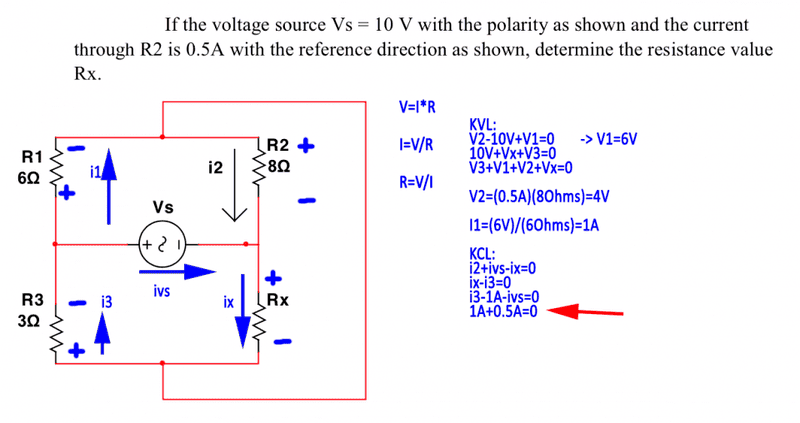
Screen Shot 2016-01-21 at 12.03.50 PM copy.png

As you can see I am running into problem getting values of current that do not add up equal to zero. My professor has never discussed how adding a wire like this would effect the circuit. I am assuming the other 0.5A go through the wire? I don't know. Everything written in blue is what I have added (and the red arrow).
 
Physics news on Phys.org
Ix - I3 is not necessarily zero, because of the wire.

BTW, since you are given R2 and I2, you know the voltage on the shorting wire... :wink:
 
  • Like
Likes   Reactions: cnh1995
Alison A. said:
Hi, I have been at this problem for days and I can't seem to see what I am doing wrong.

Here is the circuit layout along with my work
View attachment 94604
As you can see I am running into problem getting values of current that do not add up equal to zero. My professor has never discussed how adding a wire like this would effect the circuit. I am assuming the other 0.5A go through the wire? I don't know. Everything written in blue is what I have added (and the red arrow).
I believe the simpler way to solve this circuit is just by inspection, without writing too many equations. Berkeman has given an important hint! Assume ground(0V) at the -ve terminal of the source.
 
I thought I already found the voltage of V2 to be 4V? I am not quite sure how that specific element is responsible for the voltage of the wire?
 
Alison A. said:
I thought I already found the voltage of V2 to be 4V? I am not quite sure how that specific element is responsible for the voltage of the wire?
That is the voltage 'drop' across the 8Ω resistor. If you assumed ground at the -ve termianl of the source, then potential of the wire will be 4V. You'll have to fix the ground first.
 
cnh1995 said:
That is the voltage 'drop' across the 8Ω resistor. If you assumed ground at the -ve termianl of the source, then potential of the wire will be 4V. You'll have to fix the ground first.
Actually, the 4V drop across that resistor results in a voltage that is 4V below Vs... :smile:
 
Hm, we have never discussed fixing a ground before. I am not understand how a wire could hold voltage or current if there isn't any element there. Does this mean all of my other calculations are wrong because I didn't account for the properties of the wire?
 
Alison A. said:
Hm, we have never discussed fixing a ground before. I am not understand how a wire could hold voltage or current if there isn't any element there. Does this mean all of my other calculations are wrong because I didn't account for the properties of the wire?
Wire is assumed to be an ideal conductor. It's potential is same throughout it's length i.e potential difference across the wire is 0. So, whatever is the potential of the point to which the wire is connected, it is same on the wire everywhere. As the wire is connected to a 4V point(assuming ground at the -ve terminal), its potential is 4V.
 
Alison A. said:
Does this mean all of my other calculations are wrong because I didn't account for the properties of the wire?
Correct.

It may help you to re-draw the circuit. Make the Vs source be vertical, with ground at the bottom and +10V at the top. Then re-draw the (positive side of Vs) resistors as 2 parallel resistors that connect to that shorting wire, and 2 more resistors in parallel below the shorting wire that connect to ground. You already know the voltage of that common shorting wire point...

Edit -- sorry, I thought the Vs source had + to the right, but it is to the left. So when you re-draw the circuit, rotate the Vs source clockwise 90 degrees.
 
  • #10
Once you have fixed the ground at the -ve terminal, you have 3 points in the circuit with known potentials. That will be sufficient to find the currents in all the resistors. Plus, you know the voltage across Rx.
 
  • Like
Likes   Reactions: berkeman
  • #11
Thank god for photoshop.
Maybe?.png

I am not sure what you meant by switching around vs? I hope I drew this correctly.
 
  • #12
Alison A. said:
Thank god for photoshop.
View attachment 94608
I am not sure what you meant by switching around vs? I hope I drew this correctly.
Correct!
 
  • #13
So I can combine the resistance of R1 and R3 to equal Req=2Ω? Alright, I have to go to another class right now but I will sure to post my attempt of a solution by 5pm EST :)
 
  • #14
Alison A. said:
So I can combine the resistance of R1 and R3 to equal Req=2Ω?
Yes.
 

Similar threads

  • · Replies 17 ·
Replies
17
Views
12K
  • · Replies 1 ·
Replies
1
Views
1K
  • · Replies 2 ·
Replies
2
Views
1K
  • · Replies 3 ·
Replies
3
Views
2K
  • · Replies 3 ·
Replies
3
Views
3K
Replies
5
Views
4K
Replies
15
Views
2K
  • · Replies 6 ·
Replies
6
Views
2K
  • · Replies 6 ·
Replies
6
Views
4K
  • · Replies 8 ·
Replies
8
Views
2K