Calculating Vo in an AC Circuit Using Superposition Theorem

Click For Summary
SUMMARY

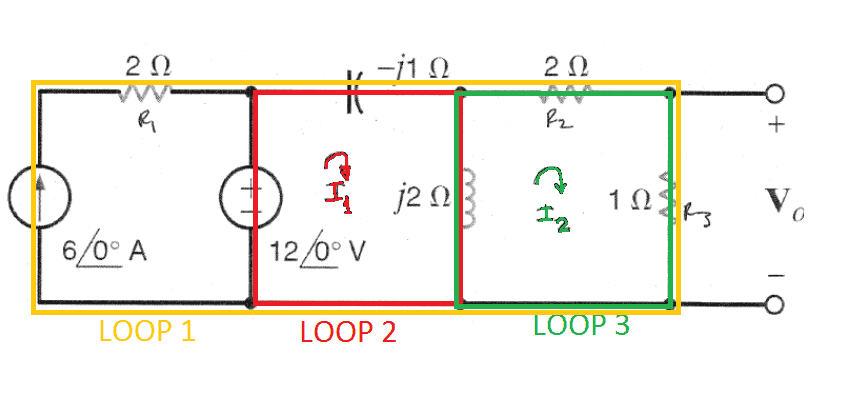
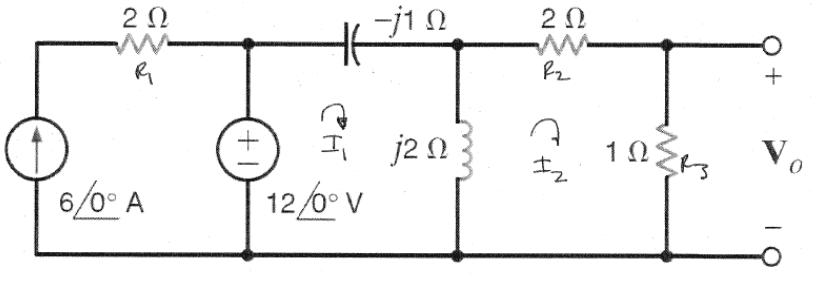
The discussion focuses on calculating the output voltage (Vo) in an AC circuit using the Superposition Theorem. The user initially struggles with applying Kirchhoff's Voltage Law (KVL) and receives clarification that the 6 amp current source does not affect the voltage of the 12 volt source. The conclusion is that the current source and the series resistor can be disregarded for the purpose of calculating Vo, simplifying the analysis to two meshes. The final answer provided is 6.66L33.67 Volts.

PREREQUISITES
  • Understanding of Kirchhoff's Voltage Law (KVL)
  • Familiarity with the Superposition Theorem in circuit analysis
  • Basic knowledge of AC circuit components, including current sources and voltage sources
  • Ability to analyze mesh circuits
NEXT STEPS
  • Study the application of the Superposition Theorem in AC circuits
  • Learn about mesh analysis techniques for circuit simplification
  • Explore the effects of current sources on voltage sources in circuit theory
  • Investigate common mistakes in applying KVL in circuit analysis
USEFUL FOR

Electrical engineering students, circuit designers, and anyone involved in AC circuit analysis and troubleshooting.
Michael_0039
Messages
59
Reaction score
7
This is the circuit:
01.PNG
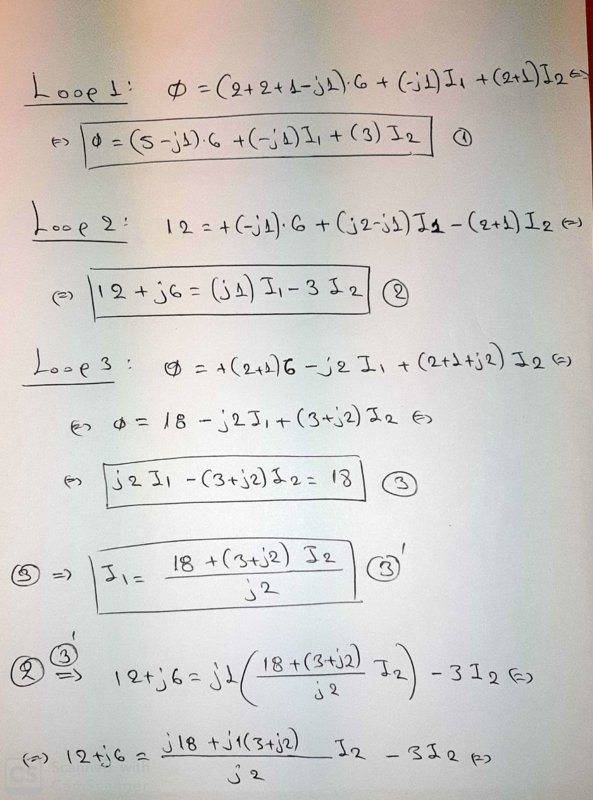
I try with KVL:

1.PNG

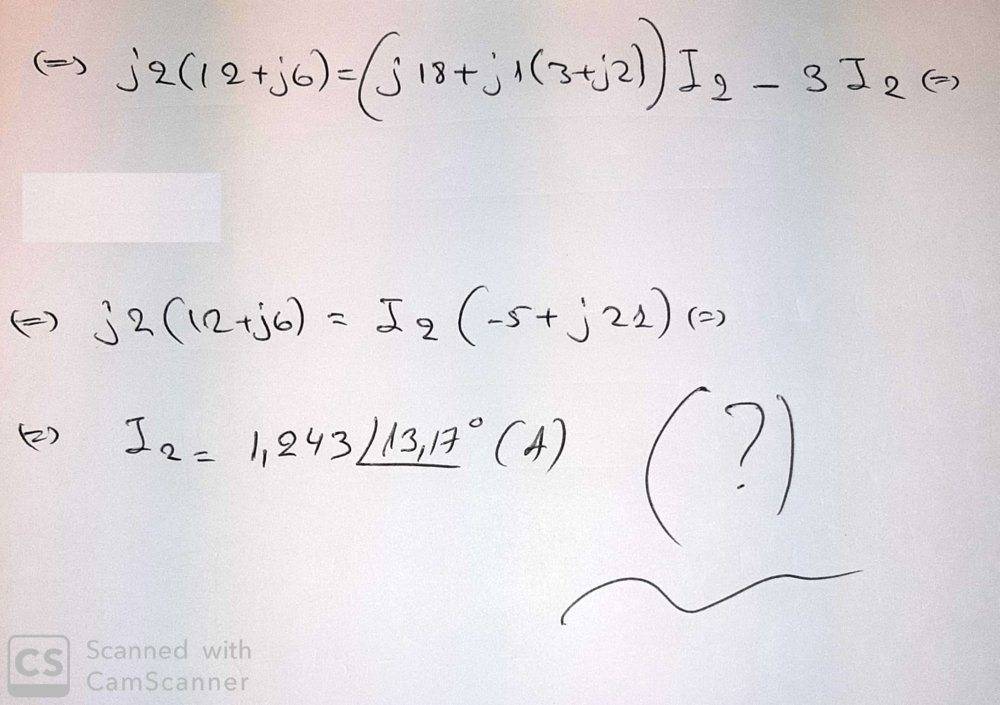
New Doc 2019-09-24 23.36.18_1.jpg

New Doc 2019-09-24 23.36.18_2.jpg


But the given answer is 6.66L33.67 Volts. So, I'm confused, any suggestions ?
 
Physics news on Phys.org
May I ask a question ?
I assume that you wrote a zero on the left side of the first loop equation, but why ?
 
The 6 amp current source injects 6 amps into the node at the top of the 12 volt voltage source, and the 2 ohm resistor doesn't change that fact. Injecting 6 amps into a voltage source doesn't change the voltage of the 12 volt source. The net result of what I've said so far is that you can get rid of the current source and the resistor in series with it; those things have no effect on Vo. Now you have only two meshes to solve.
 
  • Like
Likes Michael_0039
alan123hk said:
May I ask a question ?
I assume that you wrote a zero on the left side of the first loop equation, but why ?
Because in this loop there is no Voltage source. The same on loop 3.
 
Thanks for your answers!

I try with Superposition theorem, I think this process is correct:

New Doc 2019-09-25 13.33.24_3.jpg

New Doc 2019-09-25 13.33.24_2.jpg
 

Similar threads

  • · Replies 7 ·
Replies
7
Views
5K
  • · Replies 19 ·
Replies
19
Views
5K
  • · Replies 2 ·
Replies
2
Views
1K
  • · Replies 5 ·
Replies
5
Views
2K
  • · Replies 3 ·
Replies
3
Views
2K
Replies
2
Views
2K
  • · Replies 17 ·
Replies
17
Views
3K
  • · Replies 7 ·
Replies
7
Views
3K
  • · Replies 6 ·
Replies
6
Views
2K
  • · Replies 5 ·
Replies
5
Views
2K