Dustinsfl
- 2,217
- 5
How do I find the first 10 positive solutions numerically?
$$
\tan x = \frac{1}{x}
$$
$$
\tan x = \frac{1}{x}
$$
Dustinsfl said:How do I find the first 10 positive solutions numerically?
$$
\tan x = \frac{1}{x}
$$
Where are you stuck?Dustinsfl said:How do I find the first 10 positive solutions numerically?
$$
\tan x = \frac{1}{x}
$$
Ray Vickson said:How do you find the first positive solution? You tell US; do not ask us to tell you: read the forum rules.
RGV
SammyS said:Where are you stuck?
What have you tried?
After 490 posts, you should know the drill here at PF .
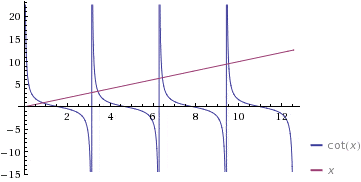
But here's one hint: One thing I would try is to take the reciprocal of both sides of that equation, giving you:[itex]\displaystyle \cot(x)=x[/itex]
Graph each side.
dextercioby said:Numerically means approximately since this is a transcendental equation. Only some computer software would give you the results, I think.
http://www.wolframalpha.com/input/?i=Plot+y(x)+=+tan+x+-+1/x
Dustinsfl said:I am not good at numerical analysis. I haven't taken a course in it yet as well as in Matlab. I will be taking Matlab this spring and Numerical Analysis next fall. So when I know how to do it and use Matlab efficiently, I won't even ask you.
SammyS said:Here are the graphs of y=x and y=cot(x), superimposed. (from WolframAlpha)
Dustinsfl said:I tried using NSolve in Mathematica but that didn't work.
I also tried
syms x
solve(tan(x)==1/x)
in Matlab and that just gave -263.
How can I do this in one of these programs?
This is what I wrote in post 3.
I can make graphs of this with the Tikz package and in Mathematica (that isn't the challenge here). How can I use Mathematica or Matlab to generate the first 10 positive solution?
Thanks. Hopefully in the spring when I take programming in Matlab I will be better at this.Ray Vickson said:I don't have access to Mathematica (except through Wolfram Alpha) or to Matlab, but in Maple it is easy:
S:=fsolve(tan(x)=1/x,x=0..Pi/2),seq(fsolve(tan(x)=1/x,x=Pi/2+(i-1)*Pi..Pi/2+i*Pi),i=1..9);
S := 0.8603335890, 3.425618459, 6.437298179, 9.529334405,
12.64528722, 15.77128487, 18.90240996, 22.03649673,
25.17244633, 28.30964285
I'm sure it must be possible, even easy, to do the same thing in Mathematica.
RGV
Try using FindRoot instead.Dustinsfl said:I tried using NSolve in Mathematica but that didn't work.
Dustinsfl said:I tried using NSolve in Mathematica but that didn't work.
...
How can I do this in one of these programs?
