Googl
- 111
- 1
Hi all,
This is not homework or coursework. I am not sure whether this question would be classed as homework or coursework because it is neither.
I am using the AQA Physics A AS textbook and attempting exercise 12.2 on page 177. In I am stuck on question 4 and I have absolutely no idea on how to find the amplitude. I have spent almost a day but still I haven't been able to find a matching answer. I was hoping someone here might help me.
Here is the full question:
For the waves in Figure 4,
a) determine i the amplitude and wavelength, ii the phase difference between P and R, iii the phase difference between P and S.
I can find the phase differences but not the wavelength and amplitude. I am probably missing something or have missed something and I am looking for a hint.
I managed to find a preview of the page here
I managed to get a screenshot of the page:
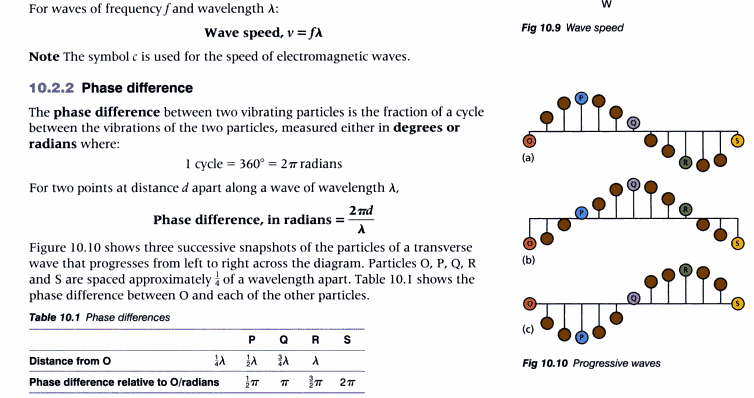
Thank you.
This is not homework or coursework. I am not sure whether this question would be classed as homework or coursework because it is neither.
I am using the AQA Physics A AS textbook and attempting exercise 12.2 on page 177. In I am stuck on question 4 and I have absolutely no idea on how to find the amplitude. I have spent almost a day but still I haven't been able to find a matching answer. I was hoping someone here might help me.
Here is the full question:
For the waves in Figure 4,
a) determine i the amplitude and wavelength, ii the phase difference between P and R, iii the phase difference between P and S.
I can find the phase differences but not the wavelength and amplitude. I am probably missing something or have missed something and I am looking for a hint.
I managed to find a preview of the page here
I managed to get a screenshot of the page:
Thank you.