Finding change in altitude, and speed in x direction and y direction

Click For Summary

Homework Help Overview

The problem involves a motion scenario where an ostrich named rhomboid runs along a mountain path defined by a vector function. The discussion focuses on calculating changes in altitude and speeds in the x and y directions over specified time intervals.

Discussion Character

  • Exploratory, Assumption checking, Conceptual clarification

Approaches and Questions Raised

  • Participants explore the method of integration to find changes in altitude and question the appropriateness of this approach. There is discussion about calculating speed by taking the derivative of the position function.

Discussion Status

Participants are actively questioning the integration approach for finding changes in altitude and are discussing alternative methods. Some guidance has been offered regarding directly evaluating the z coordinate at specific time points.

Contextual Notes

There is an ongoing debate about the correct method for determining changes in altitude and the implications of integrating position with respect to time. Participants are also considering the definitions of speed in the context of the problem.

yazz912
Messages
45
Reaction score
0
1. The problem statement, all variables and given/known
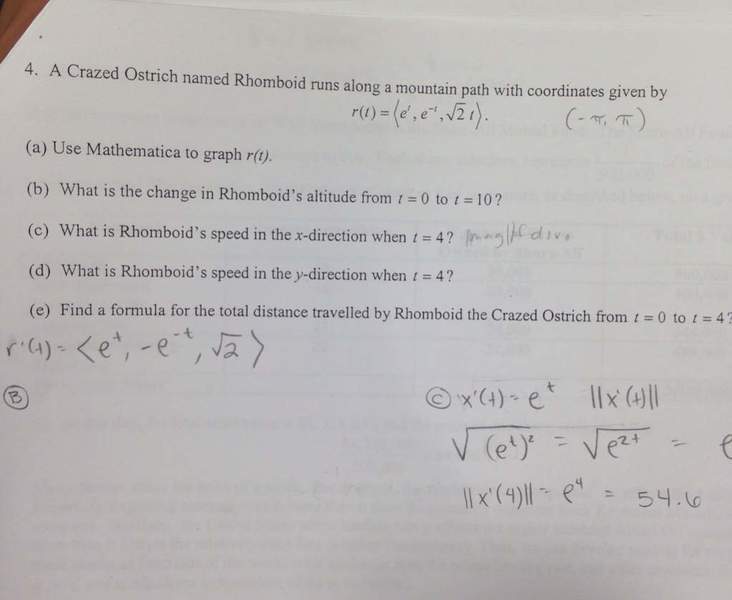
A crazed ostrich names rhomboid runs along a mountain path with coordinates given by
r(t) = < e^t, e^-t, sqrt(2) t>

B) what is the change in rhomboids altitude from t=0 to t= 10

C) what is rhomboids speed in x direction when t=4

D) what is rhomboids speed in y direction when t=4

E) find a formula for the total distance traveled by rhomboid from t= 0 to t=4

2. Homework Equations
• integration
•derivatives
3. The Attempt at a Solution

For part b) the first thing I thought to do was to integrate only the z component ( since it's height) and evaluate the integral from 0 to 10? Which I get 50*sqrt(2)

C) for speed in x direction do I take the magnitude of the derivative of e^t then plug t=4?
x'(t) = e^t
||x'(t)|| = e^t
Plug in t=4 I get 54.6

D) I do the same as C) only this time I use the y component ?
ImageUploadedByPhysics Forums1396562712.766847.jpg
 
Physics news on Phys.org
yazz912 said:
For part b) the first thing I thought to do was to integrate only the z component ( since it's height) and evaluate the integral from 0 to 10? Which I get 50*sqrt(2)
Why are you integrating? What kind of beast is the integral of a position with respect to time?
C) for speed in x direction do I take the magnitude of the derivative of e^t then plug t=4?
x'(t) = e^t
||x'(t)|| = e^t
Plug in t=4 I get 54.6

D) I do the same as C) only this time I use the y component ?
Yes and yes.
 
That's what my group thought that we had to integrate... So how would we find change in altitude then?
 
yazz912 said:
That's what my group thought that we had to integrate... So how would we find change in altitude then?

Just find the change in the z coordinate betweent t=0 and t=10.
 
Dick said:
Just find the change in the z coordinate betweent t=0 and t=10.
Just by simply plugging it into the original Z coordinate?
 
yazz912 said:
Just by simply plugging it into the original Z coordinate?

Yes.
 

Similar threads

Replies
2
Views
2K
  • · Replies 5 ·
Replies
5
Views
2K
  • · Replies 9 ·
Replies
9
Views
1K
  • · Replies 105 ·
4
Replies
105
Views
11K
  • · Replies 3 ·
Replies
3
Views
2K
  • · Replies 1 ·
Replies
1
Views
2K
Replies
6
Views
3K
Replies
3
Views
1K
  • · Replies 3 ·
Replies
3
Views
2K
Replies
12
Views
2K